inklet
Ambient e-ink displays that pull your notes out of the phone and into the room.
NewName Editorial
Editorial Team
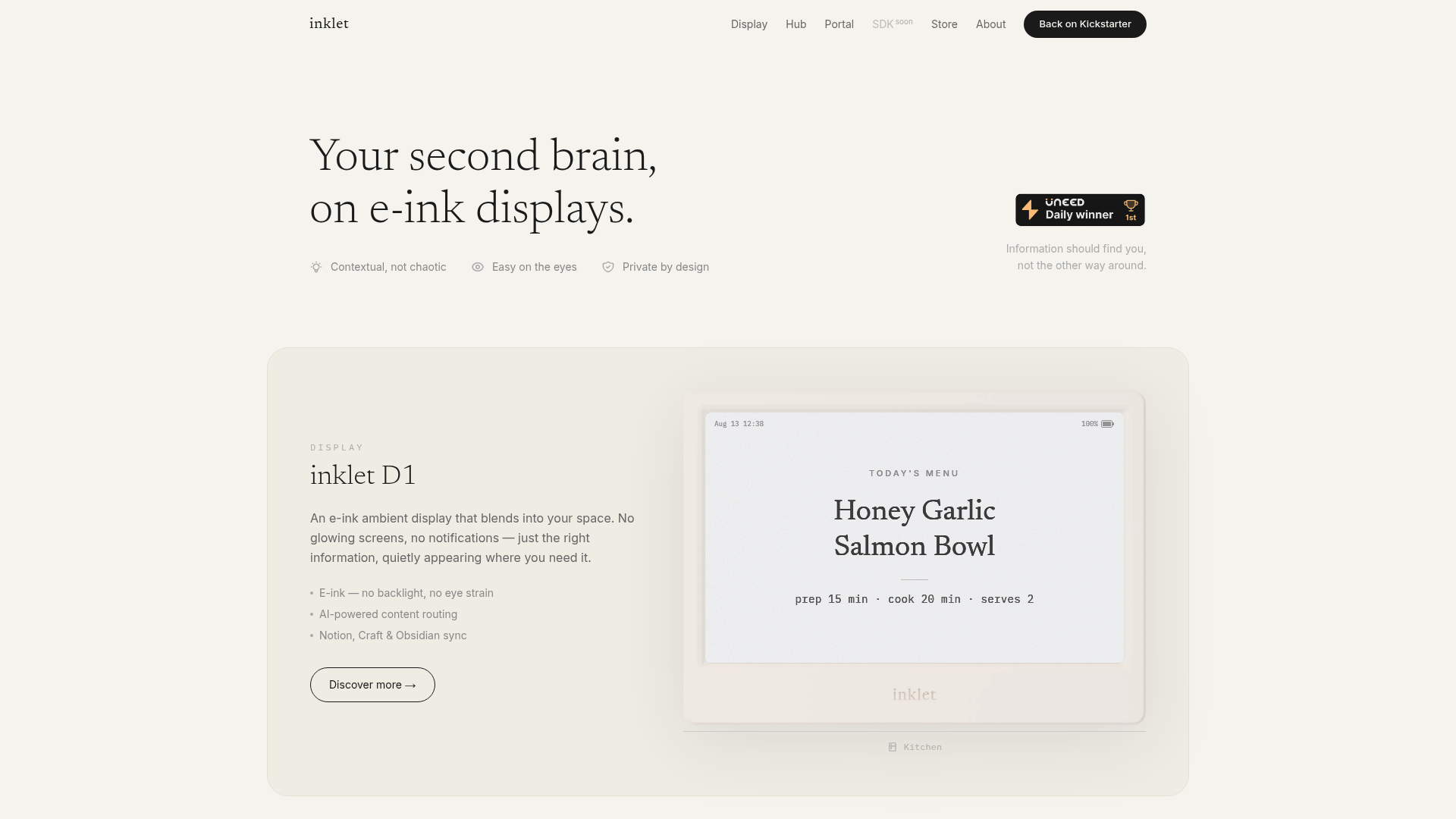
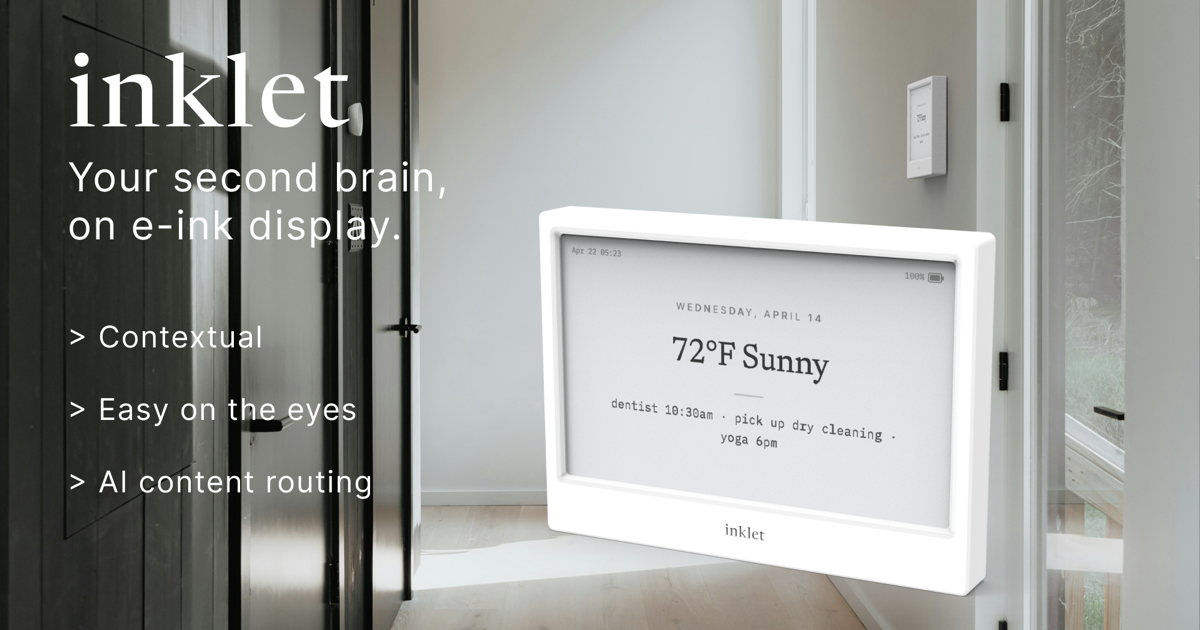
The second brain movement has a retrieval problem. You dutifully file recipes into Notion, meeting notes into Craft, and reading highlights into Obsidian — and then you never look at them again, because the only interface to that knowledge is the same glowing rectangle that also holds your email, your social feeds, and a dozen other attention thieves. inklet, a small hardware startup launching on Kickstarter, wants to break that lock by moving your second brain out of your pocket and onto your wall.
The pitch is simple: a 7.5-inch e-ink display (the D1) that sits in your kitchen or on your desk and shows you the right slice of your notes at the right time — today's menu, your schedule, a grocery list — without a notification, without a backlight, and without the rest of your digital life competing for a glance. It's a quiet, paper-like surface that behaves more like furniture than a screen. That's the thesis, and it's a genuinely interesting one. But the harder question is whether inklet can resist the gravitational pull of becoming just another dashboard.
The second brain has a retrieval problem
inklet's founding observation, stated on its site, is that "information should find you, not the other way around." That's a direct rebuke to the current model where your notes are trapped behind a screen that also holds a thousand other things. The company's about page spells out the frustration: to read one line from your notes, you unlock, you search, and you get pulled into everything else. The result is that "later" rarely comes — the recipes, reading notes, and project plans you saved for future reference stay buried.
This is a real, observable problem for anyone who has built a personal knowledge base. The tools themselves — Notion, Craft, Obsidian — are excellent at capturing and organizing information, but they're all pull-based. You have to remember to go look, and then you have to navigate the same interface that's also your portal to the rest of the internet. inklet's bet is that a physical, ambient display can change the retrieval dynamic from pull to push — but push without interruption. The D1 doesn't buzz or flash; it just shows the information in the room where you're likely to need it. That's a meaningful distinction from a smart display or a tablet in a stand, which are still fundamentally interactive devices with notifications.
E-ink as a deliberate constraint, not a feature
E-ink is often cited as a feature because it's easy on the eyes and sips power. But for inklet, it's more than that — it's a constraint that shapes the entire product philosophy. A 7.5-inch e-paper display can't play video, can't render complex dashboards, and can't refresh quickly enough for interactive use. That forces the content to be simple, glanceable, and carefully curated. The display's mockup shows a "Today's Menu" card with a recipe name, prep time, and serving size — the kind of information that benefits from being static and persistent.
The tradeoff is clear: you lose interactivity and real-time updates, but you gain a device that can sit on a shelf for months on a charge and doesn't demand your attention. This is a deliberate design choice, not a limitation. inklet's website emphasizes "no glowing screens, no notifications — just the right information, quietly appearing where you need it." That's a product philosophy that would be impossible with an LCD or OLED panel, which are inherently attention-grabbing. E-ink is the only display technology that can genuinely recede into the background.
The local-first fork: Portal cloud vs. Compute Hub
inklet's privacy positioning is one of its most distinctive elements. The company states that "privacy isn't a feature we add later — it's the foundation everything else is built on." That's a strong claim, and the hardware lineup backs it up with a fork in the architecture.
On one side, there's the inklet Portal — a cloud dashboard that syncs with your Notion, Craft, and Obsidian accounts and routes content to your displays. This is the default path for most users, and it's convenient: your displays stay in sync without any local infrastructure. On the other side, there's the Compute Hub H1, a local AI compute box that can run the routing logic entirely on your own network. With the H1, "no cloud required, no data leaving your walls," as the company puts it.
This is a meaningful architectural decision. Most ambient display products — think smart frames or digital signage — are cloud-dependent by default. inklet is offering a local-first alternative for users who are uncomfortable with their notes being processed remotely. It's also a smart product segmentation: the Portal is easier for mainstream users, while the H1 appeals to the privacy-conscious Obsidian crowd that is likely to be an early adopter. The tradeoff is that the H1 adds cost and complexity, and the company hasn't yet detailed how seamless the local setup will be. But the fact that they're even offering this option sets inklet apart in a category that usually treats the cloud as the only option.
The SDK is the real unlock
inklet's most forward-looking move is the Portal SDK. The company is releasing TypeScript and Python SDKs that let developers push content to any display through a simple API. The example on the site shows a grocery list being pushed with a tag for the kitchen and a 24-hour TTL — a simple, concrete use case.
The SDK is important for two reasons. First, it means inklet isn't limited to the integrations the company builds itself. Notion, Craft, and Obsidian are the starting point, but the SDK opens the door to anything: weather feeds, calendar events, GitHub issues, crypto prices, or custom internal dashboards. Second, it turns the display from a consumer gadget into a platform. The company's tagline is "ambient e-ink displays for your second brain," but the SDK suggests a broader ambition: a general-purpose ambient display that happens to be great for notes.
This is also where the risk lies. A platform only matters if developers build for it, and inklet is a Kickstarter project with no installed base yet. The SDK is a bet that the use cases are diverse enough that the community will want to extend the system. If that bet pays off, inklet could become the Raspberry Pi of ambient displays. If not, it's a well-designed but niche product for note-taking enthusiasts.
What Kickstarter can and cannot prove
inklet is launching on Kickstarter, with units estimated to ship in Q4 2026. That's a long lead time, and it means the product is still in the pre-orders phase. The campaign will validate demand, but it won't validate the long-term viability of the platform or the quality of the software.
The company is being transparent about its stage: it's a small team of three engineers, led by founder Kevin Zhong, and it's deliberately small to "obsess over the details that make an ambient product feel calm." That's a reasonable approach for a hardware startup, but it also means there's a lot riding on the Kickstarter campaign's success. The site lists a Trustpilot review widget, but there are no customer reviews yet — the product hasn't shipped.
What Kickstarter can prove is that there's a market for a quiet, local-first e-ink display that syncs with popular note-taking tools. What it can't prove is whether the SDK will attract developers, whether the local compute hub will work as seamlessly as promised, or whether the company can execute on its ambitious roadmap. Those are open questions, but they're not necessarily red flags — they're the normal uncertainty of any hardware startup.
For now, inklet's thesis is compelling: your second brain shouldn't live only in your pocket. It should be able to live on your kitchen counter, on your desk, in the hallway — as a quiet, paper-like presence that gives you the right information at the right time and then gets out of the way. That's a vision worth backing, even if the proof is still pending.