Impact-Site-Verification: 41b53a0c-6d04-458b-a457-fe9e29acde1a

AI & Machine Learning··3 min read

Instaplay

Turn text prompts into playable browser games, then share them with friends.

NN

NewName Editorial

Editorial Team

Instaplay product image 1

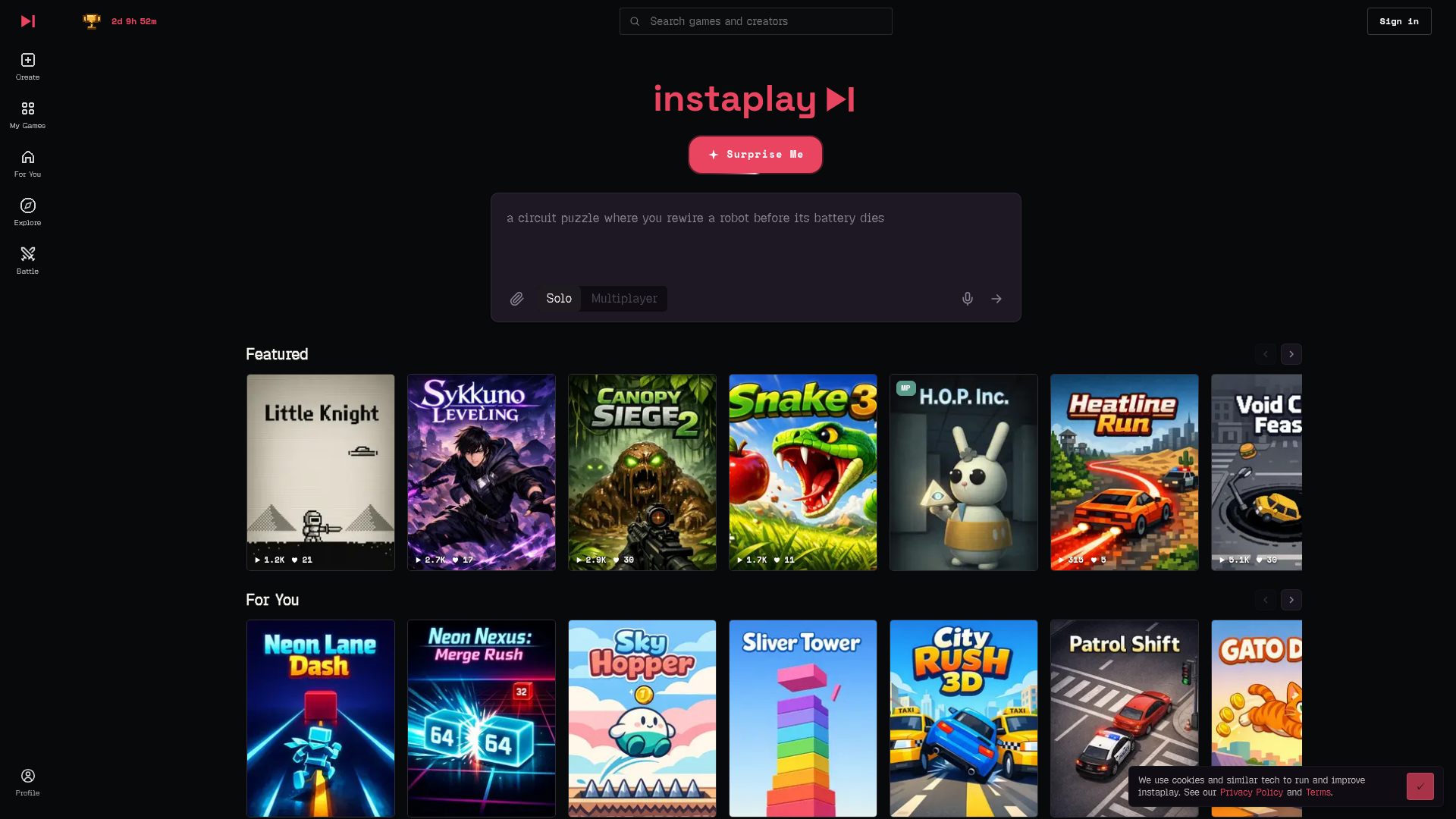
Instaplay's homepage makes a bold promise: "Every game imaginable is about to exist, and you'll find it or make it on Instaplay." That's not just a tagline—it's a thesis about the future of game creation. Instead of waiting for a studio to build the game you want, Instaplay puts the tools in your hands, powered by AI. The result is a platform that feels less like a store and more like a social network for playable ideas.

The Prompt-to-Play Pipeline

The core mechanic is deceptively simple: type a text prompt, and Instaplay generates a playable browser game. The homepage even shows a sample prompt—"a circuit puzzle where you rewire a robot before its battery dies"—to illustrate the range of possibilities. This isn't about tweaking a template; it's about starting from a blank text box and ending with a game you can actually play.

What's notable is the speed. The tagline "Make and play anything in minutes" suggests a process that's fast enough to feel like a creative spark rather than a development cycle. For context, traditional game development takes months or years, even for small indie projects. Instaplay compresses that into a coffee break, which changes the psychology of creation: you can prototype an idea, play it, and iterate immediately.

A Catalog That Grows Itself

Instaplay's game library is a direct reflection of its user base. The featured and trending sections showcase titles like "Little Knight," "Canopy Siege 2," and "Void City Feast," each with play counts that suggest real engagement. "Gravity Flip" shows 850 plays, while "Dirt Rocket" has 8.8K—numbers that indicate a community that's already creating and consuming.

What's striking is the variety. There are puzzle games, action games, multiplayer titles, and even something called "wwe Turnbuckle Thunder." This isn't a curated storefront; it's a user-generated ecosystem where the catalog grows with every prompt. The platform's "For You" feed and "Surprise Me" button add a discovery layer that feels more like TikTok than Steam, emphasizing novelty over polish.

The Social Loop: Sharing as a Feature

Instaplay isn't just about making games—it's about sharing them. The tagline "share it with friends" is baked into the workflow, and the "Social" section on the homepage highlights multiplayer games like "Snowbrawl" and "Boil The Ocean." This suggests a platform designed for social play, where games are as much about the experience as they are about the conversation around them.

The emphasis on sharing also hints at a viral loop: you create a game, share it with friends, they play it and maybe make their own. That's a powerful growth mechanism, especially for a platform that lives in the browser and doesn't require downloads. The "Battle" mode, visible in the navigation, adds a competitive layer that could keep players coming back.

A Name That Borrows from Social Video

The name "Instaplay" is a clever mashup of "instant" and "play," but it also evokes Instagram—a deliberate association with fast, visual, shareable content. That's a smart positioning move: it tells users that this is a place for quick, fun, social experiences, not hardcore gaming marathons. The domain instaplay.ai reinforces the AI angle, signaling that this is a tech-forward product.

However, the name also carries a risk. "Insta" is a prefix strongly associated with Instagram, and some might see it as riding on that brand's coattails. But in the context of AI-generated content, it works: it suggests immediacy and creativity, which are exactly what the platform promises.

What's Missing and What's Next

Public materials don't disclose funding, team size, or user numbers, so it's hard to gauge traction beyond the visible play counts. The site does mention a "Research" page and a "Demo," which could indicate an active development team. The biggest open question is quality control: with AI-generated games, how do you ensure they're actually fun? The play counts suggest some games are resonating, but the platform will need to refine its algorithms to keep the feed full of quality content.

Another question is monetization. There's no mention of paid tiers or revenue sharing, which might be intentional for now—focusing on growth first. For creators, the lack of a clear monetization path could be a barrier, but for a platform this early, the priority is likely building a community.

Instaplay is an ambitious bet on a future where game creation is as accessible as posting a photo. If it works, it could democratize game design and create a new kind of social gaming experience. If it doesn't, it'll be a fascinating experiment in what happens when you let anyone make a game. Either way, it's worth watching.