Intellistake
A public AI-infrastructure play that fuses sensors, agents, and blockchain for retail investors.
NewName Editorial
Editorial Team
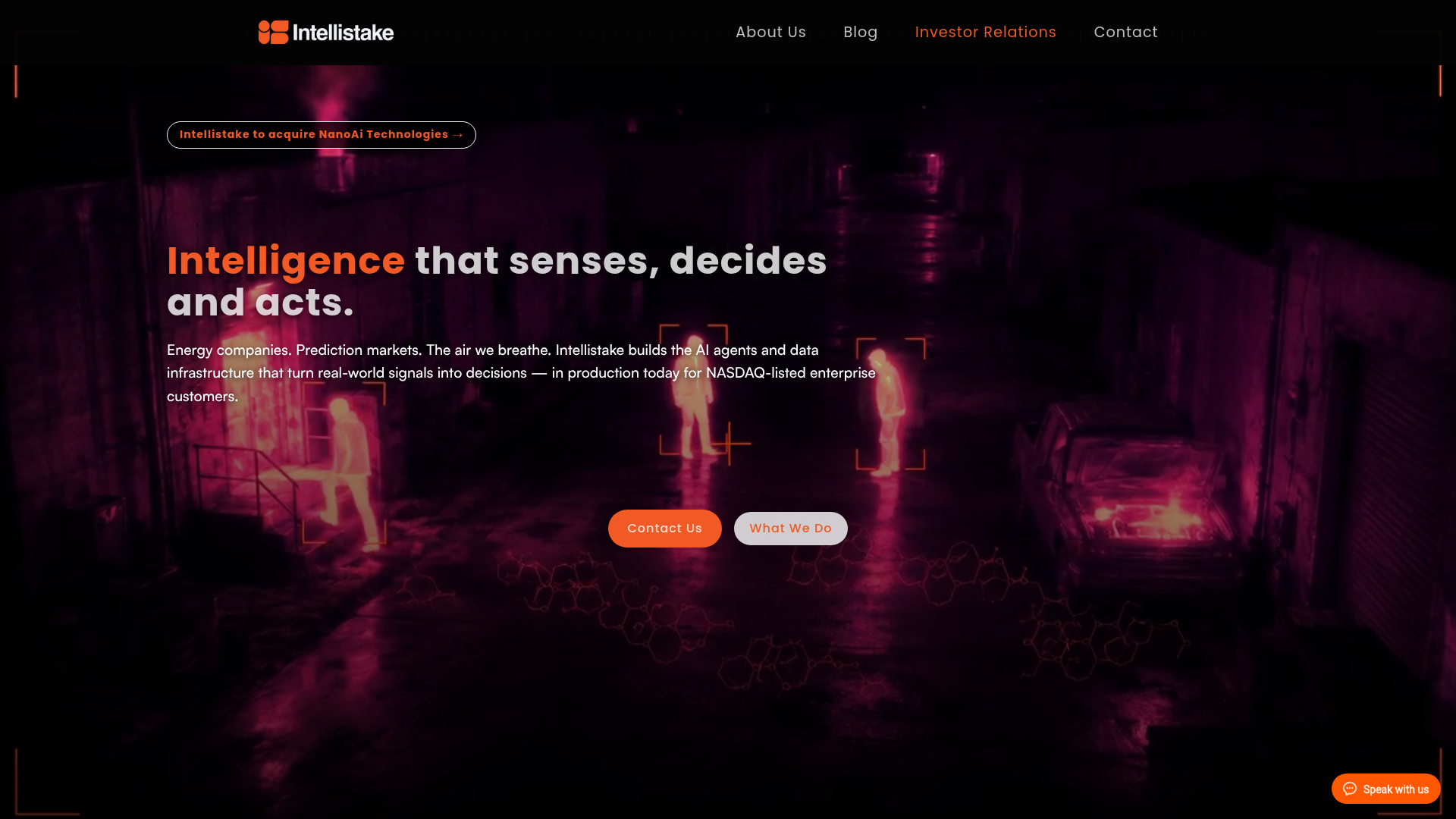

Intellistake is not a typical AI startup. It is a publicly traded company on the CSE (ticker: ISTK) that asks retail investors to buy into a vertical integration story: software that senses, decides, and acts, plus the hardware to detect threats, plus the blockchain to verify it all. The company's website is a pitch deck, its product is a narrative, and its latest move — a C$17 million acquisition of NanoAi Technologies — is a bet that the future of AI infrastructure lies in owning the sensors as well as the software.
A public company that sells a thesis, not just software
Most AI companies sell a product. Intellistake sells a thesis: that the missing layer in defence, energy, and enterprise is not more hardware, but the software that fuses data from drones, detectors, and satellites into a single operational picture. The company's tagline — "Intelligence that senses, decides and acts" — is not just marketing; it is the architecture of its entire pitch. The website is structured around this triad, with each step mapped to a product or initiative: Sense (ingesting data from enterprise systems and physical sensors), Decide (AI engines fusing inputs into a real-time picture), and Act (AI agents executing on that picture).
This is a narrative designed for investors, not just customers. Intellistake is listed on the CSE, OTCQB, and FSE, and its website prominently displays ticker symbols and a "Find Out More" link to its Investor Relations page. The company is not shy about its ambition: it wants to be the software layer for critical infrastructure, and it wants retail investors to fund that journey.
The sense-decide-act stack, minus the jargon
Strip away the buzzwords, and Intellistake's product is a data-fusion pipeline. On the "Sense" side, it ingests information from enterprise systems, market feeds, and physical sensors. On the "Decide" side, AI engines and data pipelines combine those inputs into one real-time operational picture. On the "Act" side, AI agents execute decisions — live in production for at least one customer, PowerBank, a NASDAQ-listed energy company.
This is not vaporware. The company states that AI agents are deployed in production for PowerBank, and that it has secured a C$278,000 AI software contract with the company. Two other products — Austen, an AI content platform, and IntelliScope, a business-intelligence agent — are in beta. There is also Gravity, described as "technology infrastructure for prediction markets."
The stack is deliberately horizontal. The same layer that works for energy could work for defence, borders, ports, and grids — anywhere that sensor networks are growing faster than the software that reads them. This is the core insight Intellistake is betting on: hardware has outrun software, and the company wants to be the layer that catches up.
Why a Vancouver miner of AI narratives is buying a Dallas sensor firm
The most concrete signal of Intellistake's strategy is its signed agreement to acquire NanoAi Technologies, a Dallas-based developer of a "standoff threat-detection platform," for C$17 million in Intellistake shares, subject to performance-based vesting and due diligence. The deal, announced in August 2026, would combine Intellistake's enterprise AI infrastructure with NanoAi's air-screening devices.
This is a vertical integration play. Instead of just writing software that fuses sensor data, Intellistake would own the sensors themselves. The company frames this as a natural extension: "where proven detection hardware is required, we move to own it." The acquisition is not complete — the website is careful to note that completion is subject to due diligence — but it is the clearest example of Intellistake's willingness to buy its way into the physical world.
The timing is notable. The deal was signed in August 2026, and by early August the company was already publishing scientific overviews of NanoAi's nanotechnology detection process, validated by a leading scientific publisher. This is a company that moves fast when it sees an opportunity.
Blockchain as plumbing, not hype
Intellistake's blockchain strategy is refreshingly pragmatic. The company describes blockchain as "infrastructure, not identity." It operates validators on decentralized AI networks, maintains a digital-asset treasury, and is designing chain-of-custody pathways for sensor data — tamper-proof audit trails for defence and law enforcement applications.
This is not a crypto company trying to tokenize everything. It is an AI infrastructure company using blockchain where it adds verifiable value: ensuring that data from a drone or a detector has not been tampered with. The company also runs "sovereign data centres" for environments where data cannot leave the wrong hands, and operates validators that generate recurring revenue.
The positioning is deliberate. By separating blockchain from identity and tying it to data integrity, Intellistake avoids the regulatory and reputational baggage of crypto while still leveraging the technology's core strength: immutability.
The revenue story: what is signed, what is beta, what is hoped for
Intellistake's revenue streams are a mix of the concrete and the aspirational. On the concrete side: commercial customer contracts with AI agents in production (PowerBank), and staking rewards from validator infrastructure. On the beta side: Austen and IntelliScope, both pre-commercial. On the aspirational side: the NanoAi acquisition, which would add sensor-based defence intelligence, and the broader push into defence and critical infrastructure.
The company is transparent about the risks. Its website includes a lengthy forward-looking statements disclaimer, noting that the NanoAi transaction may not complete, that digital assets are volatile, and that product development and commercialization carry inherent risks. It directs investors to SEDAR+ for full disclosure.
This is a company that knows its audience. Retail investors are not buying a finished product; they are buying a story of future growth. Intellistake is careful to show progress — signed contracts, beta products, a definitive acquisition agreement — while also hedging with legal language that would make a securities lawyer proud.
Reading Intellistake like an investor, not a customer
The most useful way to evaluate Intellistake is not as a software vendor but as a speculative investment. The company's website is essentially a long-form pitch deck, with each section designed to build a case for why its AI layer will be essential to the future of critical infrastructure.
The thesis is coherent: hardware has outrun software, and the company is building the missing layer. The execution is early but not empty — one production customer, two beta products, and a signed acquisition. The risks are real and disclosed: the acquisition may not close, the products may not commercialize, and the digital-asset treasury could lose value.
What Intellistake offers that most AI startups cannot is a public market for its narrative. Anyone can buy a piece of the story, and anyone can follow its progress through filings and news releases. Whether the story ends in a profitable company or a cautionary tale depends on execution — and on whether the sense-decide-act stack can move from pitch to production across multiple industries.
For now, Intellistake is a bet on the idea that the next big AI opportunity is not in chatbots or image generators, but in the unglamorous work of fusing sensor data into decisions. It is a bet worth watching, and for retail investors, it is a bet they can make directly.