kanye.cloud
Ask Ye Anything: Intent-driven parody search engine returning verified Kanye West quotes and lyrics
NewName Editorial
Editorial Team
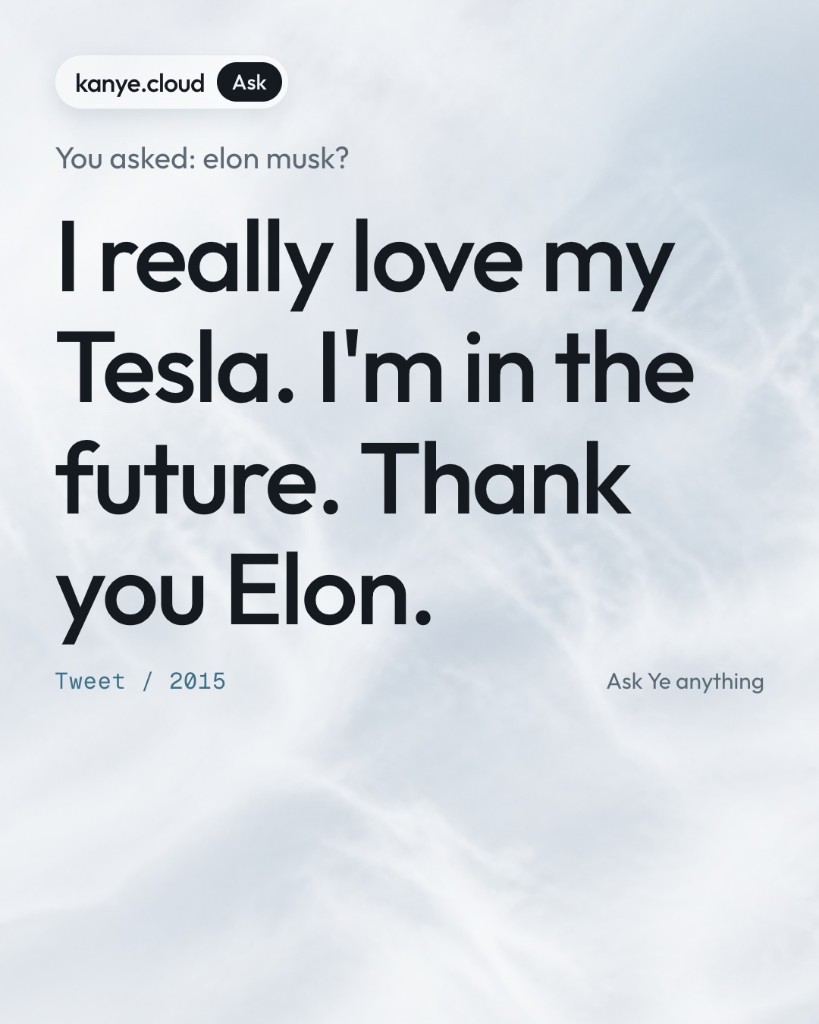
kanye.cloud does not generate music, write poetry, or pretend to chat. Built by creator @chainepic, it is a search engine with Ye's mouth—an interactive retrieval archive that answers any user prompt with an exact, verified sentence that Kanye West has previously spoken or written.
The mismatch is the entire thesis. When you ask kanye.cloud for career advice, personal wisdom, or technical insights, the system does not smooth over the contradiction with synthetic pleasantries. Instead, it plucks a raw quote from decades of interviews or a lyrical fragment from his discography, dropping it directly into your question's context. In an era dominated by homogenous conversational AI, kanye.cloud proves that curated primary sources and deliberate absurdity make for far better comedy than prompt-engineered impersonations.
The Mismatch Economy: Why Wrong Answers Are the Core Product
Standard search engines are engineered for precision, recall, and compliance. When a user enters a query, Google or Perplexity attempts to reduce ambiguity and deliver the most helpful factual answer possible. kanye.cloud inverts this fundamental assumption.
The engine operates on a core principle: 'Mismatch on purpose.' The search is allowed—and encouraged—to be slightly unhinged. The comedy lives in the conceptual chasm between what the user asks and the grandiose, hyper-confident declaration that Ye once uttered to a journalist, a camera crew, or Twitter.
Ask 'Should I start an investment fund?' and the engine might surface a quote where Ye proclaims himself the Steve Jobs of apparel. Ask 'How do I cope with heartbreak?' and you receive an excerpt from 808s & Heartbreak. Because the answer is never synthesized or softened, the juxtaposition feels authentic. It turns information retrieval into a game of surreal philosophical discovery.
The Anti-Generation Rule: Verbatim Quotes Over Hallucinated Bars
The most radical technical choice in kanye.cloud is its complete refusal to use generative large language models. The site explicitly outlines its design constraints: 'No generated lines. No voice. No portrait.'
Most developers building a celebrity-themed web app in 2026 reach for an LLM fine-tune or a cloned voice API. The result is almost always disappointing: an uncanny, slightly hollow imitation that sounds like a parody of a parody. kanye.cloud understands that Kanye West's public persona cannot be generated by a probability distribution—its power comes from the sheer unpredictability of things he genuinely declared in real life.
Every single output is an unedited, documented quote or an identified short lyric. By restricting the software to pure retrieval, the project guarantees that every sentence possesses the weight, cadence, and absurdity of historical reality. The confidence is real because the words are real.
Curation Boundaries: Filtering the Archive for Pure Ambition
The dataset powering kanye.cloud begins with the public kanye.rest open-source archive, which is subsequently cleaned, categorized, and enriched with verified song lyrics. However, creating a usable parody product around one of the most controversial figures in modern pop culture requires strict editorial curation.
The creator explicitly addresses this boundary: hate speech and 2022-era antisemitic and toxic controversy lines are deliberately excised from the pool. This is an essential editorial distinction. By pruning the darkest moments of public breakdown, kanye.cloud isolates the core elements that defined Ye's cultural resonance for twenty years: boundless self-belief, artistic perfectionism, architectural rants, fashion manifestos, and unapologetic ego.
The result is a concentrated archive of high-energy creative bravado. The platform celebrates the visionary absurdity of the artist while establishing responsible product guardrails.
Likeness Rights and the Radical Restraint of Plain Text
In an increasingly contested legal environment surrounding AI likeness, deepfakes, and unauthorized vocal synthesis, kanye.cloud adopts a remarkably safe and elegant posture.
There are no scraped portrait photographs, no cloned vocal models, and no artificial logos masquerading as official Yeezy merchandise. The visual identity consists solely of pale, high-key cloud imagery and clean typography. The disclaimer is prominent and unequivocal: an unofficial parody fan project that claims no affiliation with Ye or his business entities.
Because quotes spoken in public forums are factual events and historical record, indexing them within a text-only retrieval tool sidesteps the intellectual property minefields that trap generative deepfake apps. It provides a blueprint for how independent developers can engage with pop culture icons responsibly through software.
Pop Culture Retrieval as the Counterweight to General AI
kanye.cloud, alongside its sibling project Elon.Press, highlights a compelling fork in modern consumer software. As frontier AI models strive to become universal enterprise assistants, they inevitably lose edge, idiosyncrasy, and bite.
By stripping away the generative apparatus and focusing entirely on fast, curated semantic retrieval, kanye.cloud delivers an experience that is memorable, funny, and honest. It treats internet history as an interactive instrument, allowing users to play questions against the ego of one of hip-hop's most singular figures.