Kedge
Deploy with SSH, scale to zero, and get a global SQLite database in every app.
NewName Editorial
Editorial Team

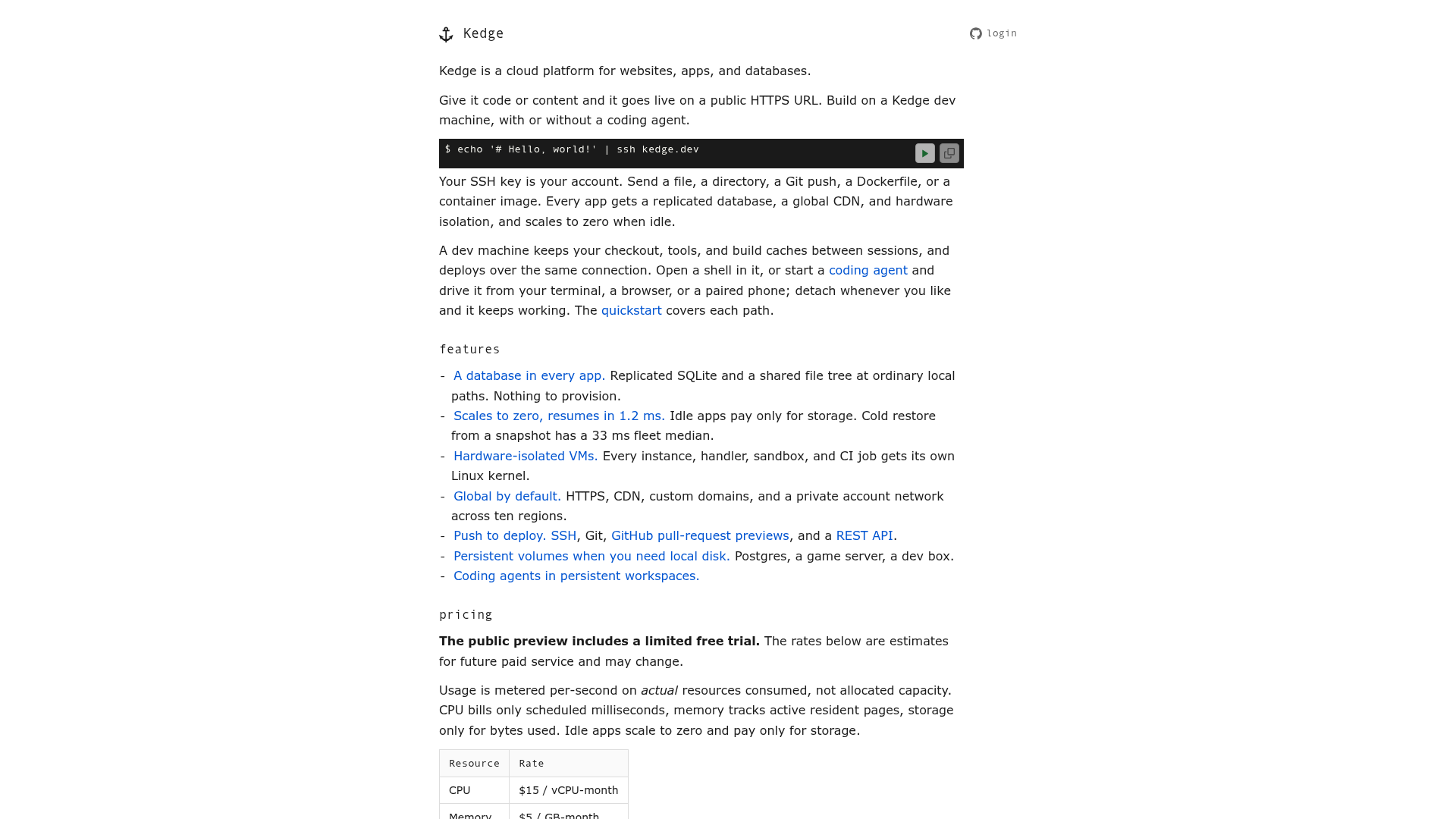
The cloud has a new contender, and it's not trying to be another Kubernetes. Kedge, a full-stack platform from the team behind kedge.dev, is betting that the future of deployment is as simple as an SSH command. Its pitch: give it code or content, and it goes live on a public HTTPS URL. No YAML, no clusters, no container registries. Just your SSH key as the account and a shell pipe as the deploy mechanism.
That's a bold thesis in an era of complex CI/CD pipelines and infrastructure-as-code sprawl. But Kedge isn't just simplifying the deploy path; it's rethinking the entire runtime. Every app gets a replicated SQLite database, a global CDN, hardware isolation, and the ability to scale to zero when idle. The result is a platform that feels less like a cloud provider and more like a personal developer's utility.
The SSH-first deployment model
The first thing that stands out about Kedge is its deployment interface. The homepage shows a single command: echo '# Hello, world!' | ssh kedge.dev. That's it. Your SSH key is your account. Send a file, a directory, a Git push, a Dockerfile, or a container image, and Kedge turns it into a live app. This is a radical departure from the typical web dashboard or CLI tool that requires authentication tokens and project setup.
The SSH approach has a deeper implication: it makes Kedge accessible to any tool that can speak SSH. That includes coding agents, which are becoming a staple in modern development workflows. Kedge's docs describe how you can start a coding agent in a persistent workspace and drive it from your terminal, browser, or even a paired phone. You can detach and it keeps working. This positions Kedge as a natural home for AI-assisted development, where the agent can deploy directly without needing to learn a proprietary API.
Forkable snapshots: the missing cloud primitive
The headline feature in Kedge's Show HN post is "forkable VM snapshots." This is a concept borrowed from the world of version control, applied to entire virtual machines. A snapshot captures the state of a running VM, and you can fork it to create a new instance that starts from that exact state. This is powerful for development workflows: you can spin up a dev environment, make changes, and then fork it to test different scenarios without affecting the original.
Kedge's documentation mentions that cold restore from a snapshot has a 33 ms fleet median, which is remarkably fast. This enables what they call "instant sandboxes" and "scale-out" — the ability to create new instances in milliseconds. For developers, this means you can treat infrastructure as disposable. Need a clean environment to test a pull request? Fork a snapshot. Need to reproduce a bug? Fork the exact state where it occurred.
This is a category-defining feature that most clouds lack. While AWS and GCP offer AMIs and machine images, they are not designed for rapid forking and experimentation. Kedge's snapshots feel more like Git branches for your VM, and that's a mental model that resonates with modern developers.
Global SQLite: a database without a server
Every Kedge app comes with a replicated SQLite database and a shared file tree at ordinary local paths. This is a bold choice. SQLite is often dismissed as a toy database, but Kedge treats it as a first-class citizen, replicated across regions and accessible via standard paths. The docs say "Nothing to provision" — you don't need to create a database instance or manage connection strings. It's just there, like a local file.
This approach eliminates a huge amount of operational overhead. For small to medium applications, SQLite is more than sufficient, and Kedge's global replication addresses the traditional limitation of SQLite being single-writer. By making it global, they're essentially offering a serverless database with a familiar API. This could be a killer feature for developers who want the simplicity of SQLite without the scaling headaches.
Per-second metering: paying for what you use
Kedge's pricing model is another differentiator. It meters per-second on actual resources consumed, not allocated capacity. CPU bills only scheduled milliseconds, memory tracks active resident pages, and storage only for bytes used. Idle apps scale to zero and pay only for storage. This is a stark contrast to the typical cloud model where you pay for provisioned instances regardless of utilization.
For developers, this means you can run a small website or a dev box for as little as $5 per month, thanks to the free tier. The rates are estimates for future paid service, but the direction is clear: Kedge wants to align cost with actual usage. This is particularly attractive for hobbyists and indie hackers who are tired of paying for idle VMs.
The name and the anchor
The name "Kedge" is short, memorable, and evokes the idea of a small anchor used to move a ship. It suggests stability and mobility — fitting for a platform that lets you move between snapshots and deploy from anywhere. The domain kedge.dev is clean and reinforces the developer-focused positioning. The anchor emoji in the logo is a nice touch that ties the name to its nautical metaphor.
However, the name doesn't immediately convey what the product does. "Kedge" could be a game, a boat accessory, or a random startup. It lacks the descriptive clarity of names like "Vercel" or "Railway." But for a developer tool, a distinctive name can be an asset — it's easy to search for and remember. The brand is still young, so it has room to build meaning.
Who should care and what's missing
Kedge is squarely aimed at developers who value simplicity and speed. If you're a solo developer, a small team, or an AI agent that needs to deploy code quickly, Kedge offers a compelling workflow. The SSH-first model and forkable snapshots are particularly attractive for experimentation and prototyping.
That said, Kedge is still in public preview, and some details are missing. The about and blog pages return 404, and the pricing page is not yet live. The documentation is thorough, but the platform's reliability and long-term viability are unproven. For production workloads, some might hesitate to trust a young platform with their data, despite the hardware isolation and replication claims.
Kedge is not trying to be another AWS. It's carving out a niche for developers who want a full-stack cloud that feels like a local tool. If it delivers on its promises, it could become the go-to platform for rapid prototyping and AI-driven development. The anchor is set; now we'll see if it holds.