Keet
Generate Duolingo-style courses on any topic, with videos and games
NewName Editorial
Editorial Team
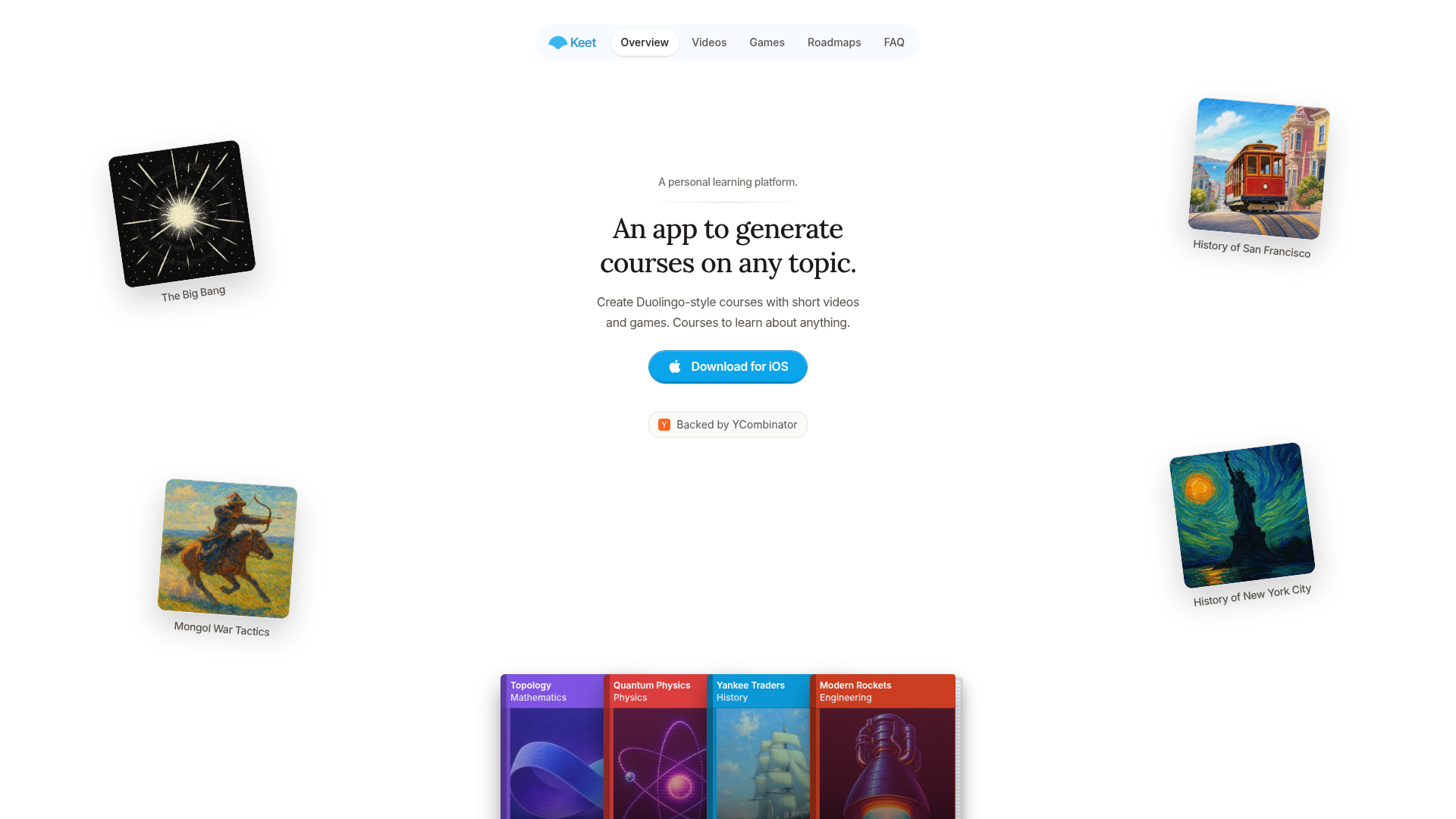


Keet is not another online course marketplace. It's a generator. Type in a topic—topology, the history of San Francisco, Mongol war tactics—and the app produces a structured, interactive course with short videos, quizzes, and games. That's a fundamentally different bet from the likes of Coursera or MasterClass, which curate content from experts. Keet, a Y Combinator S24 startup, is betting that the future of learning lies not in a library but in an engine that can create courses on demand.
From Library to Generator: The Bet Behind Keet
The traditional edtech model is a library: you browse a catalog of courses, each painstakingly produced by experts. Keet inverts this. Instead of curating, it generates. The website's tagline is "An app to generate courses on any topic," and the copy doubles down: "Create Duolingo-style courses with short videos and games." This is a radical shift. It moves the value from content curation to content generation. The question is whether an algorithm can produce courses that are not just accurate but genuinely engaging.
Keet's approach is reminiscent of the generative AI wave that has swept through text and image creation. But applying it to education is trickier. A course isn't a single output; it's a structured sequence of lessons, quizzes, and games. Keet's website shows examples like "Introduction to Topology" and "History of San Francisco," suggesting the generator can handle both academic and cultural topics. The ambition is clear: any topic, any depth, any learner.
How Keet Turns a Topic into a Course
The mechanics are straightforward from the user's perspective. You enter a topic, and Keet generates a course with a structured roadmap. The roadmap is broken into modules and lessons, each with short videos (around 4 minutes each) and accompanying quizzes. For instance, the "Introduction to Topology" course starts with "Abstract Set Theory," then moves to "Topological Spaces," "Continuity and Space Construction," and finally "Topological Properties." Each module contains lessons like "Sets and Subsets" or "Compactness." This is a real curriculum, not just a random collection of facts.
The customization options are a key differentiator. The FAQ notes that users can "set the desired depth, complexity, and narration style" when creating a course. This means a beginner and an advanced learner can get different versions of the same topic. It's a level of personalization that static courses can't offer. The site also mentions that courses include "explainer videos" and "games" to test knowledge, with game types like Multiple Choice, Swipe, Order, Connections, and Custom. This variety suggests an attempt to cater to different learning styles.
The Duolingo Formula, Applied to Anything
Duolingo's success lies in its gamified, bite-sized lessons that keep users hooked. Keet explicitly borrows this formula: short videos, interactive quizzes, and games. But Duolingo has a team of linguists and content creators; Keet aims to automate that process. The result is a potentially infinite library of courses, each with the same engaging structure.
The game types are a smart touch. Multiple choice is standard, but Swipe (likely a Tinder-style yes/no or match), Order (sequencing), and Connections (linking related items) add variety. This isn't just a quiz; it's a mini-game. The website shows a multiple-choice question about mitochondria, with options like "Protein synthesis" and "Energy production through ATP synthesis." This is a typical biology question, but the format is more interactive than a simple Q&A.
The risk is that the games become repetitive or shallow. Duolingo's exercises are carefully designed to reinforce language patterns; Keet's games are generated on the fly. Will a generated "Connections" game for topology be as meaningful as a handcrafted one? The quality of the games will determine whether Keet is a novelty or a real learning tool.
The Roadmap: Structure as the Killer Feature
The most underrated aspect of Keet is the roadmap. Many online courses are a series of videos, but Keet organizes content into modules and lessons with clear prerequisites. The topology course, for example, starts with set theory before moving to topological spaces. This is a pedagogical choice that ensures learners build a foundation before tackling advanced concepts.
The roadmap also makes learning manageable. Each lesson is a bite-sized chunk, and the progress is visible. This addresses a common problem with self-directed learning: knowing where to start and what to do next. Keet's structure provides a path, which is especially valuable for self-learners who might otherwise flounder.
The website emphasizes "structured course roadmaps" and "bite-sized chunks." This is a direct challenge to the unstructured nature of many YouTube tutorials or blog posts. Keet is positioning itself as a structured alternative to the chaos of free content.
What Keet's Name and Brand Promise (and What They Don't)
The name "Keet" is short, punchy, and memorable. It evokes "key" (as in key to knowledge) and "kit" (as in a toolkit). It's also a playful nod to "parakeet," a bird known for mimicking sounds—fitting for an app that generates courses. The domain, trykeet.com, is clean and action-oriented, inviting users to try it. The logo is a simple geometric shape, suggesting a modern, minimal aesthetic.
But the name also carries a risk. "Keet" doesn't immediately communicate "education" or "courses." It's abstract, which could be a double-edged sword. On one hand, it allows the brand to expand beyond education. On the other, it may confuse potential users who don't know what the app does. The tagline "An app to generate video courses on anything" clarifies, but the name alone is ambiguous.
Compared to competitors like Duolingo (which evokes "lingo") or Coursera (which suggests a course), Keet is less descriptive. However, in a crowded market, a distinctive name can be an advantage. It's memorable and easy to say. The brand is clearly targeting a younger, tech-savvy audience that values simplicity and innovation.