Kind
Kind by Synsira runs AI on your device, keeping data local and answers honest.
NewName Editorial
Editorial Team
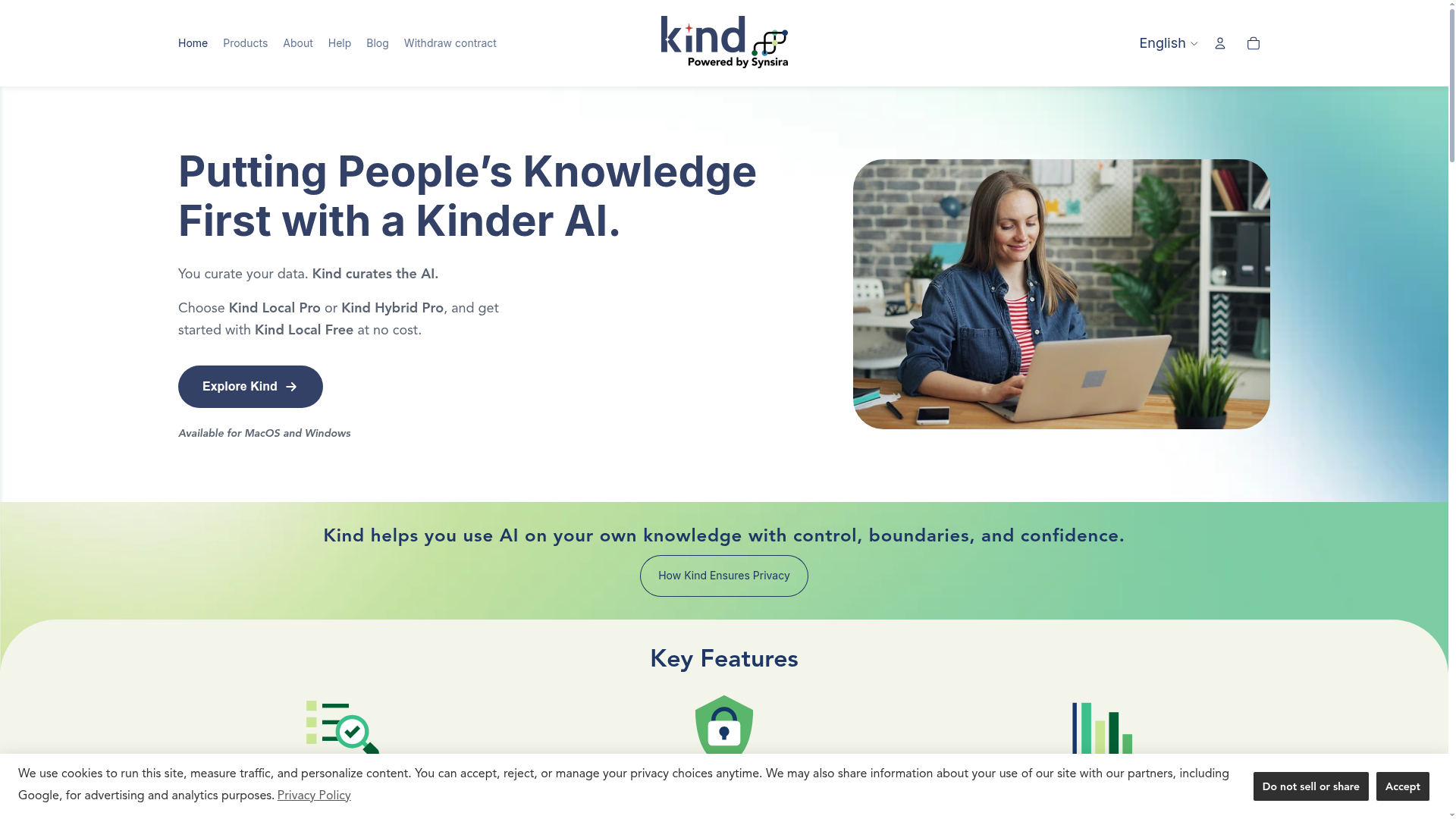

Most AI products treat privacy as a compliance checkbox: a line in the terms of service, a promise that your data won't be sold. Kind by Synsira treats privacy as the product itself. Built by Vancouver Island-based Synsira Software, Kind runs entirely on your computer—no cloud, no data centre, no training on your files—and it's willing to say "I do not know" when the answer isn't in your curated data. That combination of local processing and explicit boundaries is unusual, and it's worth examining closely.
The 'I do not know' answer as a feature
Kind's core promise is constrained question-answering. You upload files—PDFs, notes, screenshots, photos—and ask questions. If the answer isn't in your files, Kind says "I do not know." That's a deliberate design choice, not a limitation. Most AI assistants will happily hallucinate an answer from the internet's collective noise; Kind is built to refuse. This is a quiet rebellion against the 'always answer' culture of chatbots. For users who need accuracy over creativity—say, a family historian cross-referencing genealogy records or a fantasy sports enthusiast parsing stats—the ability to trust that an answer comes only from their own data is more valuable than a confident guess.
The website emphasizes this: "Ask questions that are constrained to your curated data." The word 'curated' is key. Kind doesn't ingest everything; it waits for you to decide what matters. That's a different relationship with AI—less oracle, more librarian.
Local-first AI: the tradeoff between depth and privacy
Kind's local-first approach means all processing happens on your machine. The free and Local Pro tiers work 100% offline. That's a significant engineering choice, and it comes with tradeoffs. Local models are typically smaller and less capable than cloud-based LLMs. Kind acknowledges this: the comparison table rates answer quality as 'Good' for local tiers and 'Best' for the hybrid tier, which sends privacy-preserving queries to a cloud LLM for deeper analysis.
This is an honest admission. You can't run a 70-billion-parameter model on a laptop and expect GPT-4-level reasoning. But for many personal and professional use cases—indexing recipes, organizing client drafts, cataloguing vacation photos—'good' is enough. The tradeoff is clear: you sacrifice some depth for absolute control over your data. Kind also claims 'low environmental impact' for local tiers, since no energy-hungry data centre is involved. That's a nice co-benefit, though the site doesn't quantify it.
Pricing Kind: free, pro, and hybrid as a privacy spectrum
Kind's pricing structure is a privacy spectrum, not just a feature ladder. There's a free tier (Kind Local Free) with 1 collection and up to 50 files per collection—enough to test the experience. Then Kind Local Pro at $79 for the first year, $39/year renewal, which raises limits to 20 collections and 10,000 files per collection, plus unlimited offline chats. Finally, Kind Hybrid Pro at $18.88/month, which adds cloud-based LLM queries for deeper analysis.
The pricing itself tells a story. The free tier is generous enough to be genuinely useful, not just a teaser. The Pro tier is priced like a productivity tool, not an enterprise SaaS. And the Hybrid tier is a monthly subscription, reflecting the ongoing cost of cloud inference. Notably, the site says 'No AI model lock-in' and 'No vendor lock-in'—a subtle jab at the ecosystem lock-in common in AI platforms. Whether that holds up in practice is unclear, but it's a strong positioning statement.
Who actually buys a local AI? The use cases Kind names
Kind's website lists six user personas: influencers, amateur chefs, fantasy sports enthusiasts, strategic communicators, family historians, and expert travellers. These are deliberately non-technical, personal-use cases. This is not a tool for data scientists; it's for people who have a messy folder of files and want to ask questions without uploading everything to a cloud service.
Take the family historian: they have scanned documents, photos, and notes from archives. They want to find connections—"when did my great-grandfather move to Winnipeg?"—without sending sensitive family data to a third party. Or the strategic communicator: they store drafts, client assets, and knowledge, and Kind helps cut prep time by as much as half (a claim the site makes, though without a detailed methodology). These personas suggest Kind is aiming at the 'personal knowledge management' niche, a space that's growing but still early. The challenge is that these users may not be willing to pay $79/year for a tool that's not yet essential. The free tier is crucial for conversion.
The Kind brand: softness as a positioning weapon
The name 'Kind' is a bold choice. It's warm, approachable, and suggests benevolence—a stark contrast to the intimidating names of many AI products (think 'Singularity', 'TensorFlow', or 'OpenAI'). The tagline "You curate your data. Kind curates the AI" reinforces this: the user is in control, and the AI is a helpful assistant, not a black box. The brand extends to the company name, Synsira Software, which is less memorable but provides a professional umbrella. The domain, kind.synsira.com, is a subdomain, which is a bit unusual for a flagship product—it might have been stronger to use getkind.com or kind.ai. But the subdomain keeps the brand tightly linked to the company, which is fine for now.
The visual identity is soft and clean, with pastel gradients and friendly imagery. The word 'Kind' itself is a promise: this AI will be gentle with your data, respectful of your boundaries. In a market where AI is often portrayed as a powerful but dangerous force, Kind's softness is a differentiator. It's a positioning weapon, not just a name.
What Kind doesn't say: the open questions
The website is refreshingly transparent about what Kind does, but it's silent on some important details. There's no information about the underlying model architecture, the hardware requirements, or the specific privacy-preserving techniques used in the hybrid tier. The 'About' page is a 404, which is a bad sign for a company trying to build trust. The founder, Dr. Jonathan Schaeffer, is described as an AI pioneer with 40 years of experience, but there's no detailed bio on the site. The BetaKit article mentions he's a former Amii founder, which adds credibility, but the site itself doesn't leverage that.
Another open question is the environmental impact claim. The site says local processing has 'low environmental impact,' but there's no data on energy consumption or lifecycle analysis. It's a plausible claim, but not substantiated. Finally, the hybrid tier's privacy-preserving queries are a black box—how exactly does it protect data when sending to a cloud LLM? The site says 'privacy-preserving handling,' but the details are vague.
Despite these gaps, Kind by Synsira is a thoughtful product in a category that's often thoughtless about privacy. It's not trying to be the smartest AI; it's trying to be the most trustworthy. For users who value control over their data, that's a trade worth making. The free tier is a smart entry point, and the pricing is reasonable. The open questions are real, but they don't undermine the core value proposition. Kind is a name to remember—and a product to watch.