Libra Robotics
Autonomous solar installation with a 45-120 second cycle and supervised field robots.
NewName Editorial
Editorial Team
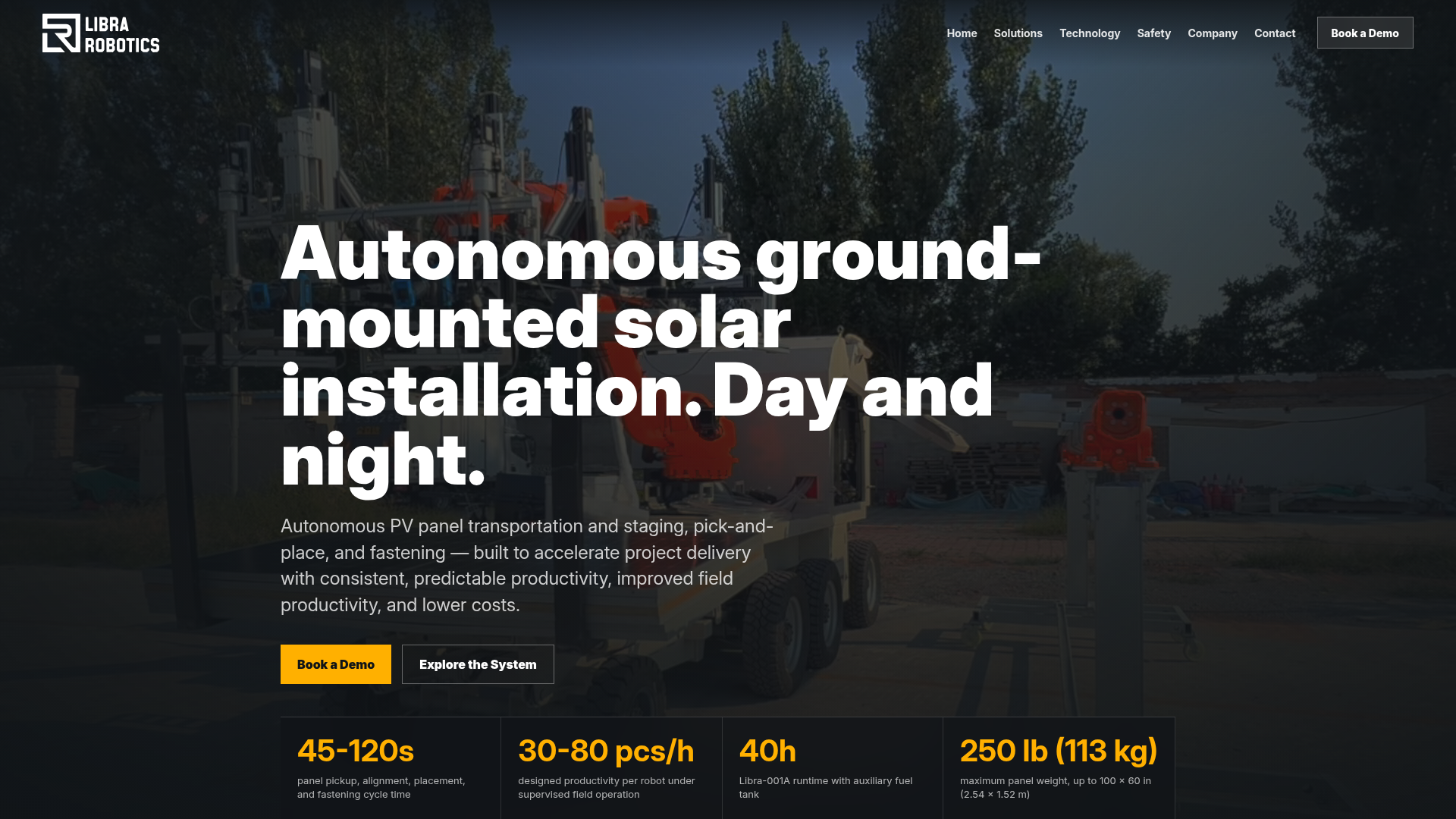
The solar industry has a productivity problem, and it is not a panel-efficiency problem. It is a field problem: thousands of heavy modules, each one lifted, aligned, and fastened by hand, under sun, wind, and deadline pressure. Libra Robotics, a Y Combinator-backed startup out of Newark, California, is attacking that problem not with a faster human crew, but with a robot squad that claims a 45-120 second cycle for panel pickup, alignment, placement, and fastening. That number is the whole story.
The 45-120 second promise
On its homepage, Libra Robotics leads with a set of hard operational numbers: 45-120 seconds per panel cycle, 30-80 panels per hour per robot under supervised field operation, 40 hours of runtime with an auxiliary fuel tank, and support for panels up to 250 pounds and 100 by 60 inches. These are not vague marketing claims about 'AI-powered efficiency.' They are the kind of specifications a project engineer would put into a bid.
The 45-120 second range is the most telling figure. It is not a single number because installation speed depends on racking type, site conditions, and the specific fastening method. But the range itself signals a deliberate design goal: consistency. A human crew might average a certain number of panels per hour, but that average hides enormous variance — fatigue, weather, skill differences, lunch breaks. Libra is selling predictability. The robot will take 45 seconds on a good day and 120 on a bad one, but the project manager can plan around that band.
One robot, one workflow: from pallet to fastened panel
Most solar automation attempts have focused on single tasks: a crane that lifts panels, a cart that moves them, a screwdriver that fastens them. Libra Robotics collapses the entire sequence into one robotic workflow. The robot transports the module from the pallet, picks it up, aligns it relative to the rack, places it, and fastens it — all within the same cycle. The company highlights two core capabilities: the autonomous installation workflow and autonomous fastening.
The fastening piece is the differentiator. Many 'automated' systems stop at placement, leaving the human to torque the bolts. Libra's end-effectors include compatible fasteners that allow the robot to complete the mechanical connection within the installation cycle. That means the robot does not just move the panel; it finishes the job. This is what makes the productivity numbers meaningful. A robot that only places panels still requires a human to follow behind, which cuts the labor savings in half. By including fastening, Libra removes the need for a dedicated fastening crew.
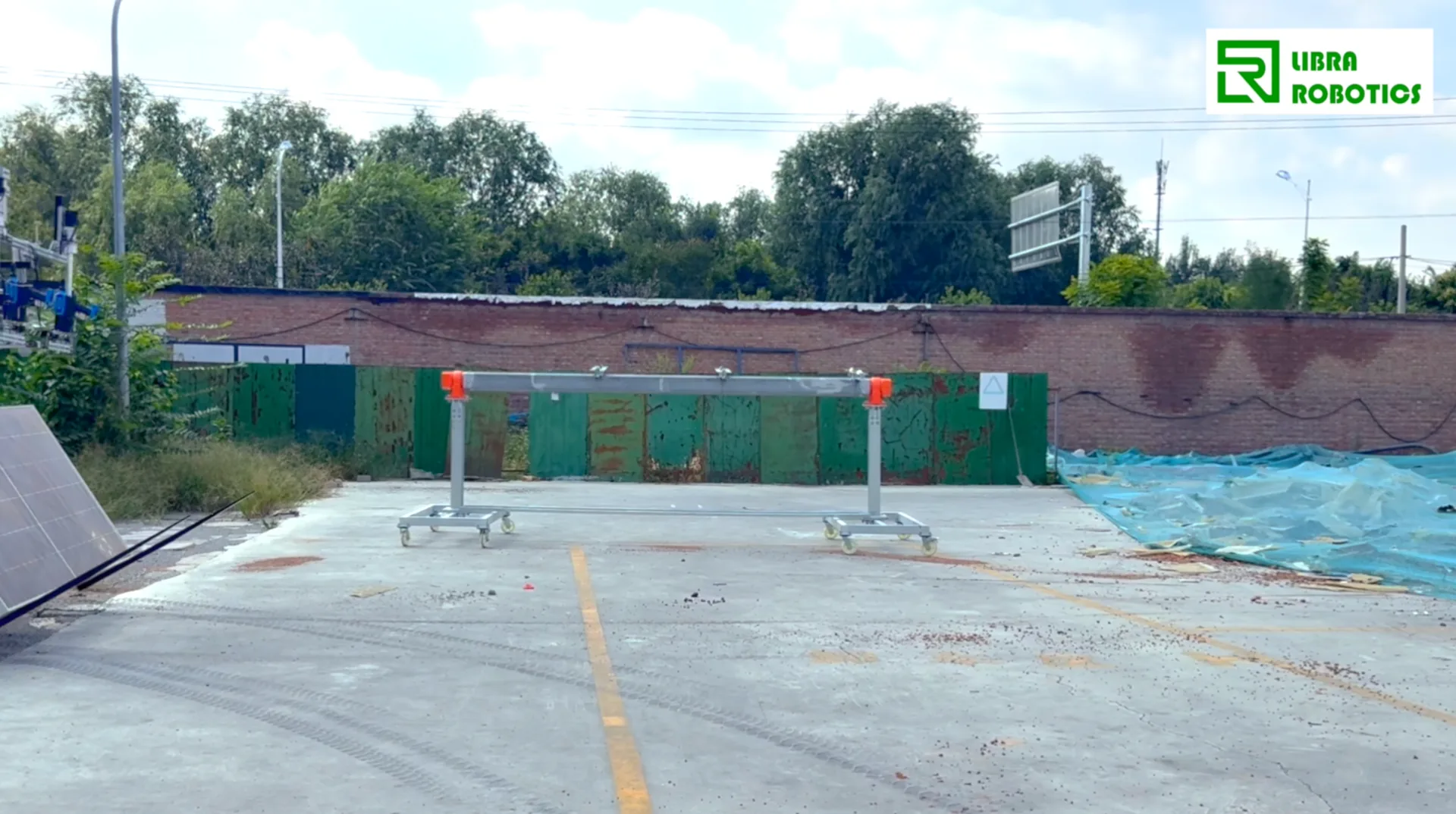
The system is designed to work across mainstream commercial racking systems, including single-axis trackers, as shown in the field demo. The company says it has been demonstrated in the United States and is deployable today. That is a strong claim for a startup at the YC Summer 2026 batch stage, but the public materials back it with a detailed field demo video and a technology page that describes end-effectors, perception, fastening tools, and mobility.
The supervised autonomy tradeoff
Libra is not selling a fully autonomous, lights-out solar farm. The key phrase is 'supervised field operation.' The robot works under human oversight, and the safety page emphasizes supervision, feedback, and operator safeguards. This is a deliberate tradeoff. Full autonomy in a chaotic construction site — with uneven terrain, loose gravel, wind gusts, and other crews moving around — is a research problem that may take a decade to solve. Supervised autonomy is a product that can ship today.
The tradeoff is clear: the robot does the heavy, repetitive, precise work, while the human handles exceptions, quality checks, and site-level judgment. This is the same pattern that has worked in warehouse robotics, where humans and robots share the floor. For solar, it means the robot can work day and night — the homepage explicitly mentions nighttime operation — while the human supervisor can monitor multiple robots from a safe distance. The 40-hour runtime with an auxiliary fuel tank suggests the robot is designed for long shifts, not just a few hours of demonstration.
But supervised autonomy also means the labor savings are not absolute. A crew still needs to be on site, and the ratio of robots to supervisors will determine the actual cost benefit. Libra does not disclose that ratio in its public materials. The productivity numbers are per robot, not per crew. A project manager will need to run a pilot to see if one supervisor can handle two, five, or ten robots. That is the kind of detail that separates a demo from a deployment.
What the numbers don't say
The 30-80 panels per hour is a designed productivity rate under supervised field operation. It is not a guaranteed output on every site. The range depends on racking configuration, panel size, and the fastening method. Libra is transparent about this by showing a range rather than a single headline number, but the public materials do not include real-world field data from customer sites. The company says the system has been demonstrated in the United States, but it does not disclose which projects or what measured throughput was achieved.
There is also no pricing information. The cost of a Libra-001A unit, the leasing model, and the total cost of ownership are not published. For a construction equipment purchase, that is a significant unknown. A solar developer will want to compare the robot's capital cost and maintenance against the cost of a manual crew over the life of a project. The 250-pound panel weight limit is another constraint. Most commercial solar panels are well under that, but the industry is moving toward larger formats, and the 100-inch length limit may rule out some of the biggest modules.
None of this is a knock on the product. It is simply the gap between a compelling spec sheet and a proven business case. Libra is at the stage where it needs to convert demonstrations into paid pilots, and the public evidence suggests it is well positioned to do so.
Why solar is the proving ground
Libra's tagline — 'Collaborative Robot Squads for Solar Installation' — and its mission to unlock 'remote, harsh, and hard-to-reach places' point to a broader ambition. Solar farms are often built in deserts, on slopes, and in locations where labor is scarce or expensive. The harsh environment is exactly where a robot that does not tire, does not need shade, and can work at night has the most value. If the system works in the Mojave, it can work on a flat rooftop in California.
The choice to start with solar is also strategic. Solar installation is a massive, growing market with a well-documented labor shortage. The work is physically demanding and repetitive, making it a prime candidate for automation. Unlike manufacturing, where robots are fixed to a line, solar fields are outdoor, unstructured environments — a harder problem, but one with a clear payoff. Libra's approach of supervised, collaborative squads is a pragmatic middle ground between today's manual reality and a future of fully autonomous construction.
The 'Libra' name — the scales — is an apt metaphor for a company that is balancing the weight of panels, the tradeoff between autonomy and supervision, and the equation of cost versus productivity. It is not a clever pun, but it fits the engineering mindset.
Libra Robotics is not claiming to replace solar crews. It is offering them a tool that can make their work faster, safer, and more predictable. The 45-120 second cycle is the promise. The field demos are the proof of concept. The next step is proving the economics on a real project. If they can do that, Libra will have built more than a robot — it will have built a new standard for solar construction productivity.