Impact-Site-Verification: 41b53a0c-6d04-458b-a457-fe9e29acde1a

Developer Tools·Unknown··5 min read

Line9

A Mermaid rendering engine with its own layout algorithm — for diagrams you'd actually show your team.

NN

NewName Editorial

Editorial Team

Line9 product image 1
Line9 product image 2

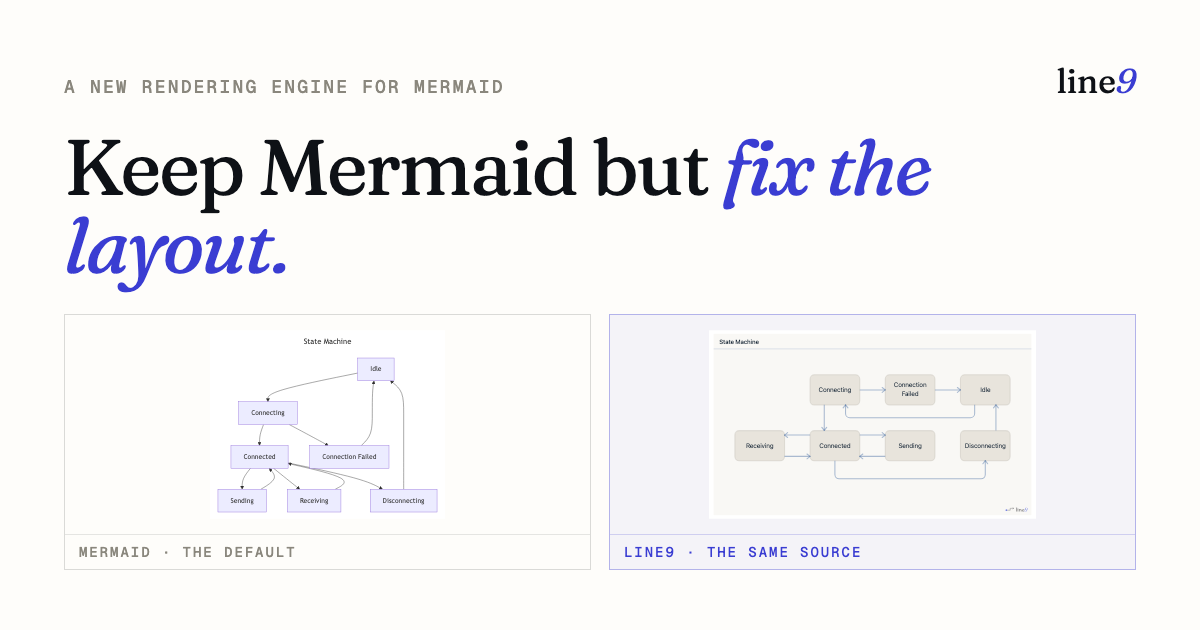
Mermaid is the rare developer tool that everyone uses and almost no one loves. The syntax is forgiving, the ecosystem is everywhere, and the output is often a mess. Nodes collide, edges snake across the canvas, and the diagram you pasted into a PR looks like it was drawn by a toddler with a mouse. For years, the standard answer has been: tweak the layout options, rearrange the nodes, or just give up and use a different tool. Line9, a new rendering engine for Mermaid diagrams, is making a different bet: the problem isn't your diagram — it's the layout algorithm underneath. And the only way to fix it is to build a new one.

The diagram that never looks like the code

Anyone who has pasted a Mermaid flowchart into a README knows the feeling. The text describes a clean, logical flow. The rendered output shows a tangled web of overlapping boxes and arrows that loop back on themselves. The gap between what you wrote and what you see is not a syntax error — it's a layout problem. Mermaid's default renderer uses a layout algorithm that prioritizes something other than human readability. It's not wrong, exactly; it's just not good.

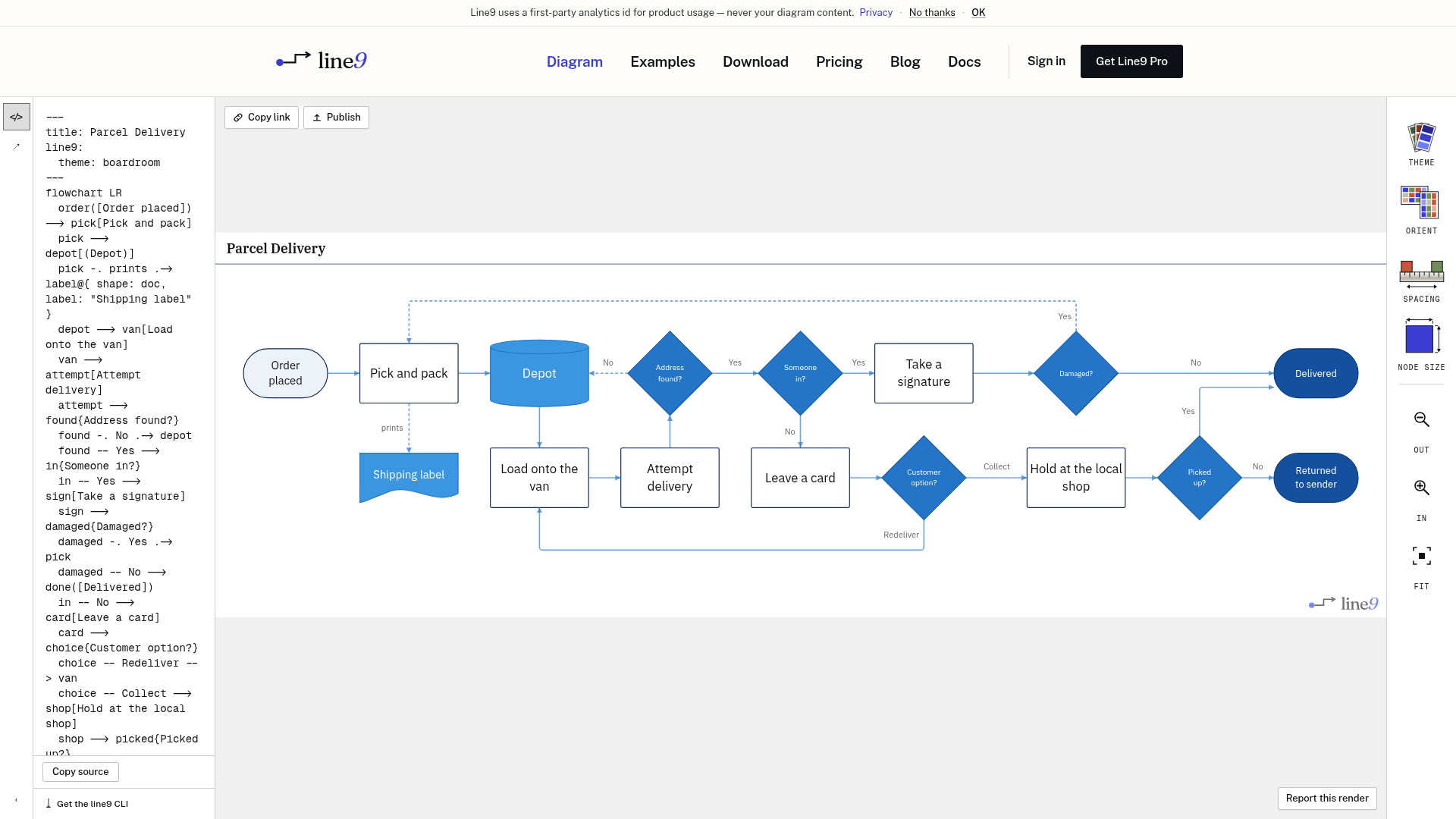
Line9's pitch is that it has built a better layout engine. The homepage shows a parcel-delivery flowchart — a classic decision tree with branches for "address found?", "someone in?", "damaged?" — and the rendering is clean, orderly, and legible. The nodes are evenly spaced, the arrows follow predictable paths, and the whole thing looks like something you'd put in a slide deck, not just a code comment. The difference is immediately visible, and it's the entire product.

Why the layout is the product, not the parser

Most Mermaid tooling focuses on the parser: making sure the syntax is valid, adding new diagram types, or integrating with editors. The rendering engine is often treated as an implementation detail. Line9 treats it as the core. The company describes itself as "a Mermaid rendering engine with its own layout" — not a Mermaid editor, not a documentation tool, but the piece that turns text into a diagram you'd actually show someone.

That's a meaningful distinction. A layout algorithm is hard to get right. It has to balance node size, edge routing, label placement, and overall aesthetics, all without user intervention. It's the kind of problem that takes years to solve well, and most projects settle for "good enough." Line9's bet is that "good enough" is no longer acceptable — especially when the diagram is being generated by an AI agent.

The AI workflow that made Mermaid's rendering a bottleneck

Line9's own blog post, "Why Line9," frames the problem in the context of AI agents. As the post notes, "Your AI agent is an expert in Mermaid language. So when you ask for a diagram to explain your codebase or plan your next project, it happily delivers the Mermaid text that you…" — and then what? The agent produces syntactically perfect Mermaid, but the rendering still looks bad. The agent can't fix the layout because it doesn't control the renderer. It can only tweak the text, and the text was never the problem.

This is the insight that makes Line9 timely. As more developers delegate diagram creation to AI, the bottleneck shifts from syntax generation to visual output. A tool that can take the same Mermaid text and render it beautifully becomes more valuable, not less. Line9 is positioned to be that tool, and its CLI is designed to slot into agent and CI workflows — a hint that the company sees its future in the automated pipeline, not just the interactive viewer.

A rendering engine with a business model

Line9 is not an open-source project with a donation button. It has a clear pricing page with a free tier and a Pro tier. The free tier includes the web viewer, standard themes, SVG/PNG export, and URL-hash sharing — where the diagram lives in the link, not on a server. The Pro tier, at $12 per seat per month or $120 per year, adds commercial CLI use, private workspaces, published URLs, watermark removal, and embed-ready output for Notion, Confluence, and READMEs.

The pricing is notable for two reasons. First, it's a rendering engine — a component — being sold as a product. That's a bold move in a world where rendering is usually free and bundled. Second, the free tier is genuinely useful, which makes the Pro tier a choice rather than a ransom. The "try it at work, then upgrade" EULA, which grants a brief commercial-evaluation window, is a pragmatic acknowledgment of how tools actually get adopted.

The name, the domain, and the quiet privacy pitch

"Line9" is a short, technical name. It suggests lines of code, lines in a diagram, or a specific line in a file — the kind of name a developer would type without thinking. The domain, line9.ai, is clean and memorable, and the .ai TLD signals the AI-agent focus. The name doesn't describe the product directly, but it doesn't need to; it's the kind of name that becomes meaningful once you've seen the product work.

The privacy angle is also worth noting. The site repeatedly states that it uses a first-party analytics ID for product usage, "never your diagram content." In an era where AI tools are criticized for training on user data, this is a deliberate positioning choice. It's also a practical one: a rendering engine that processes diagrams locally or in a privacy-preserving way is more likely to be trusted with proprietary codebase diagrams.

What's missing and what's next

The site is still early. The about page returns a 404, the docs have a single "Getting Started" page, and the blog has two posts. Premium themes are "coming soon." There's no mention of team collaboration features beyond the workspace, and the CLI's commercial license is still being defined. The product is live, but the surrounding ecosystem is thin.

The bigger question is whether a rendering engine can sustain a standalone business. Line9 is competing with the default Mermaid renderer, which is free and improving. The company's bet is that its layout algorithm is enough of a differentiator to justify a subscription. For developers who regularly share diagrams with teams, the $10-per-seat early-adopter rate might be an easy sell. For others, it's a nice-to-have. The next few months will show whether Line9 can turn a better layout into a lasting product.