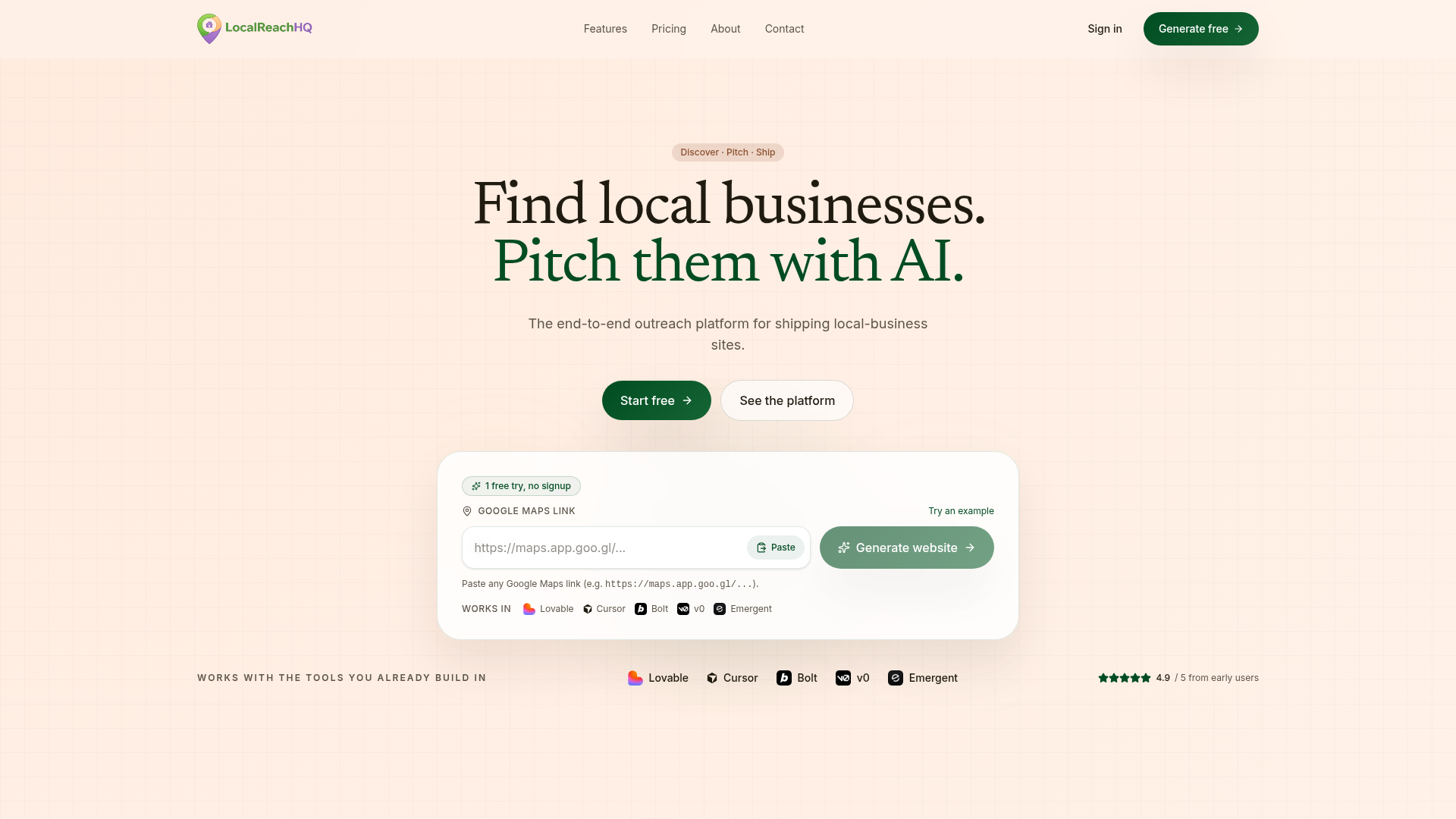
LocalReach
Discover local businesses without websites, pitch them with AI, and ship sites in one dashboard.
NewName Editorial
Editorial Team


LocalReach is not another AI writing tool. It's a bet that the entire local-business website outreach loop — discovery, qualification, pitching, and shipping — belongs in one dashboard. The pitch is simple: paste a Google Maps link, get a website build prompt. But the product's real insight is hiding in a single filter: 'No website.' That filter turns a generic outreach list into a high-intent list of businesses that demonstrably need what you're selling.
For freelancers and agencies selling websites to local businesses, the workflow has always been fragmented. You scroll Google Maps, copy-paste businesses into a spreadsheet, click each result to check if they have a site, rewrite the same cold email for every lead, and bounce between Notion, Gmail, and whatever AI builder you use. LocalReach's origin story, as told on its About page, is exactly this: a freelance designer stuck in five tabs to pitch one business. The product collapses that into a five-step loop: Discover, Save, Generate, Pitch, Ship.
The five-tab problem behind LocalReach
The problem LocalReach targets is not that local businesses need websites — that's obvious. The problem is that finding the ones that don't have a website is manual, tedious, and error-prone. The site's comparison table spells out the status quo: "Maps + spreadsheet" and "Generic CRM + GPT." With those tools, you can't filter by website status, you don't get live business signals, and your AI output isn't grounded in real lead data. LocalReach's answer is a single dashboard that runs the whole loop.
The company's About page frames this as a "bet": what if discovery, pitch, and ship were one tool? Google Places already knows which businesses lack websites, and AI can write the email, call script, and build prompt. There was no reason a single dashboard couldn't run the loop end-to-end. That bet is the product.
The 'no website' filter is the real product
The centerpiece of LocalReach's Discover engine is a filter that shows only businesses without a website. The site calls it "the only filter on Google Maps you've ever actually wanted." That's not hyperbole — it's the core value proposition. For an agency, a business with a 4.9 rating and no website is a prime prospect: they clearly have demand, they clearly lack a digital storefront, and they're likely losing business to lower-rated competitors who rank on Google.
The sample output in the AI Studio demonstrates this. For a fictional florist, Bloom & Basil Atelier in Savannah, GA, the generated cold email says: "I noticed two things: a near-perfect 4.9 rating and no website. That combination is unusual — most florists with that review profile are losing weekend bookings to the lower-rated shops that rank on Google." This is not a generic pitch; it's grounded in the lead's actual data — rating, category, location, and review themes. The filter makes this possible at scale.
One lead, three outputs: email, call, and build prompt
For each lead, LocalReach generates three outputs: a cold email, a cold-call script, and a website build prompt. The cold email is tailored to the lead's reviews — it might name a 3-star review or mention that customers keep talking about weddings. The cold-call script includes objection handling and prep tips. The build prompt is designed to be senior-grade, meaning it's detailed enough to produce a quality site in an AI builder.
The site's sample email for Bloom & Basil includes a five-point plan: a hero with a booking CTA, a wedding and events page, a workshops calendar, auto-pulled hours from Google, and email capture. It even mentions "Tuesday classes seem popular" based on review themes. This is the kind of personalization that would take an hour to write manually, and LocalReach does it in seconds.
Builder-agnostic shipping: a bet on the AI ecosystem
LocalReach doesn't build websites itself. Instead, it generates a build prompt that opens in one of five AI builders: Lovable, Bolt, Cursor, v0, and Emergent. This is a strategic choice. The company's About page states a principle: "Builder-agnostic forever. If your favorite AI builder ships tomorrow, your prompts shouldn't have to." This positions LocalReach as an intermediary that benefits from the ecosystem's growth rather than competing with it.
The risk is that build prompts are only as good as the builders they target. If a builder changes its interface or prompt format, LocalReach must adapt. But the bet is that the ecosystem will keep expanding, and LocalReach will be the go-to tool for generating prompts across all of them.
The pipeline: a lightweight CRM for outreach
The lead pipeline is a simple kanban board with stages: Pending, Contacted, Replied, Closed. You can rename stages to match your workflow. Every saved lead triggers a background research pass — review themes, neighborhood signals, recent activity. This is a lightweight CRM built specifically for outreach, not a general-purpose sales tool. It's enough to track where each lead is in the conversation, and it's integrated with the generation history.
The pipeline addresses a real pain point: keeping track of which businesses you've contacted, who replied, and who closed. Without it, you're back to spreadsheets and lost follow-ups. With it, the entire outreach loop lives in one place.
What LocalReach doesn't tell you yet
The site is refreshingly honest about being early. The testimonials section says: "The quotes below are placeholders — replace with real customer voices as they come in." That's a rare admission for a product page. It also doesn't disclose funding, team size, or specific customer counts. The pricing is simple: Free (10 outreach/month, 5 prompts/day, 5 leads/month), Starter ($19/month, 100 outreach, 40 prompts/day, 20 leads), and Pro ($49/month, unlimited).
The open questions are whether the AI output is genuinely unique per lead or just template-shaped with variable insertion. The site claims "Real data, never templates," but the sample email follows a recognizable pattern. The real test is whether the build prompts produce sites that don't look like every other AI-generated site. That's a risk the site acknowledges indirectly by emphasizing "senior-grade" prompts.
For now, LocalReach is a focused tool for a specific job: selling websites to local businesses. It's not trying to be a general CRM or a website builder. It's a workflow that collapses five tools into one, and its 'no website' filter is the killer feature. If you're a freelancer or agency pitching local businesses, it's worth a free try — just paste a Google Maps link and see what comes out.