Impact-Site-Verification: 41b53a0c-6d04-458b-a457-fe9e29acde1a

AI & Machine Learning··6 min read

Locke

An AI-native government affairs firm rebuilding the public-private partnership, with YC backing and a philosophical name.

NN

NewName Editorial

Editorial Team

Locke product image 1
Locke product image 2
Locke product image 3

Locke is not a lobbying firm with a chatbot bolted on. It is an "applied AI company" that has chosen government affairs as its first battlefield, and it is backed by Y Combinator. The pitch is audacious: use AI to rebuild the partnership between companies and the U.S. government, a relationship that Locke's founders argue has decayed into slowness and inaccessibility. If the thesis holds, Locke could make government affairs as systematic and data-driven as modern software sales. If it fails, it will be because the problem was never just information asymmetry, but trust and relationships—things AI has not yet learned to build.

The partnership has decayed — Locke's founding premise

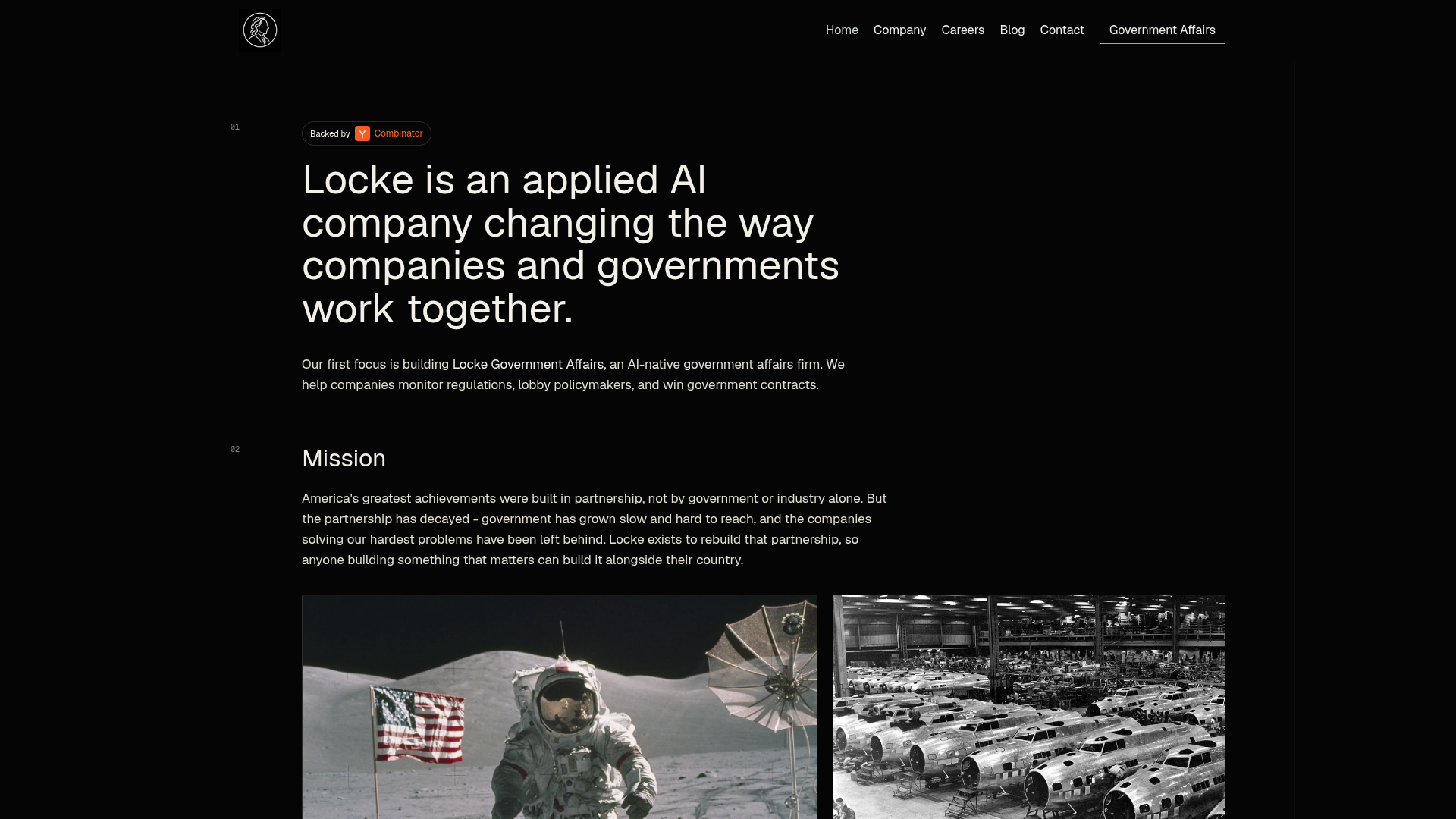
Locke's homepage opens with a stark claim: "America's greatest achievements were built in partnership, not by government or industry alone." It then walks through a gallery of examples—the Apollo Program, the Arsenal of Democracy, Operation Warp Speed, ARPANET, the CHIPS and Science Act, the Manhattan Project, the Interstate Highway System. Each is presented as a collaboration between public ambition and private execution. The implication is that this partnership has broken down. Government is "slow and hard to reach," and companies solving hard problems are "left behind." Locke's mission is to rebuild that bridge, and it believes AI is the tool to do it.

This is not a neutral observation; it is a founding narrative. The site frames Locke as existing to serve "anyone building something that matters" so they can "build it alongside their country." That language is deliberately inclusive—not just defense contractors or Fortune 500s, but startups and innovators who might otherwise never navigate the federal labyrinth. The thesis is that the barrier to government collaboration is not just regulatory complexity, but a kind of institutional friction that AI can reduce.

What an AI-native government affairs firm actually does

Locke's first product is "Locke Government Affairs," described as an "AI-native government affairs firm." The services are threefold: monitor regulations, lobby policymakers, and win government contracts. Each of these is traditionally a manual, relationship-driven, and information-heavy process. Monitoring regulations means tracking thousands of Federal Register notices, agency rules, and legislative amendments. Lobbying requires understanding the levers of influence on Capitol Hill and in agencies. Winning contracts involves navigating the sprawling world of federal procurement, from SAM.gov to agency-specific solicitations.

AI-native means that Locke is not just using AI as a copilot for human lobbyists; it is building the firm around AI from the ground up. The website does not disclose the exact mechanics—whether it uses large language models to analyze legislation, predictive algorithms to identify contract opportunities, or automated drafting of comments and position papers. But the claim is clear: Locke intends to do this work faster, cheaper, and at a scale that traditional firms cannot match. For a startup, this is a wedge into a market dominated by well-connected incumbents.

The mission slide: Apollo, Warp Speed, and the CHIPS Act

The homepage's mission section is not just decoration; it is a deliberate rhetorical strategy. By invoking Apollo, Warp Speed, and the CHIPS Act, Locke aligns itself with a patriotic tradition of public-private collaboration. The images are evocative: an astronaut on the moon, factory lines from World War II, a vaccine summit, early ARPANET equipment, President Biden signing the CHIPS Act, a Manhattan Project photo, and interstate construction. Each caption ties a national achievement to a partnership between government and industry.

This is a powerful narrative for a startup. It positions Locke not as a disruptor of government, but as a restorer of a golden age. It also subtly reframes the company's mission as patriotic—not merely commercial. For potential clients, this could be appealing: they are not just hiring a lobbying firm; they are joining a movement to rebuild America. The risk is that this narrative may feel grandiose for a company that has not yet proven its model. But for a startup aiming to attract top talent and early customers, the mission is a recruiting and sales tool in itself.

Why the name Locke carries philosophical weight

Choosing the name "Locke" is a bold move. It evokes John Locke, the Enlightenment philosopher whose ideas on government, property, and consent heavily influenced the American founding. The name suggests a philosophy of limited government, individual rights, and the social contract—all themes that resonate with a company seeking to improve the relationship between private enterprise and the state.

The name also carries a double meaning: "locke" as in "lock"—securing access, locking in contracts, or unlocking opportunities. The domain locke.inc is clean and memorable, with a modern feel that suits an AI company. The branding is minimal: a logomark, a simple wordmark, and a color palette that leans on dark tones and historical imagery. The site's design is polished, with a sense of gravitas that matches the mission.

However, the name also invites scrutiny. John Locke's philosophy is not without controversy, and some may question whether a company that profits from government relations should invoke a thinker associated with the separation of powers. Yet the name is likely to stick in the memory—a key advantage in a crowded market.

The Justinian connection and the YC signal

The footer of Locke's site reveals that the company is operated by "Justinian AI, Inc." and that it is "Backed by YCombinator." The Justinian name is another historical reference—to the Byzantine emperor who codified Roman law—suggesting a focus on legal and governmental systems. The YC backing is a strong signal of credibility and ambition. Y Combinator has backed many successful startups, but few in the government affairs space. This gives Locke an air of Silicon Valley disruption in a field traditionally dominated by K Street insiders.

The YC connection also suggests that Locke has access to a network of founders and investors who could become its first clients. Many startups face regulatory hurdles and could benefit from AI-driven government affairs services. Locke's positioning as an "applied AI company" rather than a pure lobbying firm may also help it attract engineering talent who want to work on meaningful problems.

What's missing: pricing, clients, and the open questions

Locke's website is notably sparse on operational details. There is no pricing page, no list of clients, no case studies, and no detailed explanation of how its AI works. The blog has a single post with the cryptic title "$10,000,000,000,000.00"—presumably referring to the U.S. national debt, but it is not explained. The contact page links to a Cal.com scheduling page for a "demo with Justinian," suggesting that the company is still in early stages and engaging with potential customers on a one-on-one basis.

This lack of transparency is typical for a startup in stealth or early launch, but it also raises questions. How does Locke's AI differ from existing legal research tools? What is the pricing model—retainer, success fee, or subscription? How does it handle the ethical and legal complexities of lobbying, which are heavily regulated? And crucially, can AI truly replicate the relationship-building that is at the heart of effective government affairs?

These open questions are not fatal, but they are important for anyone evaluating Locke. The company's ambition is clear, its mission is compelling, and its name is memorable. But the proof will be in the execution. If Locke can demonstrate that AI-native government affairs delivers measurable results—faster regulatory monitoring, more effective lobbying, more contract wins—it could redefine the industry. If not, it will remain a promising idea with a beautiful website.

For now, Locke is a startup to watch. It has the right backers, the right narrative, and the right name. The next step is to show that it can deliver on its promise.