Lumeto
AI-driven VR simulation for medical training, proven to boost skills and psychological safety.
NewName Editorial
Editorial Team
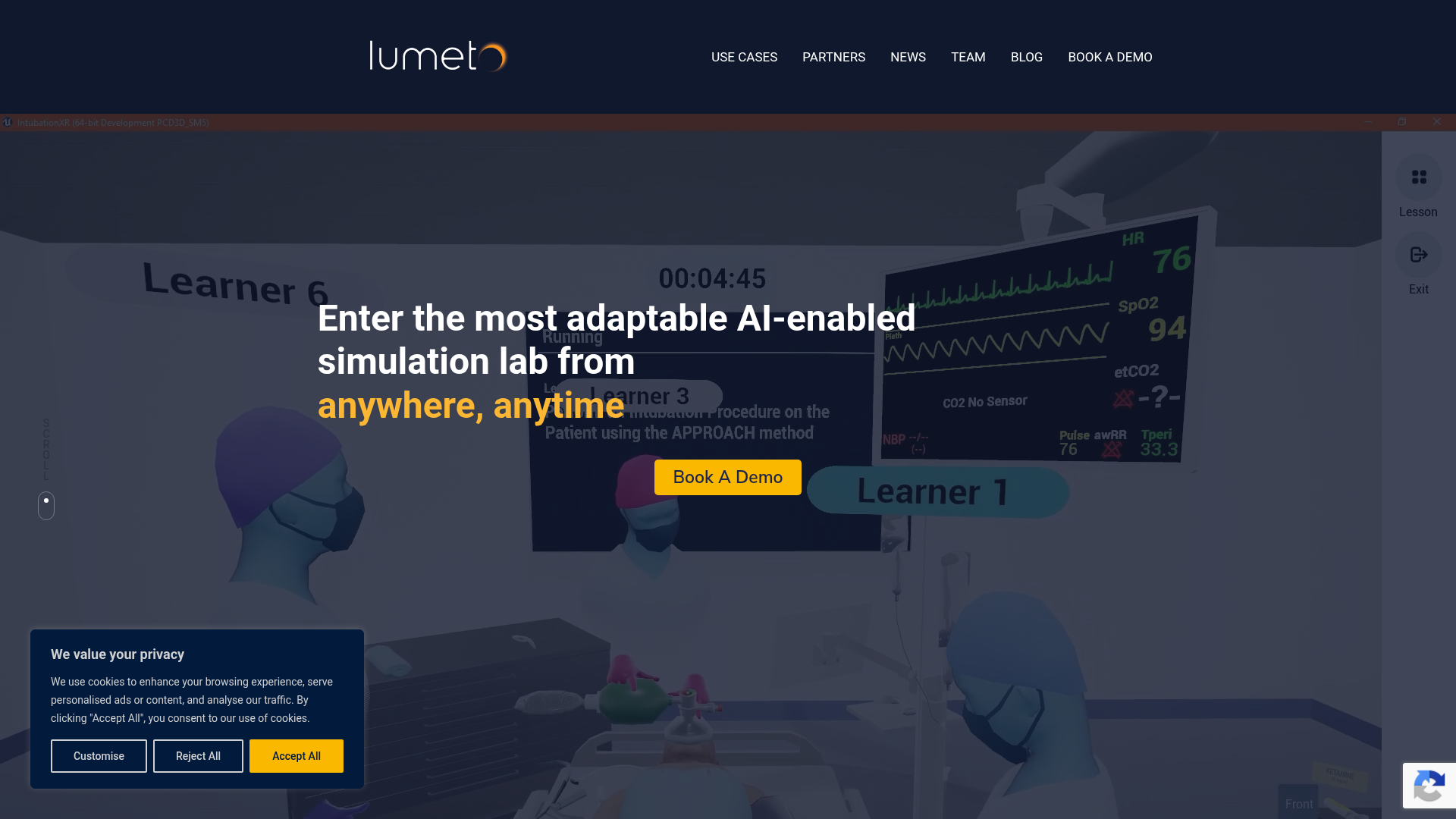

Medical simulation has long been a trade-off: either you invest in expensive, logistically heavy standardized patients (SPs) who can't be everywhere, or you settle for plastic mannequins that never flinch, never speak, and never make a mistake that feels real. Lumeto's InvolveXR platform is trying to break that trade-off by putting AI-driven virtual patients inside VR headsets, and it's backing the pitch with peer-reviewed data.
The company, which lists the Armed Forces among its target learner groups, isn't just selling another training video. It's selling a complete simulation lab that runs on a laptop and a headset, with AI characters that respond verbally and non-verbally, vitals that change on the fly, and an AI evaluator that grades performance. The core claim, supported by studies at Toronto Metropolitan University, the University of Manitoba, and a CHEST pilot, is that this approach doesn't just match traditional simulation—it surpasses it in some of the most important ways.
The VR Sim Lab That Lets Medics Fail Safely
The most striking finding in Lumeto's evidence comes from a 2025 study at the University of Manitoba with 240 nursing students. When asked to compare their experience with a standardized patient (SP) versus Lumeto's AI-VR simulation, students reported a dramatically different psychological environment. In the SP scenario, they felt peer pressure and performance anxiety; in VR, they felt safe to fail. They were more willing to ask difficult questions and felt the environment was judgment-free.
This is not a minor detail. Psychological safety is the foundation of effective learning, especially in high-stakes fields like medicine. If a trainee is afraid to make a mistake in front of an instructor or a peer, they'll hide their uncertainty, and the simulation loses its value. Lumeto's AI patients, by contrast, offer a private, repeatable space where learners can try, fail, and try again without social consequences. The study's authors note that while SPs still lead in emotional realism, VR is 'developing'—and for the specific goal of building confidence and encouraging open questioning, it appears to be stronger.
AI Patients That React Like Real People
The heart of InvolveXR is its customizable AI characters. These aren't pre-recorded loops; they're dynamic agents that can respond verbally and non-verbally in real time. A nurse educator at the University of Manitoba described how working with these AI patients evoked genuine emotional responses—joy at a breakthrough, sadness during a patient's distress. That kind of engagement is what makes the training stick.
Lumeto's platform allows instructors to tweak almost everything about a patient: their condition, vitals, dialogue, medications, and even the assessment checklist. This is a far cry from off-the-shelf simulation scenarios that force every class into the same mold. As Dr. Barry Smith of Queen's General Hospital in NYC put it, the ability to adapt scenarios to local practice is 'huge.'
The Data Behind the Immersion
Lumeto isn't shy about sharing its evidence. A 2024 study at Toronto Metropolitan University with 30 nursing students found high perceived learning (10.6 out of 12) and confidence (9.93 out of 12) after a single 50-minute VR session on respiratory distress management. A CHEST pilot with 39 participants showed relative knowledge gains in difficult airway management across all learner types, with residents improving by 26% after just 25 minutes of training.
These numbers are small, but they're a start. The company is careful to note that its simulations are 'validated through peer-reviewed research across multiple institutions,' and it offers to share the studies in full. For a category that often relies on anecdotal enthusiasm, this is a refreshingly concrete approach.
Customizing the Unpredictable
One of the platform's standout features is the ability to change a patient's vitals and states on the fly, mid-scenario. Tim Koboldt, MD, an emergency physician at the University of Missouri, explains why this matters: learners always do something unexpected, and instead of breaking immersion to guide them back to the script, an instructor can adapt the scenario in real time. This keeps the simulation challenging and responsive, mirroring the unpredictability of real clinical work.
This flexibility extends to the library of 500+ no-code Learning Experiences, created by clinicians for clinicians. Instructors can use them as-is or customize them in minutes, without needing a programmer. The emphasis on clinician authorship is a deliberate choice—it ensures the scenarios reflect real-world practice, not just technical possibilities.
From Civilian Hospitals to the Armed Forces
Lumeto's website lists 'Armed Forces' as a key use case, alongside nursing, medicine, interprofessional education, and mobile/remote healthcare workers. The company's involvement in defence is underscored by its TX-Ramp certification, a designation that signals readiness for military deployment. While the site doesn't disclose specific military contracts, the positioning is clear: VR training that works in a civilian hospital can also prepare medics for the chaos of the battlefield, where simulation centers are impractical and the stakes are even higher.
This dual-use strategy is smart. It broadens Lumeto's market beyond academia and hospitals, and it aligns with a growing interest in Canadian tech for defence applications. The company's leadership team, including CEO Raja Khanna and CTO Ben Unsworth, brings a mix of media and tech experience that suggests they understand both the product and the procurement landscape.
The ACE Evaluator: AI as a Teaching Assistant
No simulation is complete without assessment, and Lumeto's ACE (Artificial Clinical Evaluator) is designed to take on the educator's workload. ACE provides customized evaluations and debriefs, freeing up instructors to focus on teaching rather than grading. As Chris Martin, Director of Medical Education at Royal Victoria Regional Health Centre, notes, AI can remove the need for a facilitator altogether, allowing learners to practice on their own time while still receiving structured feedback.
This is where the platform's AI investment pays off beyond the patient interactions. ACE doesn't just track performance; it helps learners understand their mistakes and improve. For institutions facing faculty shortages, this could be a game-changer.
Lumeto's InvolveXR is still early, and the evidence base is growing rather than conclusive. But the direction is clear: VR simulation with AI patients isn't just a novelty—it's a practical tool that can make training more accessible, more flexible, and, crucially, psychologically safer. For medics who will one day treat real patients under fire, that kind of preparation is invaluable.