MadeThis
MadeThis: AI employees that build, market, and run your business—launch without hiring.
NewName Editorial
Editorial Team
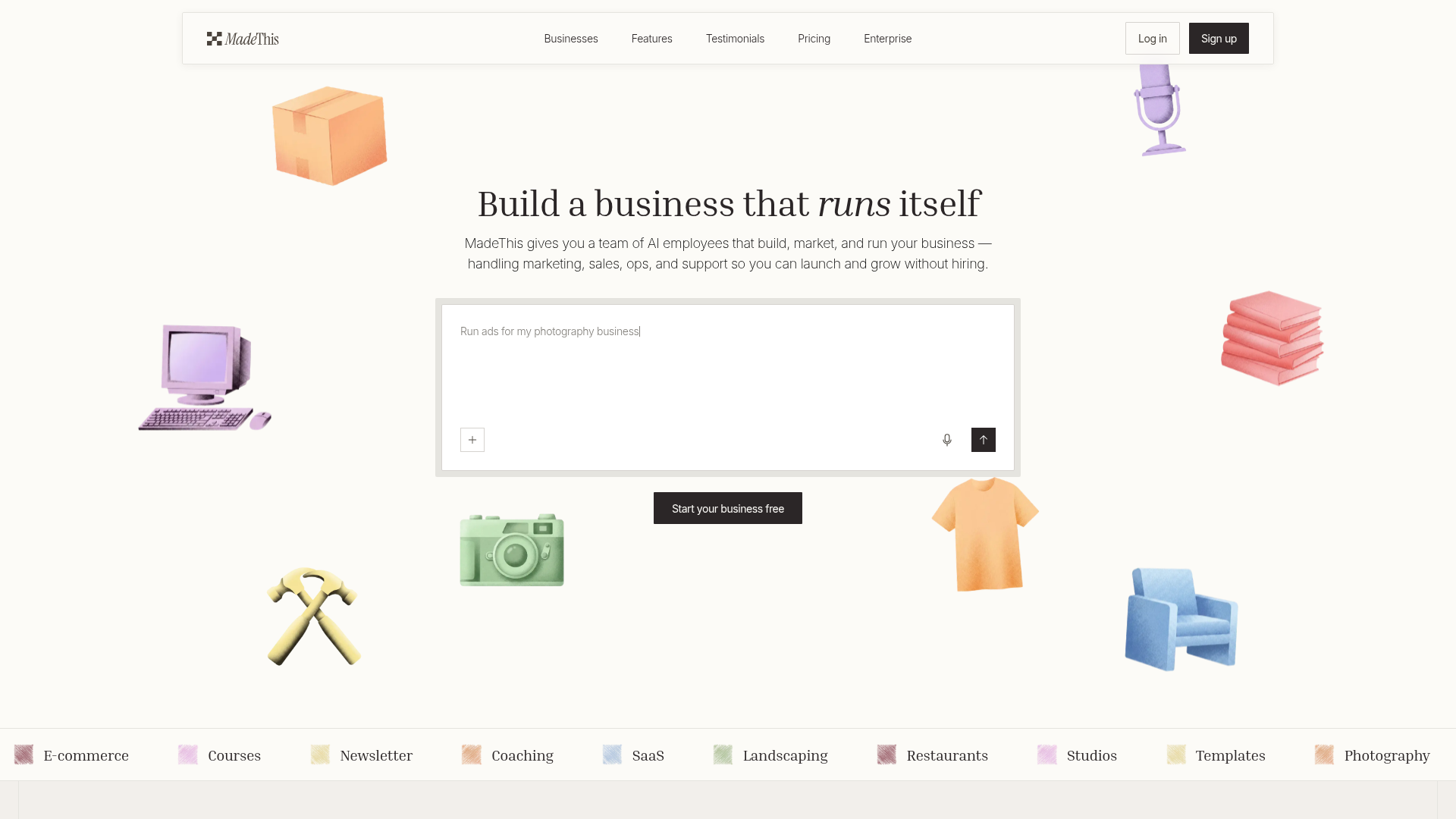

MadeThis is not another AI wrapper that writes blog posts or generates logos. It's a bet that a single platform can replace the entire early-stage team of a small business—the marketer, the salesperson, the operations manager, and the support rep—with a cohort of AI employees. The landing page doesn't mince words: "Build a business that runs itself." That's a promise most founders would kill for, and it's also the kind of claim that invites skepticism.
The AI Employee Stack
The core idea is that MadeThis gives you a "team of AI employees" that handle marketing, sales, ops, and support. This isn't a single chatbot; it's a stack of roles. The website lists specific functions: "handling marketing, sales, ops, and support so you can launch and grow without hiring." That's a bold scope. Most AI tools focus on one slice—say, ad copy or customer service. MadeThis is trying to be the whole org chart.
The examples on the landing page show the breadth: create a dropshipping business, a marketing agency, an online course, a SaaS product, a clothing brand, a photography business, a service business, or a furniture store. Each comes with a pre-filled prompt that outlines a multi-step plan. For instance, the dropshipping prompt asks MadeThis to "source 10–15 hero products from verified suppliers, build a clean storefront with checkout, set up abandoned-cart emails, and launch a starter Instagram + TikTok ad campaign to drive my first 50 orders." That's not a single task; it's a whole business plan.
From Prompt to Paying Customer
The workflow appears to start with a prompt. You type something like "Run ads for my photography busi" (the site's example, cut off mid-word), and MadeThis presumably takes it from there. The pre-filled prompts are detailed, suggesting the platform can handle complex, multi-step projects. For a photography business, it would "build a portfolio website with online booking, set up an inquiry-to-contract email flow, package services into three tiers, and run a local SEO and Instagram strategy to book my first 10 clients this quarter."
That's a lot of moving parts. The question is whether MadeThis actually executes all of these, or whether it generates a plan that you then have to execute yourself. The marketing language says "build, market, and run your business," which implies ongoing operation, not just setup. But the evidence is thin on the specifics of how the AI employees work together, how they hand off tasks, and what happens when something goes wrong.
The Self-Driving Promise vs. The Human Reality
Here's the tension: "self-driving" suggests you can set it and forget it. But any business owner knows that even with great automation, things break. A supplier misses a shipment, an ad gets disapproved, a customer has a complex issue. The website doesn't address what happens in those moments. Does the AI employee escalate to a human? Can you intervene mid-flow? The public materials don't say.
This is the classic AI overpromise. The examples are all greenfield scenarios—launching a new business. They don't cover the messy middle: what happens when you have 50 orders and a product is out of stock, or when a client wants to cancel a retainer. MadeThis might handle those, but the site doesn't show it. The risk is that the "self-driving" part works only for the first mile, and then you're back to manual.
The Naming Trap
The name "MadeThis" is a double-edged sword. On one hand, it's short, memorable, and action-oriented—"I made this." It positions the user as the creator, with the platform as the tool. That's smart. On the other hand, it's generic. "This" could be anything. The name doesn't hint at AI, automation, or business operations. It could be a craft marketplace or a portfolio builder. The tagline "Build a business that runs itself" does the heavy lifting, but the name alone doesn't signal the category.
The domain, madethis.com, is clean and brandable. That's a plus. But the name's ambiguity might confuse potential users who stumble upon it without the tagline. In a crowded market of AI business tools, a more descriptive name might help, but MadeThis bets on memorability over clarity.
Who Should Care (and Who Shouldn't)
MadeThis is aimed at people who want to start a business but don't have the time or skills to build a website, write marketing copy, or set up sales funnels. That's a huge audience: side-hustlers, solopreneurs, and the curious. The pre-filled prompts are tailored to common business types, so you don't need to know what you're doing. You just pick a template and go.
But if you're an experienced operator, MadeThis might feel too prescriptive. The prompts are detailed, but they're also generic. A seasoned marketer won't need MadeThis to "package services into three tiers." The value is for beginners who need a starting point, not for experts who want control.
Tags