makers.page
A free directory plus a coding-agent MCP that turns listings into a repeatable launch loop.
NewName Editorial
Editorial Team
The indie product directory is a crowded graveyard. Hundreds of sites promise visibility, deliver a few pageviews, and then sit forgotten. makers.page is trying something different: it treats the listing not as the end of a launch, but as the entry point into an automated marketing loop — one that runs inside the coding agent you already use.
The pitch is simple: list your product for free, get a public indexed page and a dofollow backlink, then connect the hosted Marketing MCP to Cursor, Claude Code, or any MCP-compatible agent. From there, the agent can find relevant conversations, draft posts in your voice, and publish to X — with your approval at every step. It is a directory that wants to be a growth engine, and that ambition shapes everything about the product.
The directory that does not stop at a listing
Most directories are static. You submit, you wait, you maybe get a backlink. makers.page's directory is built to be the first step in a longer relationship. Every approved product gets a public page, a dofollow link, and inclusion in the site's sitemap — the standard SEO tokens. But the page is also the hook for the Marketing MCP. The site's own copy frames it as "List once. Get discovered. Grow from there."
The directory itself is free, with no credit card required to submit. That is a deliberate choice: the moat is not the listing fee, but the automation layer that connects to the listing. The example listing on the homepage ("Acme Analytics") shows what a page looks like, and the "Open slot" placeholder invites the next product in. It is a subtle but effective way to communicate that the directory is alive and actively curated.
The Marketing MCP: your coding agent as a growth engine
The real differentiator is the Marketing MCP. MCP, or Model Context Protocol, is the emerging standard that lets AI agents interact with external tools. makers.page hosts one that plugs directly into coding agents like Cursor, Claude Code, Codex, Windsurf, and Copilot. Instead of switching to a separate marketing dashboard, you stay in your editor and let the agent handle the marketing legwork.
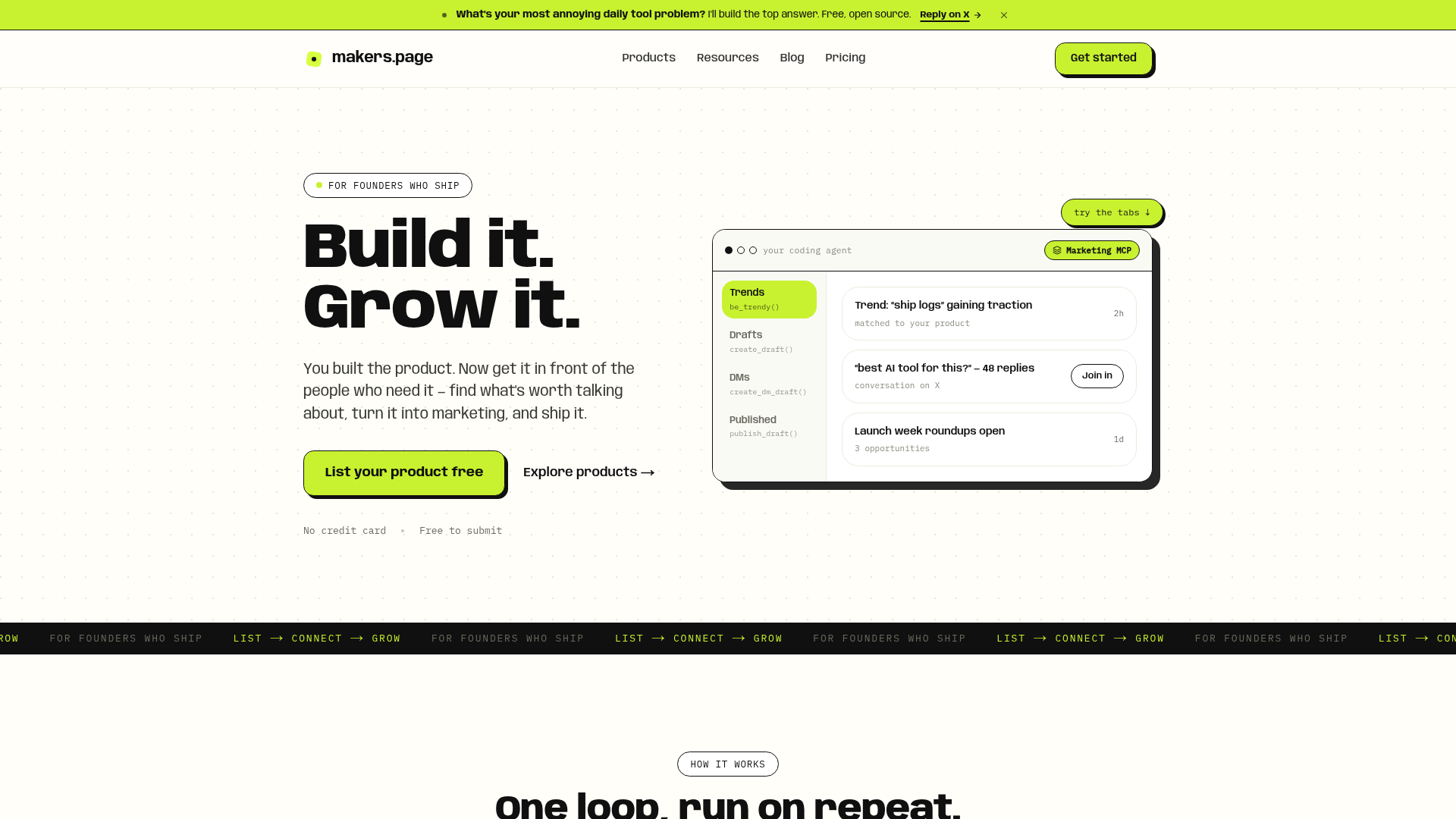
What does it actually do? The site lists four functions: be_trendy() to spot trends, create_draft() to write posts, create_dm_draft() to draft DMs, and publish_draft() to ship to X. The workflow is framed as a loop: find something worth talking about, draft it in your voice, and ship it. The agent surfaces conversations and trends where your product fits, drafts posts and threads, and even prepares DMs for your review. Nothing goes out without your approval — a critical safeguard for a tool that could otherwise spam your feed.
The MCP is hosted, meaning you do not need to set up your own infrastructure. It is also free to self-host, with no paid tier mentioned. That is a bold move: the company is betting on adoption and ecosystem lock-in rather than direct monetization.
The loop: find, draft, ship — and the human in the middle
The core insight is that marketing for indie products is not a one-time launch event; it is a continuous process of finding conversations, drafting responses, and publishing. makers.page tries to automate the first two steps and make the third a one-click approval.
The homepage illustrates this with a mock interface: a trend card ("ship logs" gaining traction), a conversation on X ("best AI tool for this?" — 48 replies), and a draft ready for review. The agent is not just generating content; it is finding the moments where your product is relevant. That is the hard part of indie marketing, and it is what most tools miss.
But the human remains in the loop. The emphasis on approval is not just a safety feature; it is a positioning choice. The site's copy says "Draft it, in your voice" and "You approve everything before it goes out." This addresses the trust problem that plagues AI-generated content: the fear of sounding robotic or off-brand. By keeping the founder as the final editor, makers.page positions itself as an assistant, not an autopilot.
What 'free' really means: backlinks, sitemaps, and the attention economy
For a product that is free, makers.page has to create value somewhere. The directory offers three concrete SEO benefits: a public indexed page, a dofollow backlink, and sitemap inclusion. For a new indie product, these are tangible assets that can help with discoverability on Google and other search engines.
The site also lists a long row of badges from other directories — AI Launch, Peerlist, BetterLaunch, Nick Launches, and dozens more. This is a meta-signal: makers.page is itself a product that has been launched on many directories, and it is using those badges as social proof. It is a clever way to show that the founders understand the launch ecosystem because they are active participants in it.
But the real value proposition is the MCP. The directory is the bait; the automation is the hook. By connecting the two, makers.page avoids the fate of most directories, which become ghost towns after the initial launch buzz fades.
Naming and positioning: 'makers.page' as a promise and a constraint
The name "makers.page" is both a promise and a constraint. It signals a focus on makers — indie hackers, founders, product builders — and it uses the .page TLD to evoke the idea of a simple, clean web page. The name is memorable and descriptive, but it also locks the product into a narrow identity: it is a page for makers, not a platform for enterprises.
The domain makers.page is short and brandable, though the .page TLD is less common than .com or .io. It may raise questions about legitimacy for some users, but for the indie audience, it reinforces the hacker aesthetic. The name also creates a natural extension: each product gets its own page on makers.page, which aligns with the directory concept.
The tagline, "List indie products free and automate your product launch," is functional but a bit long. It does, however, clearly communicate the two-part value proposition: listing and automation. The brand voice throughout the site is direct and founder-focused — "You built it. Now grow it." — which resonates with the target audience.
The risk: automation fatigue and the trust tax
The biggest risk for makers.page is that automated marketing becomes noise. If every indie product uses the same MCP to find trends and draft posts, the X timeline could become a sea of similar-sounding AI-generated content. The approval step helps, but it does not guarantee originality.
There is also a trust tax. Users must trust that the MCP will not publish something embarrassing or off-brand. The site's emphasis on approval is reassuring, but it also means the founder still has to do the final work, which may limit the time savings.
Finally, the free model raises questions about sustainability. The site does not disclose a paid tier or a business model beyond the free listing and MCP. If the service grows, will it introduce paid features? The lack of clarity could be a concern for long-term users.
Despite these risks, makers.page is a thoughtful experiment in combining directories with automation. It recognizes that the indie product launch is not a one-time event but a continuous loop, and it puts the coding agent at the center of that loop. For founders who already live in Cursor or Claude Code, it might be the most natural way to handle marketing yet.