Marble
Marble: The AI-native operating system that runs restaurant back-of-house on autopilot.
NewName Editorial
Editorial Team
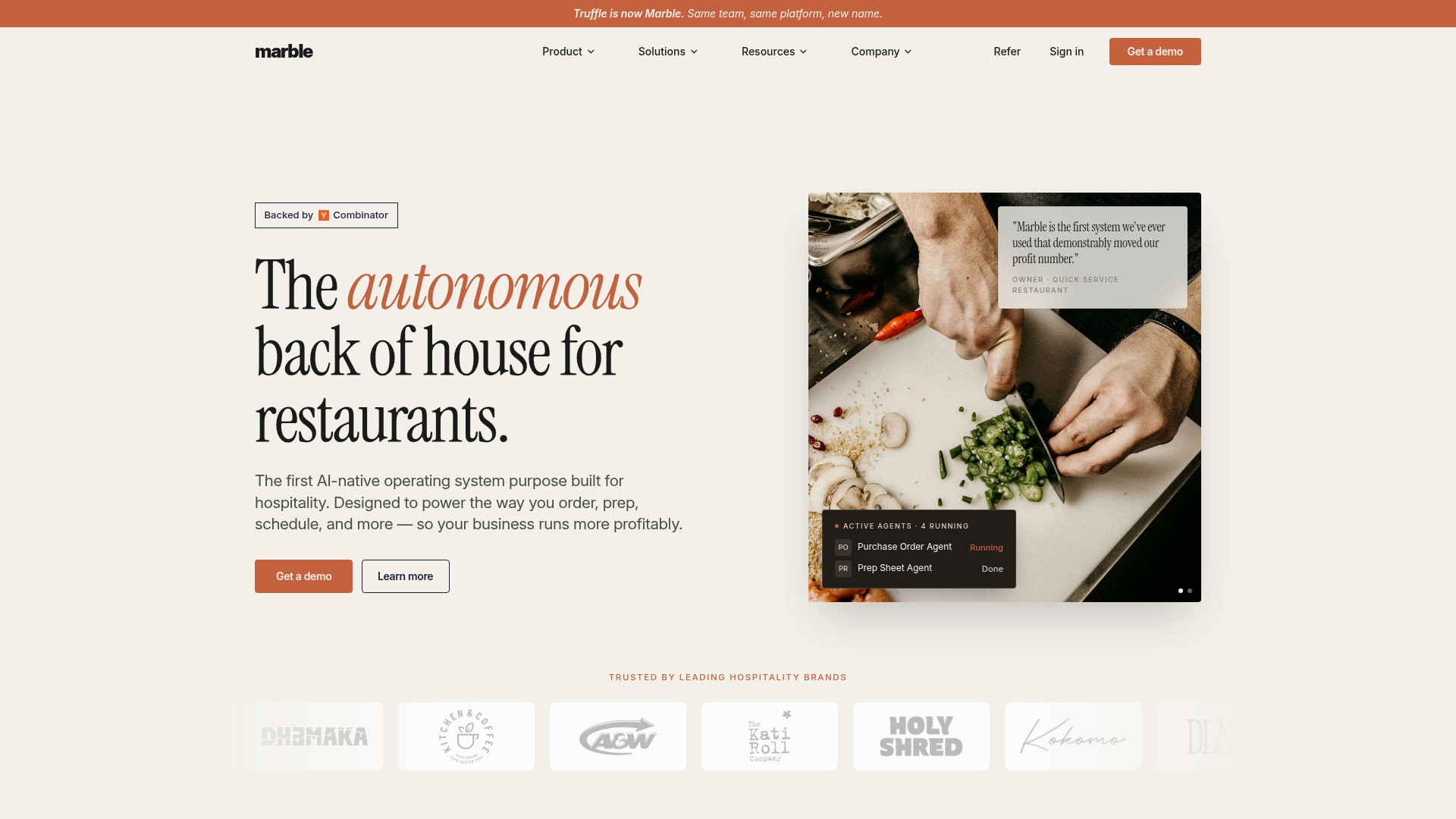


The restaurant industry has long been a laggard in technology adoption, but a new wave of AI-native tools is finally addressing the operational chaos that defines the back-of-house. Marble, formerly known as Truffle, is positioning itself as the first AI-native operating system for hospitality, promising to automate inventory counting, prep sheets, purchase orders, and labor management. The pitch is bold: instead of managers spending hours on manual counts and spreadsheets, Marble's computer vision and voice AI can count inventory in minutes, and a suite of AI agents can run the back-of-house on autopilot. This isn't just a feature upgrade; it's a fundamental shift in how restaurants manage their operations.
The back-of-house is the last manual frontier in restaurants
While front-of-house operations have been transformed by POS systems, online ordering, and delivery apps, the back-of-house remains stubbornly analog. Inventory counts are often done by hand, with clipboards and spreadsheets, and labor scheduling is a manual juggling act. This is where Marble focuses its efforts. The company's website emphasizes that it's "designed to power the way you order, prep, schedule, and more — so your business runs more profitably." The back-of-house is where margins are made or lost, and Marble is betting that AI can bring the same efficiency gains that software brought to other industries.
From Truffle to Marble: a name that signals autonomy
Marble's rebrand from Truffle is a strategic move. Truffle, a luxury ingredient, suggested sophistication but also a certain delicacy. Marble, on the other hand, evokes solidity, durability, and a certain permanence. It also hints at the autonomous nature of the product: a marble is a smooth, self-contained object that rolls on its own. The name change aligns with the company's pivot from a simple inventory tool to an autonomous back-of-house platform. The website states, "Truffle is now Marble. Same team, same platform, new name." This signals a maturation of the product and a clearer vision for its role in the restaurant ecosystem. The domain, joinmarble.ai, reinforces the AI-native identity, a smart choice for a company that wants to be at the forefront of the AI revolution in hospitality.
How Marble's AI agents actually sit inside the kitchen workflow
Marble's platform is built around a collection of AI agents that handle specific tasks. The website shows active agents like the "Purchase Order Agent" and the "Prep Sheet Agent," both marked as running or done. This suggests a modular approach where operators can activate different agents as needed. For example, the Purchase Order Agent might automatically generate purchase orders based on inventory levels and usage patterns, while the Prep Sheet Agent creates daily prep lists based on expected demand. These agents are not just passive tools; they actively execute tasks, reducing the cognitive load on managers.
The computer vision and voice AI that make inventory painless
At the core of Marble's offering is its ability to count inventory in minutes using computer vision and voice AI. Instead of manually entering counts, a manager can point a camera at a shelf or use voice commands to update quantities. This is a significant time saver, as inventory counts are typically a tedious, error-prone process. The use of voice AI also allows for hands-free operation, which is crucial in a busy kitchen environment. While the website doesn't provide specific accuracy metrics, the claim that it can count inventory "in minutes" suggests a dramatic improvement over traditional methods.
What Marble automates that spreadsheets and POS systems cannot
Spreadsheets and POS systems are reactive tools; they record data but don't act on it. Marble's AI agents are proactive. They can analyze historical data to forecast demand, optimize labor schedules, and even suggest order quantities. This moves beyond simple automation to true intelligence. The website's tagline, "The autonomous back-of-house for restaurants," underscores this ambition. Marble is not just digitizing existing processes; it's replacing them with autonomous systems that learn and adapt.
The trust question: Can operators hand over the back-of-house to AI?
Despite the promise, there are legitimate concerns. Restaurant operators are often skeptical of new technology, especially when it comes to critical tasks like inventory and labor. Marble's website includes a testimonial from an owner who says, "Marble is the first system we've ever used that demonstrably moved our profit number." This is a powerful endorsement, but it's just one data point. The company will need to prove that its AI agents can handle the variability and unpredictability of restaurant operations. Trust is built over time, and Marble will need to deliver consistent results to win over the industry.
Who should care about Marble's autonomous approach
Marble is targeting a wide range of hospitality businesses, from quick-service restaurants to full-service establishments. The website lists customers like A&W Restaurants, The Original Pancake House, and Ess-a-Bagel, indicating a mix of national chains and independent operators. For multi-unit operators, the ability to standardize back-of-house processes across locations is a major value proposition. For independent owners, the time savings and potential for increased profitability are compelling. As AI becomes more prevalent in the industry, Marble is positioning itself as a leader in the autonomous back-of-house space, and it's a space worth watching.