Impact-Site-Verification: 41b53a0c-6d04-458b-a457-fe9e29acde1a

SaaS & Productivity··5 min read

MeltsWell

MeltsWell: Where small sweet businesses get found and take orders directly.

NN

NewName Editorial

Editorial Team

MeltsWell product image 1
MeltsWell product image 2

The sweetest part of any city is rarely on a menu. It's the neighbor who bakes cinnamon rolls that sell out by noon, the friend-of-a-friend who makes jars of jam you dream about, the home baker whose cookies have a waiting list but no storefront. MeltsWell is a directory built entirely for these invisible makers — and it's making a quiet bet that the future of local food discovery isn't a delivery app, but a leaderboard.

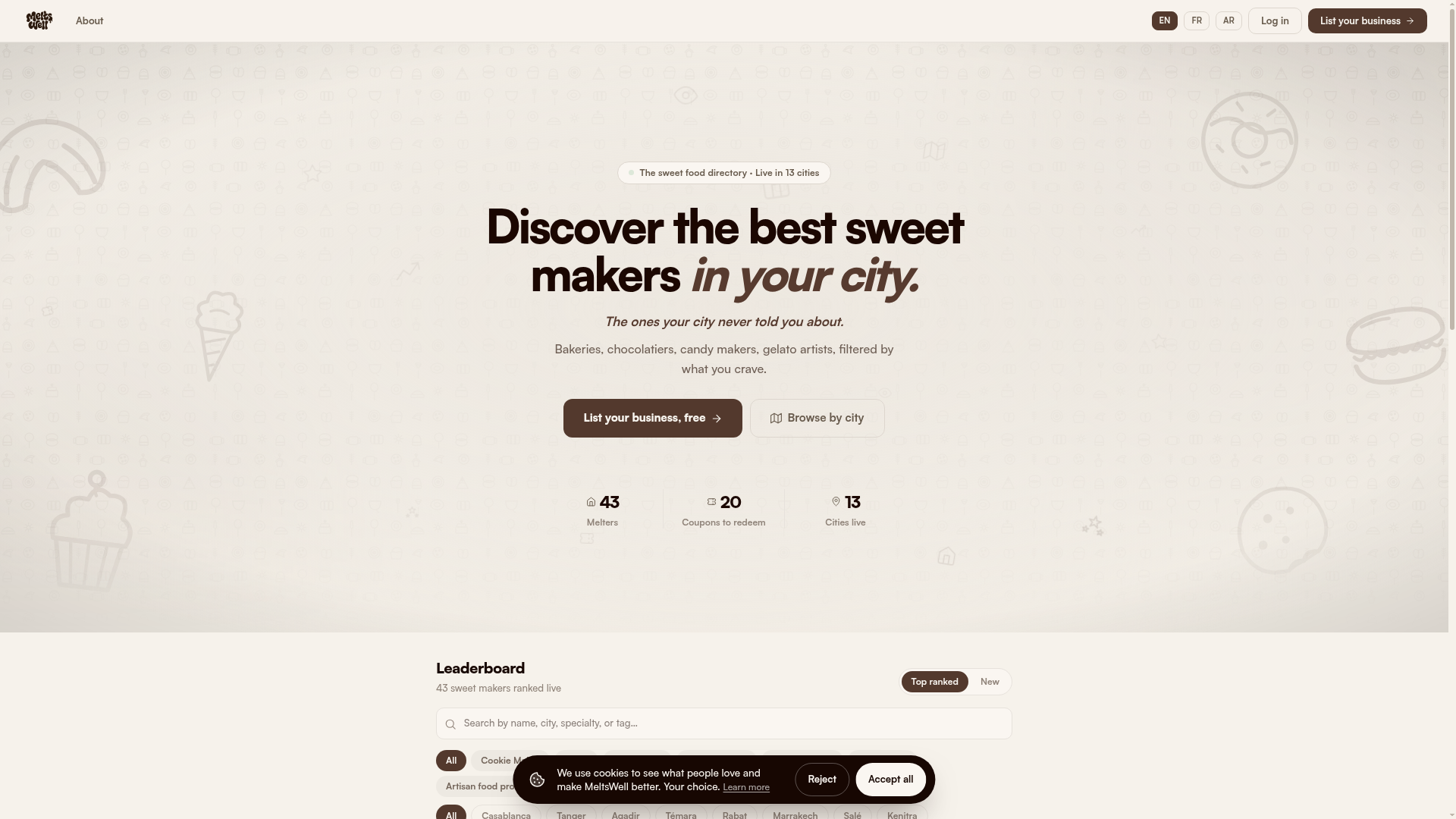
Launched in Morocco with 43 "Melters" listed across 13 cities, MeltsWell is part directory, part social proof engine, and part rebellion against the commission economy. It's early, it's small, and it's deliberately free. But the design choices it's making — from its public ranking to its direct-order model — reveal a clear thesis about how small sweet businesses should be found.

The invisible bakery next door

MeltsWell's origin story, told by founder Badr on the About page, is refreshingly honest: he loves sweets, can't bake, and started the project after a friend suggested building a restaurant directory. But restaurants already have the spotlight, Badr realized. The real gap was home-based sweet makers — people with talent and a kitchen but no marketing budget and no storefront.

That gap is real. In Morocco, and everywhere else, home bakers rely on Instagram hashtags, WhatsApp statuses, and word-of-mouth to find customers. Discovery is fragmented, trust is fragile, and there's no central place to compare options. MeltsWell's answer is a vertical directory: bakers, chocolatiers, cake designers, cookie studios, jam makers, and candy makers each get a page — no tech skills required, no website to build.

The site's own copy puts it plainly: "Today, finding a home baker means scrolling Instagram for an hour, waiting for an ad, and hoping you can trust the seller. MeltsWell is the opposite." It's a strong positioning statement, and the product seems built to back it up.

The leaderboard as a discovery engine

The most distinctive feature on MeltsWell's homepage is the public leaderboard. 43 sweet makers are ranked live, with filters for city and category — Cookie Maker, Baker, Pastry Chef, Dessert Maker, Cake Designer, Chocolatier, and more. It's a gamified approach to discovery: instead of an alphabetical list, makers compete for the top spot, and buyers get a curated sense of who's worth trying.

Rankings are inherently subjective, and MeltsWell's methodology isn't spelled out on the homepage. But the leaderboard serves two clear purposes. For buyers, it reduces choice paralysis — you can see at a glance who's popular in your city. For makers, it creates a tangible incentive to be listed and to improve their page, because visibility on the leaderboard directly correlates with orders.

The leaderboard also reinforces the local focus. With 13 cities live — Casablanca, Tanger, Agadir, Témara, Rabat, Marrakech, Salé, Kenitra, and others — MeltsWell is betting that sweet discovery is inherently local. You don't want a cinnamon roll shipped across the country; you want one from the baker down the street. The city filter makes that explicit.

No commission, no website: the direct-order bet

MeltsWell's most radical choice is its business model: no commission on sales. Instead, buyers are directed to contact makers directly via WhatsApp, Instagram, or TikTok. This is a deliberate departure from food delivery platforms that take a cut of every order.

The logic is simple: small sweet businesses operate on thin margins. A commission-based model would eat into their profits and make the platform less attractive. By charging nothing, MeltsWell removes the biggest barrier to adoption — and builds trust with makers who've been burned by platforms before.

But this model raises a question: how does MeltsWell make money? The site doesn't disclose revenue plans, and the founder's story mentions a "big free tier" launched on purpose, with the goal of getting real makers using it and providing feedback. It's a classic build-first, monetize-later approach, and it's not without risk. Without a revenue stream, MeltsWell will need to find a way to sustain itself — perhaps through premium listings, featured spots on the leaderboard, or advertising.

For now, the no-commission model is a powerful differentiator. It positions MeltsWell as a champion of the small maker, not another middleman taking a cut. And by pushing orders to WhatsApp or Instagram, it meets makers where they already are — no need to learn a new ordering system or manage a separate inbox.

A name that melts in your mouth

The name MeltsWell is a clever piece of branding. It evokes the sensory experience of sweets — melting in your mouth — while also suggesting that the platform helps makers "melt well" into the market. It's memorable, category-specific, and has a warm, approachable feel that fits the target audience.

The domain, meltswell.com, is clean and brandable. It's not a keyword-stuffed URL, but it doesn't need to be — the name itself is the hook. The term "Melters" for the makers is a nice touch, creating a sense of community and identity. It's the kind of naming that makes users feel like they're part of something, not just using a tool.

There's a slight risk that the name could be confused with a chocolate brand or a wellness product, but in context, it works. It's distinctive enough to stand out in a crowded market, and it's easy to remember — which is half the battle in local discovery.

What's missing and what's next

MeltsWell is clearly in its early days. The leaderboard shows 43 makers, and the blog posts — which are in French — suggest a focus on the Moroccan market. The site is bilingual (English and French), which is a smart move for a country with both official languages, but it also hints at a broader ambition.

The founder's story mentions that the goal is "bigger than one country: a place where any small sweet business, anywhere, can show what they make and get a real shot." That's an ambitious vision, and the infrastructure seems scalable — a directory with city filters could easily expand to other countries.

But there are open questions. How will MeltsWell handle trust and quality? The blog posts mention ratings and reviews, but the leaderboard ranking criteria aren't transparent. Will there be a verification process for makers? And most importantly, how will the platform monetize without alienating its user base?

For now, MeltsWell is a promising experiment in vertical discovery. It's not trying to be the next Amazon or the next Uber Eats — it's trying to be the place where the best home baker in your city finally gets found. If it can maintain its no-commission stance and build trust with both makers and buyers, it might just succeed. And if it does, the sweetest part of your city might finally have a home on the internet.