MentalHappy
Demand-driven support groups: request, upvote, and join expert-led circles that actually fill.
NewName Editorial
Editorial Team
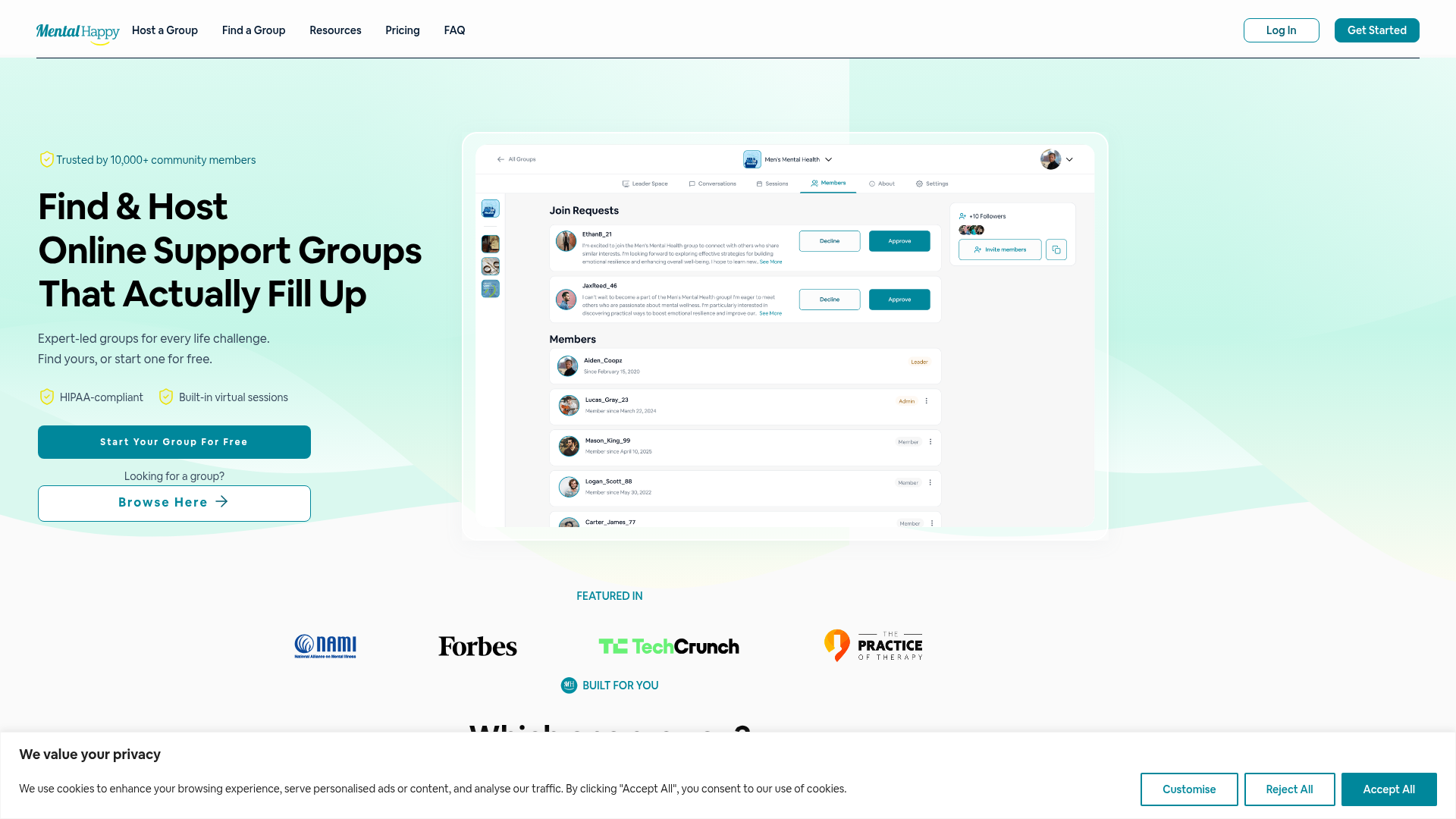
The mental health support market has a structural failure that no amount of therapy apps or meditation subscriptions has solved: the people who need peer support most are often the ones who cannot find a group that fits their specific condition, schedule, or cultural context. Generic wellness content scales, but specific, expert-led support groups do not. MentalHappy, a Y Combinator-backed startup, is attacking this void by inverting the traditional marketplace model. Instead of waiting for supply to appear and then hoping demand follows, MentalHappy aggregates demand first—users request a group, others upvote it, and only then does a leader step in to launch it. This demand-first mechanism is the core of its thesis: build the audience before the group exists, and the group will fill itself.
The Demand-Side Void in Mental Health Support
The mental health landscape is bifurcated. At one end, there is one-on-one therapy, which is expensive, scarce, and often inaccessible. At the other, there are anonymous forums like Reddit or Facebook Groups, which are free but unstructured, unmoderated, and clinically risky. In between lies a massive, underserved middle: structured, expert-led support groups that meet regularly and provide a safe, consistent container for shared experiences. This middle is not new—organizations like NAMI have run peer support groups for decades—but they are typically local, limited in scope, and hard to discover online. The result is a fragmented patchwork of Meetup listings, Facebook groups, and hospital-affiliated programs that rarely scale beyond a single community.
The economic inefficiency is clear: demand for niche support (e.g., "adult children of narcissists," "postpartum anxiety for working moms," "LGBTQ+ chronic illness") is distributed across the country, but supply is hyperlocal. A therapist in Austin might want to run a group on grief, but cannot find enough local members to make it viable. Meanwhile, a woman in rural Ohio with the same need cannot find any group within 100 miles. MentalHappy's insight is that the internet removes the geographic constraint, but only if the platform can aggregate enough demand to make a group viable. Its request-and-upvote mechanic is a low-friction way to test demand before a leader commits time and energy.
How MentalHappy Inverts the Marketplace Funnel
Most marketplaces (think Airbnb, Uber, or even Meetup) start with supply: hosts list rooms, drivers sign up, organizers create events. Demand is then expected to follow, often through expensive marketing or network effects. MentalHappy flips this. A user who cannot find a group for their specific need can create a request. Other users with the same need upvote it. The platform tracks these votes as a signal of proven demand. When a leader sees a request with enough upvotes, they can decide to launch a group, knowing there is already an audience waiting. The platform then pings all the requesters the moment the group goes live.
This mechanism is not just a nice UX feature; it is a demand-generation engine. It solves the chicken-and-egg problem that kills most marketplace startups. Instead of a leader creating a group and then struggling to fill it, the group is born with a built-in waitlist. The website explicitly markets this: "List your group as 'Group Listing' and let members follow it for launch updates. You gauge interest before you commit to a schedule." This is a pre-sales pipeline for support groups. The AI component, though not deeply documented, is positioned as a matchmaker—presumably to recommend groups to users based on their stated needs and to help leaders identify demand clusters. The result is a platform where the act of finding a group and the act of starting a group are two sides of the same demand coin.
The Supply Problem: Recruiting and Retaining Group Leaders
The biggest operational challenge for MentalHappy is not demand aggregation—it is supply. Who leads these groups? The platform targets "expert-led" groups, which implies licensed therapists, counselors, or trained peer specialists. This is a deliberate trust signal, but it creates a supply bottleneck. Therapists are busy, often fully booked, and may not see group facilitation as a lucrative use of their time. MentalHappy's value proposition to them is twofold: first, it acts as a demand engine, filling groups without the leader having to market themselves; second, it provides the infrastructure—scheduling, payments, HIPAA-compliant video sessions—so the leader can focus on the clinical work.
Testimonials on the site reinforce this. One licensed professional from Arizona says, "I launched my first group and had members joining within days, without any marketing on my end." A relationship therapist from Texas adds that she does not have capacity for new one-on-one clients, but running groups is a scalable way to serve more people. This suggests MentalHappy is positioning itself as a practice-expansion tool for therapists, not just a support group directory. The free tier for leaders is a classic marketplace subsidy: reduce friction for supply, let the demand engine do the work, and then monetize through premium features or transaction fees. The risk is that the platform becomes a lead-generation tool for therapists who then take their groups off-platform, but the built-in infrastructure (HIPAA compliance, video, payments) creates a switching cost.
Why Meetup and Facebook Groups Can't Fix the Trust Gap
Meetup has the scale and the local focus, but it is a general-purpose events platform. It lacks the clinical guardrails, the expert-led positioning, and the demand-aggregation mechanic. A Meetup group for "anxiety support" might be led by anyone—a well-meaning amateur, a life coach, or worse. There is no vetting, no HIPAA compliance, and no structured payment model. Facebook Groups are even more chaotic: they are free, but they are also unmoderated, prone to misinformation, and offer no privacy guarantees. For a person in a vulnerable state, the risk of joining a Facebook group is not just uselessness—it is active harm.
MentalHappy's wedge is trust. By requiring leaders to apply (the "Start a Group" flow includes an application), by offering HIPAA-compliant sessions, and by curating groups around expert-led facilitation, it creates a safe harbor that the general-purpose platforms cannot replicate. This is also its defense against big tech. Facebook could copy the feature, but it cannot easily copy the trust infrastructure or the clinical credibility. The same applies to telehealth giants like BetterHelp or Talkspace, which focus on one-on-one therapy and have no peer group model. MentalHappy is not competing with them for the same dollar; it is creating a new category between clinical care and social networking.
The Business Model: Free Tiers, Paid Hosting, and Enterprise Ambitions
Public materials do not disclose detailed pricing, but the website mentions a free tier for both members and leaders. The likely model is freemium: members can join free groups, while leaders pay for premium features (advanced analytics, custom branding, or lower transaction fees). The site also has a page for "Health Organizations," suggesting an enterprise sales motion. Hospitals, clinics, and non-profits could use MentalHappy to launch and manage support groups for their patients or communities, paying a per-group or per-member fee. This B2B2C angle is smart because it leverages existing clinical relationships and provides a predictable revenue stream, unlike consumer subscriptions which are hard to sustain in mental health.
The go-to-market motion is two-sided: on the demand side, it relies on organic search (people searching for "support group for [condition]") and word-of-mouth; on the supply side, it targets therapists and counselors through content marketing and testimonials. The Y Combinator backing provides credibility and a network of advisors. The unit economics are favorable if the platform can keep acquisition costs low—demand aggregation is inherently cheap because users self-select based on their needs. The challenge is monetization: if most groups are free, where does the revenue come from? The answer likely lies in the enterprise tier and in premium leader tools, but this is still unproven.
The Scalability Ceiling: Clinical Risk and Network Effects
MentalHappy's biggest risk is clinical liability. If a group leader is not properly vetted, or if a member experiences harm during a session, the platform could face legal and reputational damage. HIPAA compliance is a start, but it does not cover all peer support scenarios. The company must invest in leader training, moderation tools, and crisis protocols. This is a heavy operational burden that could slow scaling.
Network effects are also tricky. On one hand, more members mean more upvotes, which attract more leaders, which create more groups, which attract more members—a virtuous cycle. On the other hand, the market is fragmented by condition. A group for "caregivers of Alzheimer's patients" is not useful to someone with "social anxiety." The platform must reach critical mass in each niche, which is slow. The AI matchmaking could help by identifying clusters of demand and suggesting groups, but it is not a silver bullet.
Over the next three to five years, MentalHappy's trajectory depends on its ability to become the default infrastructure for online support groups. If it can sign up enough licensed therapists and health organizations, it could become the "Shopify for support groups"—a platform that enables any expert to launch and monetize a group. The alternative is to remain a niche directory, which would be a missed opportunity. The demand is real; the question is whether the supply side can scale fast enough to meet it.