MeruBot
MeruBot automates the interview loop with adaptive AI questioning and anti-cheat proctoring.
NewName Editorial
Editorial Team


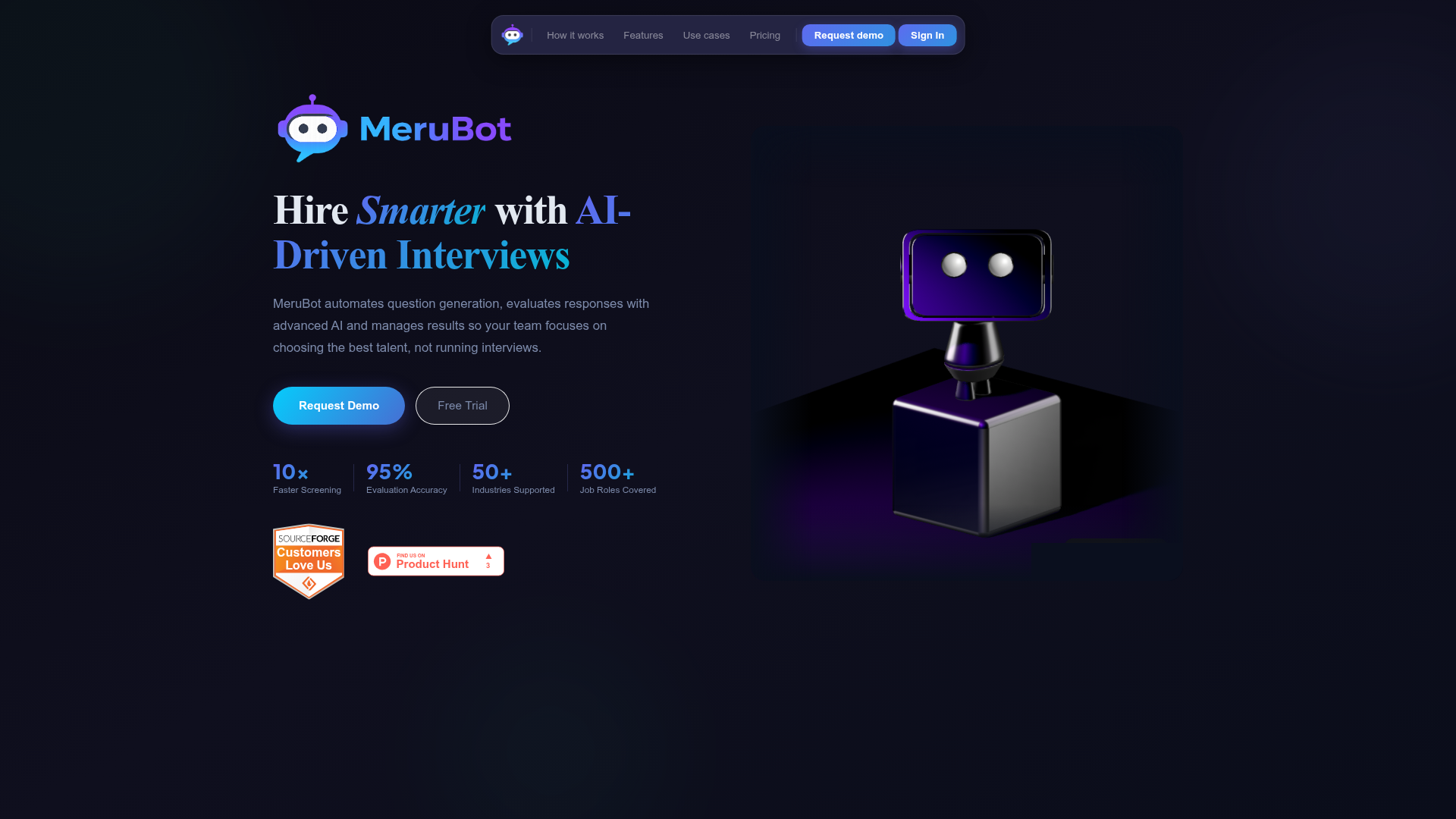
Hiring software has spent a decade automating the easy parts: sourcing, scheduling, and résumé screening. The interview itself — the hour-long conversation where a human decides if another human can do the job — has stubbornly remained manual. MeruBot, an AI-driven interview platform, is making a bet that this last manual step is ready for automation. Its pitch is not just to screen candidates but to conduct the interview itself, asking questions, evaluating responses in real time, and ranking candidates with a claimed 95% evaluation accuracy.
The ambition is clear from the tagline: "Your AI Interviewer." Not "AI screening tool" or "interview copilot," but the interviewer. That's a bold positioning in a market crowded with AI-assisted hiring tools. MeruBot's approach, detailed across its site, suggests a fundamental shift: instead of helping humans interview better, it aims to replace the human interviewer for the screening phase. This article examines how MeruBot works, where its claims hold up, and what its name and pricing reveal about its strategy.
The interview is the last manual step in hiring — MeruBot wants to automate it
Most recruitment technology stops at the shortlist. An AI parses résumés, scores candidates, and hands a ranked list to a recruiter. Then the recruiter spends hours on phone screens and video calls, asking the same questions, taking notes, and trying to compare apples to oranges. MeruBot's thesis is that this step is not only tedious but also biased and inconsistent. By automating the interview itself, it promises to make screening faster, fairer, and more scalable.
The company's website claims a "10x faster screening" rate, which, if true, would be transformative for high-volume hiring. But the real differentiator is the "Dynamic AI path": the AI generates follow-up questions in real time based on a candidate's answers, adjusting difficulty to probe the true skill ceiling. This is a step beyond static question banks, which most AI interview tools use. It mimics a human interviewer's ability to dig deeper, but with the consistency and patience of a machine.
Inside the pipeline: from JD parsing to adaptive questioning
MeruBot's workflow, as described on its site, is a six-step pipeline that starts with admin setup and ends with exportable analytics. The first step is "Smart Profile Extraction," where the AI reads a job description like an expert recruiter, identifying must-have skills, certifications, and experience. This feeds into "Precision Candidate Ranking," which scores candidates not on keywords but on actual fit, highlighting "Top Picks."
Then comes the interview itself. Candidates can take a "Static path" — a fixed set of questions — or the "Dynamic path," where the AI generates follow-ups based on answers. The evaluation engine assesses accuracy, depth, and communication quality, and in dynamic sessions, it adjusts difficulty on the fly. Finally, "Comprehensive Talent Analytics" produces a report with overall scores and answer-by-answer breakdowns, ready for export.
This end-to-end approach is both MeruBot's strength and its risk. By controlling the entire pipeline, it can offer a seamless experience — but it also means the tool must be reliable at every step. A failure in question generation or evaluation could undermine the whole process, and the stakes are high when hiring decisions are on the line.
The anti-cheat arms race: why proctoring is now a feature
One of the most telling features on MeruBot's list is the "Anti-Cheat Engine." It monitors tab switches, uses face proctoring, and employs a "multi-layer integrity system" to catch cheating. This is a direct response to a growing problem in remote hiring: candidates using AI tools like ChatGPT to answer interview questions. As AI becomes more accessible, the risk of candidates gaming automated interviews increases, and MeruBot is positioning its proctoring as a competitive advantage.
The inclusion of anti-cheat measures reveals a key assumption: that candidates will try to cheat. This is a realistic view, but it also adds a layer of surveillance that might deter some candidates. The balance between integrity and candidate experience is delicate. MeruBot's approach suggests it prioritizes security, which could be a selling point for employers worried about AI-enabled cheating, but it might also raise privacy concerns.
Pricing by the interview: a usage model that scales with hiring volume
MeruBot's pricing is usage-based, with plans ranging from ₹4,500 for approximately 10 interviews to ₹3,75,000 for 1,000 interviews. There are no time limits or expiry, which is unusual in SaaS. The plans are bundled with AI JD generation, resume parsing, and candidate matching, so the cost scales with the number of interviews conducted.
This pricing model is transparent but also revealing. It positions MeruBot as a tool for high-volume screening, where the cost per interview is low enough to justify automation. For a startup hiring 50 people a year, the Basic plan at ₹21,000 could be a bargain compared to recruiter hours. But for a company that only hires a handful of people annually, the per-interview cost might be prohibitive. The India-centric pricing (in INR) and the flag on the pricing page suggest a focus on the Indian market, which could limit global appeal.
What MeruBot's name and brand signal — and what they obscure
The name "MeruBot" combines "Meru" — possibly a reference to Mount Meru, the sacred mountain in Hindu and Buddhist cosmology — with "Bot," clearly indicating automation. The name suggests a powerful, almost mythical helper, but it's also generic. "Bot" is overused in AI products, and "Meru" is obscure to most Western audiences. The brand does little to differentiate MeruBot from a crowded field of AI hiring tools.
The domain, merubot.com, is clean and memorable, which is a plus. The logo, a stylized bot icon, reinforces the automation angle. But the brand lacks a clear narrative: it doesn't hint at the "dynamic interview" feature or the anti-cheat engine, which are its most distinctive capabilities. The tagline "Your AI Interviewer" is more descriptive but also generic. In a market where names like "HireVue" or "MyInterview" convey the value proposition more directly, MeruBot's name is a missed opportunity.
Open questions: accuracy claims, global reach, and the human touch
MeruBot's website makes bold claims: 95% evaluation accuracy, 50+ industries supported, 500+ job roles covered. These numbers are impressive but unverified. The site does not disclose how accuracy is measured or what benchmarks were used. Without third-party validation, these claims should be taken with a grain of salt.
Another question is global scalability. The pricing is in INR, and the demo request form includes country codes for India, the US, the UK, and others, suggesting some international ambition. But the focus on the Indian market is clear. Will MeruBot adapt its AI to different cultural contexts and languages? The site mentions "50+ industries" but doesn't specify which ones beyond IT, manufacturing, and BFSI.
Finally, there's the human touch. Even if AI can conduct a technically sound interview, it cannot read body language, pick up on emotional cues, or build rapport. For roles where soft skills are critical, an AI interviewer might miss the intangibles. MeruBot's pitch is that its analytics provide a comprehensive view, but it's a different kind of view — one that prioritizes measurable answers over human intuition.
MeruBot is a bold experiment in automating the interview. Its dynamic questioning and anti-cheat features are genuinely innovative, and its usage-based pricing is transparent. But the brand is generic, the claims are unverified, and the global appeal is uncertain. For high-volume hiring in India, it could be a game-changer. For the rest of the world, it remains a promising but unproven tool.