Millow
Clean-label mycelium protein from Swedish oats, fermented in 24 hours for chefs and food brands.
NewName Editorial
Editorial Team
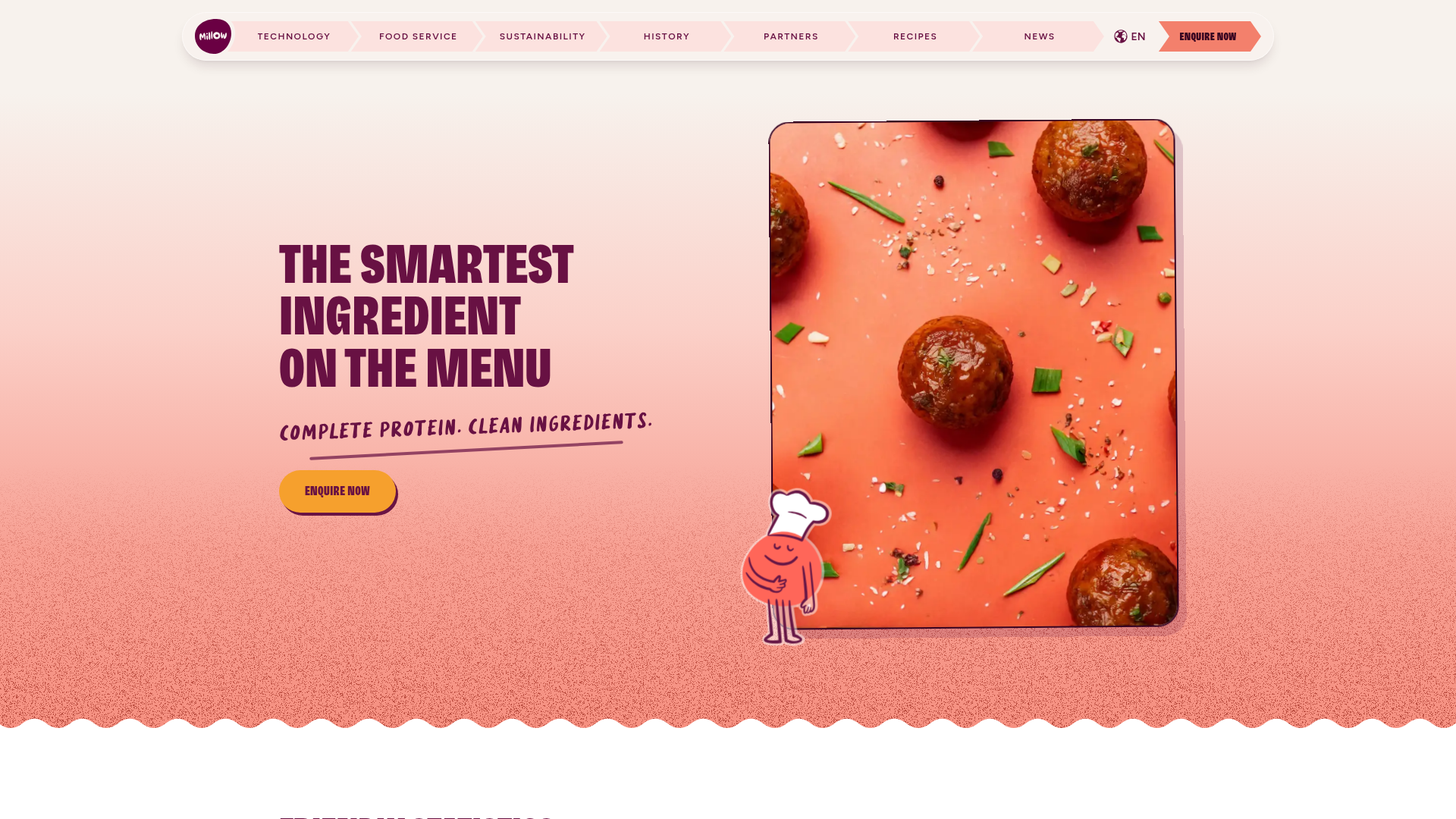
The alternative-protein aisle is full of products that try to be something they're not: burgers that bleed, nuggets that mimic, powders that promise. Millow, a Gothenburg-based FoodTech company, is taking a different route. Its protein is made from just two ingredients — Swedish oats and mycelium — fermented together in under 24 hours using a patented dry-state process. No binders, no additives, no soy. The result is a whole food that sears, shreds, and plates like meat, but with a clean label that could actually survive a nutritionist's scrutiny.
Millow's thesis is quietly radical: the fastest way to mainstream alternative protein is not to perfect the illusion of meat, but to give chefs and food manufacturers a versatile, clean ingredient that they can build dishes around. The company is not selling a branded consumer product — at least not yet. It's selling an ingredient, a platform, and a story, all wrapped in a fermentation process that compresses what usually takes days into a single day.
The 24-Hour Fermentation That Skips the Binder
Most mycoprotein production is a liquid-state fermentation that takes days and requires significant water and energy. Millow's patented process is different: it's a dry-state fermentation that runs in under 24 hours. The company claims this uses only 2.3% of the water of conventional mycelium processes — a striking figure, even if the comparison is to an industry baseline rather than to beef.
The speed is not just a technical curiosity. It has commercial implications. A 24-hour cycle means faster production runs, lower energy costs, and the ability to respond to demand without massive lead times. For a B2B supplier, that's a real advantage over competitors who might need a week to produce a batch. Millow's website is careful to note that its emissions figures are measured across the lifecycle versus beef, and its water figures versus conventional mycelium processes. That transparency is refreshing in a category often heavy on vague eco-claims.
Oats Meet Mycelium: A Hybrid That Avoids the Quorn Trap
Ask Millow how it differs from Quorn, and the answer is blunt: "Not at all!" The FAQ section is almost defensive. Quorn, the original mycoprotein, is made from a single fungal strain in a liquid fermentation. Millow's product is a hybrid — mycelium combined with oats. That distinction matters for two reasons.
First, it changes the texture and flavor profile. Oats bring a natural creaminess and a hint of sweetness that can carry a range of cuisines, from Swedish meatballs to Asian bao. The mycelium provides the protein structure and umami. The result is a product that doesn't need binders or starches to hold its shape — it binds naturally. Second, it allows Millow to position itself as a "new category" rather than a direct competitor to Quorn or other meat analogues. That's a smart framing, because it sidesteps the inevitable comparison to a brand that has been on shelves for decades.
But the hybrid approach also raises a question: is it really a whole food, or is it a processed blend? Millow's answer is that fermentation is a natural process — "fermented, not fabricated" — and that the body knows what to do with it. The ingredient list is short: oats, mycelium, water. No binders, no additives, no unpronounceables. For a clean-label-obsessed market, that's a powerful story.
Why Millow Sells to Chefs, Not Consumers
Millow's website is not designed for a home cook looking for a meat substitute. It's designed for a chef, a procurement manager, or a sustainability officer. The homepage asks, "Who are you?" and offers five doors: chefs and food developers, buyers and procurement, sustainability and CSR, distribution and partners, and business and investors. Each door leads to a tailored pitch — culinary performance, supply and pricing, audit-ready impact data, co-development opportunities, and the platform case.
This B2B-first approach is a deliberate choice. Consumer brands require massive marketing budgets and retail distribution. An ingredient company can grow by winning a few key accounts and letting the "Made with Millow" mark do the marketing. The website even shows a "Made with Millow" logo, suggesting a co-branding strategy similar to how Intel Inside worked for PCs. For food manufacturers and private-label producers, Millow offers a way to launch clean-label protein products without building a fermentation facility from scratch.
The risk is that B2B sales cycles are long, and the company is still small. But the approach has a logic: if you can get your ingredient into a few popular dishes at Nordic restaurants or into a private-label line at a major retailer, you've created a proof point that no advertising campaign can match.
The 97% Emissions Claim and the Audit-Ready Pitch
Millow's sustainability page is a key part of its pitch. The headline claim: 97% lower CO₂ emissions than Swedish beef, measured across the lifecycle. The company also claims to use 660 times less water than beef. These are striking numbers, but they come with a caveat: they are comparisons to beef, not to other plant-based proteins. That's a common framing in the industry, but it's worth noting that the comparison is to the most resource-intensive meat, not to chicken or pork.
The website is careful to say "emissions measured across the lifecycle versus beef" and "water and production figures versus conventional mycelium processes." That's a level of specificity that suggests Millow is preparing for scrutiny. For sustainability officers and CSR teams, the pitch is "audit-ready" — a term that appears on the site. The company has also been co-funded by the European Innovation Council, which adds a layer of credibility.
But the real test will be whether those numbers hold up in a third-party life-cycle assessment. Millow's website does not yet publish a full LCA report, only the headline figures. Until that happens, the claims are self-reported, even if they are presented with more care than most.
From Lab to Ledger: The €2 Million Commercialization Push
In August 2026, Millow closed a €2 million funding round led by serial entrepreneur Magnus Emilson, with participation from Jan Enhager, co-founder of Vitamin Well. The round is earmarked for expanding production capacity and scaling the commercial team for the Nordic foodservice market. The news also notes that Millow's core European patent stands unopposed — a significant detail for a company whose entire model rests on a proprietary fermentation process.
The funding is modest by alt-protein standards, but it's a signal of intent. Millow is not trying to build a massive consumer brand overnight. It's trying to win the Nordic foodservice market, prove the technology at scale, and then expand. The appointment of Fredrik Öhrn as CEO in March 2026, with scientific founder Mohammad Taherzadeh moving from academia to focus on the company, suggests a shift from research to commercialization.
The story of Millow is still early. The company has a patent, a process, a product, and a handful of partners. What it doesn't have yet is a track record of large-scale production or a household name. But the direction is clear: Millow is betting that the future of protein is not a lab-grown burger or a pea-protein isolate, but a fermented whole food that tastes good, cooks like meat, and leaves a lighter footprint. If the 24-hour fermentation delivers on its promise, that's a bet worth watching.