MODRA
Same-day retail delivery from stores you already shop, powered by AI.
NewName Editorial
Editorial Team


MODRA is an AI-powered on-demand retail marketplace that lets customers browse inventory from nearby stores, boutiques, malls, and national retailers, then have purchases delivered the same day. Its AI shopping assistant, Savvy, learns customer preferences to provide personalized recommendations. Founded by Jeremy Bernier, a plumber and Navy veteran, MODRA aims to make local retail as convenient as ordering food delivery.
The Plumber Who Wanted to Unclog Retail
Jeremy Bernier is not the typical founder you'd expect to take on the retail industry. He's a plumber and Navy veteran, which means he's spent his career solving problems that are messy, urgent, and often invisible to the people who benefit from the solution. That's exactly the mindset he's bringing to MODRA, his new startup that wants to make local retail as convenient as ordering takeout.
Bernier's origin story, as told in a GeekWire Startup Spotlight, is rooted in a universal frustration: you're getting ready for a wedding, a date, or a business meeting, and you realize you forgot something—a shirt, a pair of shoes, a gift. You can get food delivered in minutes, but for retail, your choices are either drive across town or wait days for shipping. MODRA was created to bridge that gap.
The plumber analogy is apt. Just as a plumber unclogs pipes, Bernier wants to unclog the last-mile problem in retail. He's not building a new category from scratch; he's applying the convenience economy's playbook to an industry that has lagged behind. It's a bold bet, and it's one that only makes sense if you understand the specific pain point he's targeting.
The DoorDash for Clothing Stores—and What That Really Means
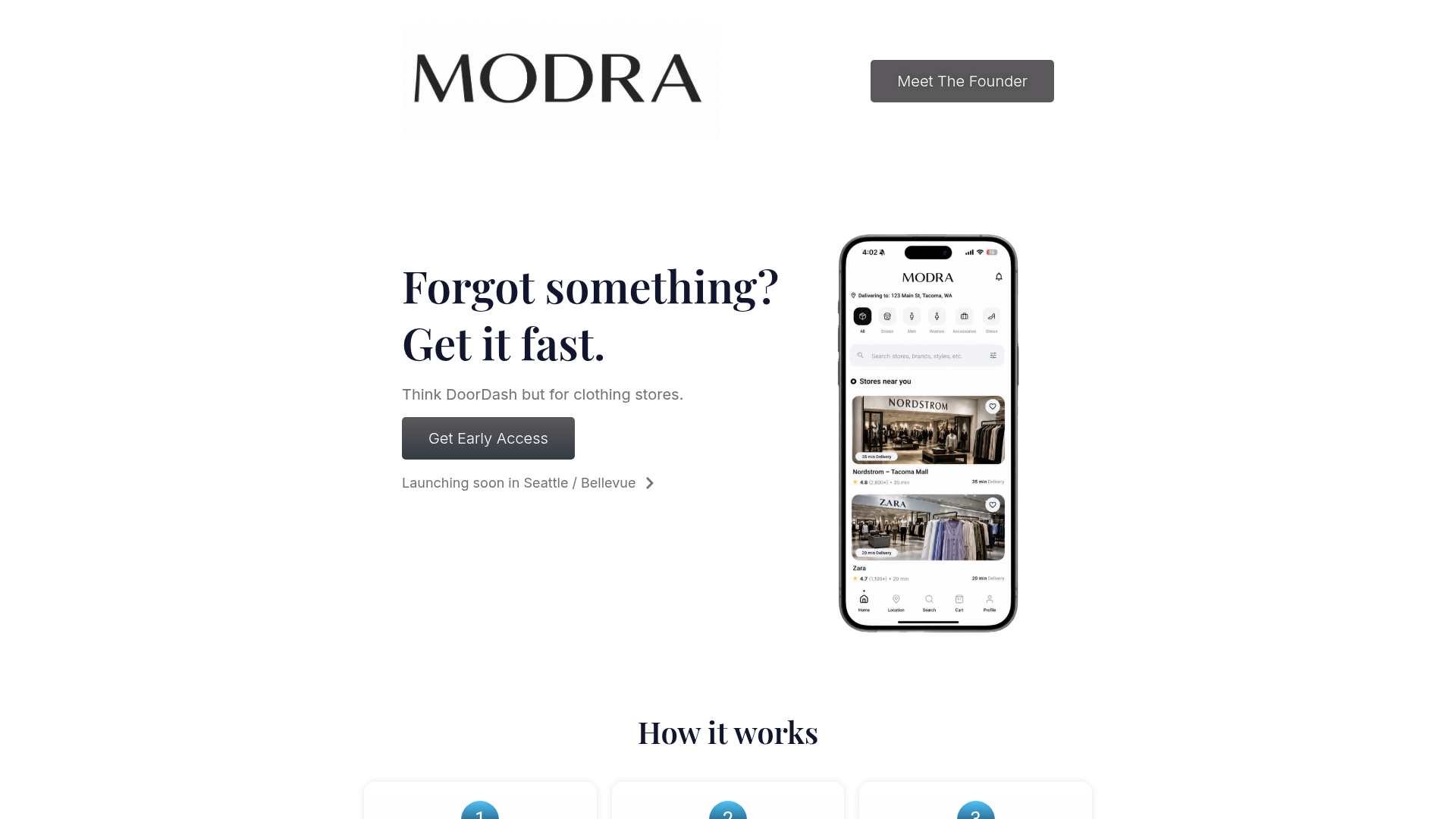
MODRA's website doesn't mince words: "Think DoorDash but for clothing stores." That's a clear, if ambitious, positioning. DoorDash built its empire on delivering food from local restaurants in minutes. MODRA wants to do the same for retail, but with a twist: it's not just about delivery speed, but about inventory access.
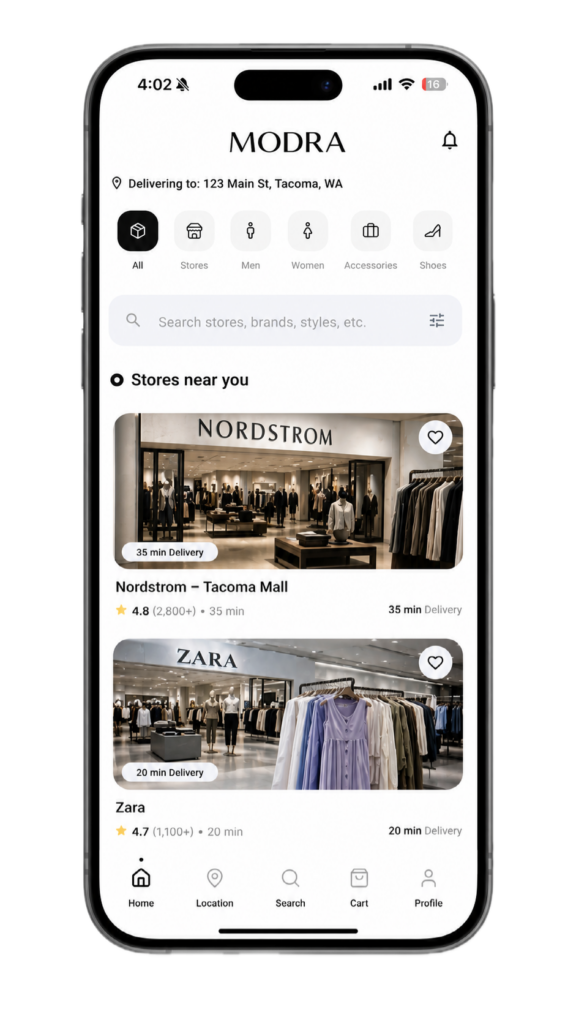
The core value proposition is simple: browse inventory from stores you already shop at, order instantly, and get it delivered in as little as 30 minutes. This isn't about random dropshipped goods from overseas; it's about the stores in your neighborhood, the mall, or the boutique down the street. MODRA's promise is to make those stores' inventory available on-demand, without the need to physically go there.
That's a meaningful distinction. Food delivery works because restaurants are already set up for takeout. Retail stores, on the other hand, are not. They have to manage inventory, handle in-store pickup, and coordinate with delivery drivers. MODRA's challenge is to make that process seamless for both the store and the customer.
The "DoorDash for" framing is both a strength and a risk. It immediately communicates the concept, but it also sets a high bar. DoorDash has spent years perfecting logistics, and MODRA is starting from scratch. The question is whether the convenience economy can truly extend to retail, where the inventory is more complex and the margins are thinner.
What Savvy Actually Does
MODRA's AI shopping assistant, Savvy, is a key differentiator. According to the website, Savvy learns customer preferences to provide personalized recommendations. That's a common feature in e-commerce, but MODRA is applying it to local retail, where the inventory is finite and location-specific.
Savvy's job is to help customers find what they need quickly, especially in those last-minute moments. Instead of scrolling through endless listings, Savvy can narrow down options based on past purchases, style preferences, and even the occasion. For example, if you're looking for a black dress for a wedding, Savvy could surface options from nearby stores that match your taste.
The AI angle is also a nod to the future. As MODRA grows, Savvy could become the connective tissue between customers and stores, learning not just individual preferences but also local trends. That data could be valuable for retailers, who often struggle to understand what customers want in real-time.
But Savvy is also a promise that's hard to prove before launch. The website says it "learns customer preferences," but there's no detail on how it works or how accurate it is. For now, it's a feature that sounds good on paper, but its real value will depend on execution.
Why Seattle First, and Why It Matters
MODRA is launching in Seattle/Bellevue, a choice that's both practical and strategic. Seattle is a tech-savvy city with a dense urban core, making it an ideal testing ground for a delivery service. It's also home to Amazon, which has set high expectations for delivery speed and convenience. If MODRA can succeed there, it can succeed anywhere.
The website emphasizes "launching soon in Seattle/Bellevue," which suggests a phased rollout. That's a smart approach for a bootstrapped startup. Instead of trying to cover the entire country, MODRA can focus on a single market, build a reputation, and iterate based on feedback.
Seattle also has a thriving local retail scene, with boutiques and malls that could benefit from a delivery service. By partnering with these stores, MODRA can offer a unique value proposition: supporting local businesses while providing convenience to customers. That's a narrative that resonates with consumers who want to shop locally but don't have the time.
The Name MODRA: A Blank Slate with a Story
The name MODRA is short, punchy, and easy to remember. It doesn't have an obvious meaning, which is both a strength and a weakness. On one hand, it's a blank slate that can be filled with whatever brand identity MODRA wants to build. On the other hand, it lacks the descriptive clarity of names like "DoorDash" or "Instacart," which immediately tell you what the service does.
MODRA's brand is built around the idea of "modern retail"—a subtle nod to the company's mission. The wordmark is clean and modern, with no tagline on the main logo, which suggests confidence in the name alone. The website uses a warm orange accent, which conveys energy and approachability, fitting for a service that wants to be as easy as ordering food.
The domain, modraapp.com, is straightforward and reinforces the app-first approach. It's not a .com that you'd guess immediately, but it's short enough to type and share. As the company grows, the name will need to stand on its own, and MODRA has the potential to do that.
What MODRA Hasn't Proved Yet
MODRA is still pre-launch, and there are several open questions. The website says "Get Early Access" and "Launching soon," but there's no confirmed date. The company is bootstrapped, which means it has limited resources to compete with well-funded rivals like DoorDash or Instacart, should they decide to enter the retail delivery space.
The biggest challenge is logistics. Delivering clothing and other retail items is different from delivering food. Items need to be picked from store shelves, checked for quality, and packed appropriately. That's a labor-intensive process that could eat into margins. MODRA will need to partner with stores that are willing to integrate with its system, which could be a slow process.
There's also the question of demand. While the "forgot something" scenario is relatable, it's not clear how often it happens. Food delivery has a high frequency because people eat multiple times a day. Retail purchases, especially last-minute ones, are less frequent. MODRA will need to prove that there's a sustainable market for its service.
Despite these uncertainties, MODRA's concept is timely. The convenience economy has trained consumers to expect fast, seamless delivery. If MODRA can execute on its promise, it could carve out a niche in the retail landscape. The plumber-turned-founder has a clear vision, and the early signs are promising. But as with any startup, the proof will be in the delivery—literally.