Mojave Paint
A deterministic, retro-styled macOS image editor for Apple Silicon, free of AI and subscriptions.
NewName Editorial
Editorial Team
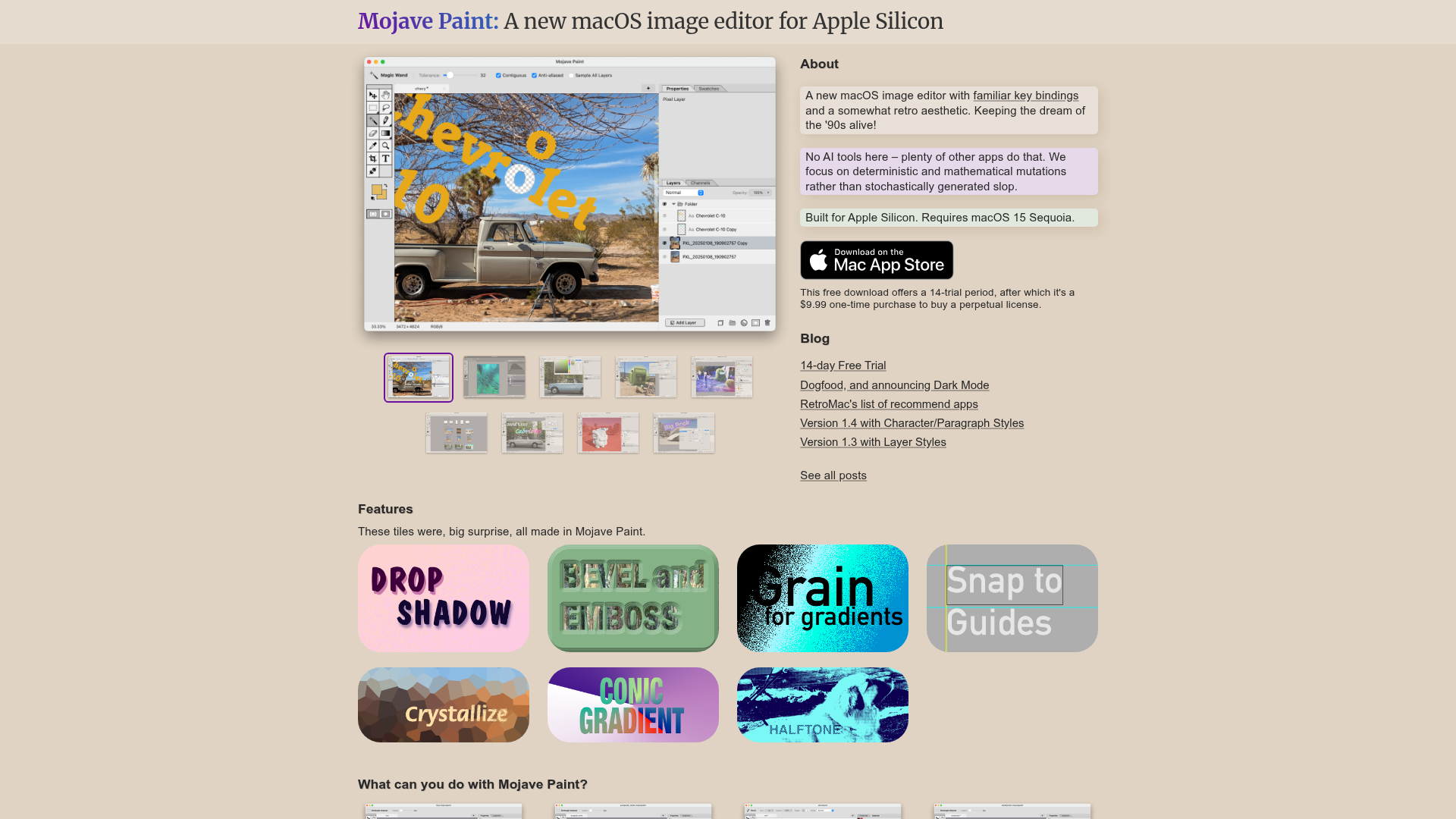
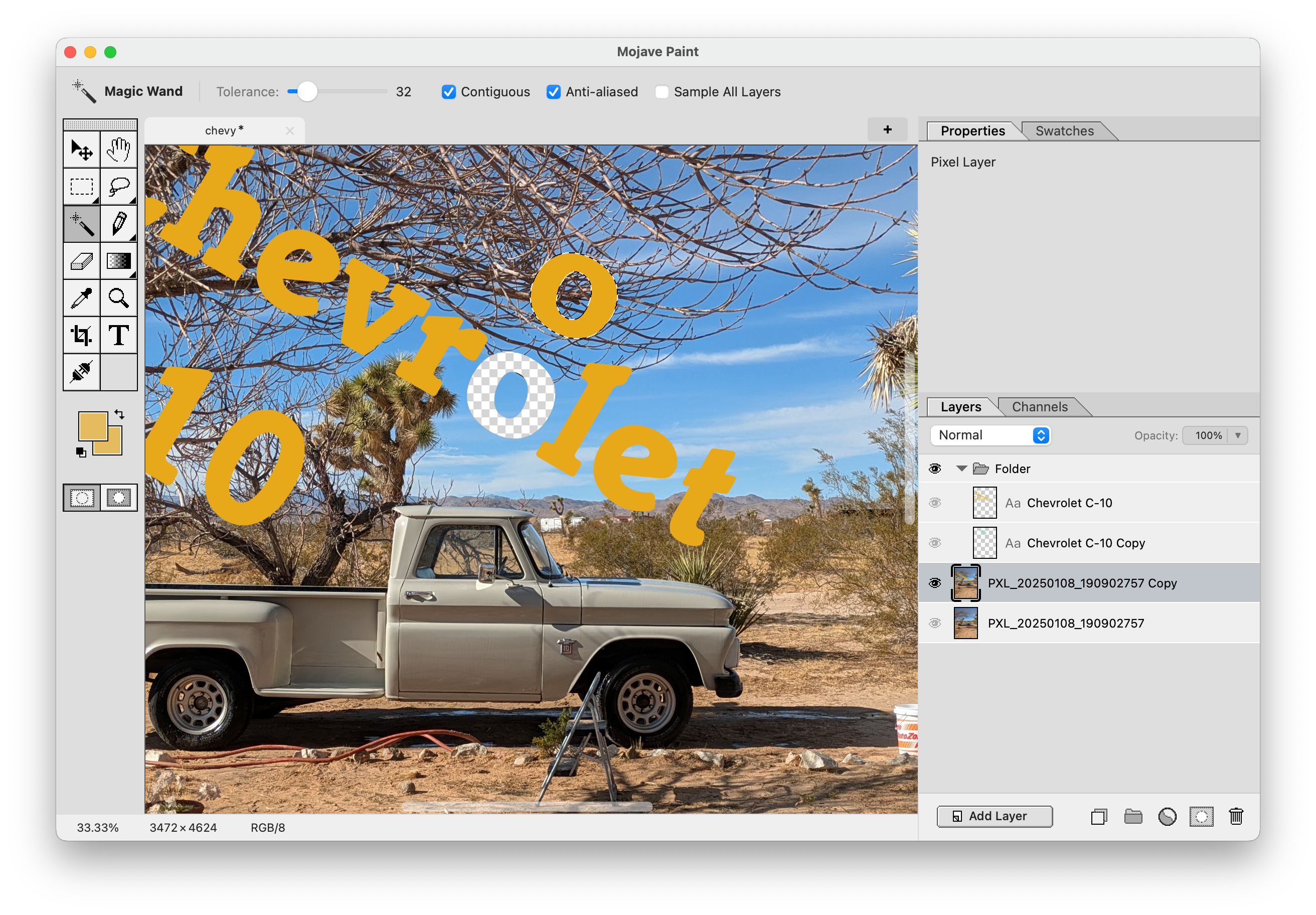
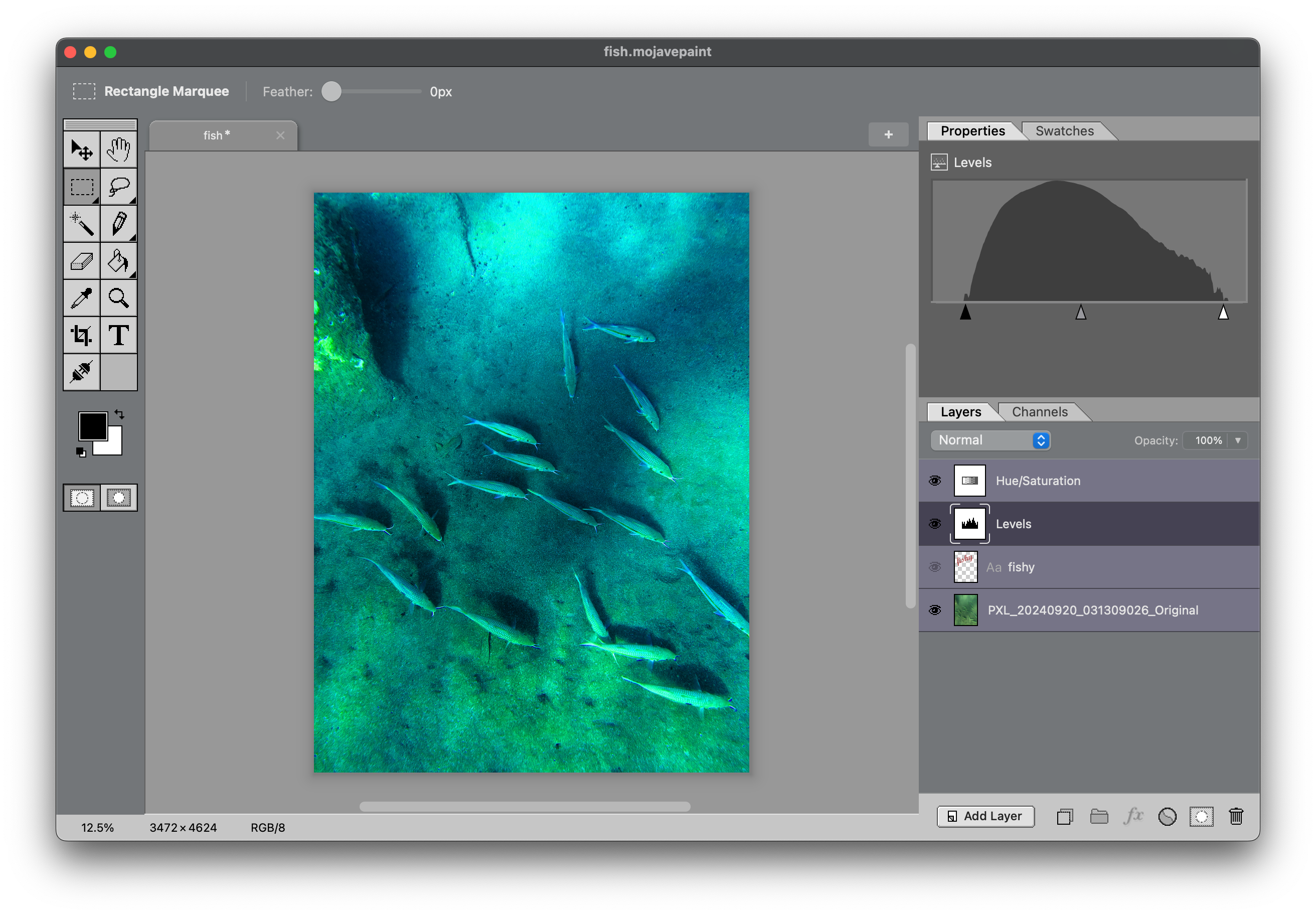
In an era when every image editor is racing to bolt on generative AI and subscription plans, Mojave Paint is a deliberate counter-movement. Launched in 2026 by solo developer John Simons, this macOS-only bitmap editor is built for Apple Silicon and proudly declares: "No AI tools here." It targets a specific but real segment of users—designers, illustrators, and retro-computing enthusiasts—who are exhausted by the stochastic unpredictability of AI-generated imagery and the subscription fatigue of the Adobe ecosystem. Mojave Paint's thesis is that there is still a market for deterministic, mathematical image manipulation, where every pixel is placed with intent and every filter produces a predictable result. This is not a tool for generating "slop"; it's a tool for precise, hands-on creation. The question is whether this niche is large enough to sustain a business, and whether a solo developer can compete against both the AI giants and the legacy incumbents.
The Anti-AI, Anti-Subscription Image Editor for a Niche That Still Exists
Mojave Paint's positioning is almost contrarian. The product page explicitly states: "No AI tools here – plenty of other apps do that. We focus on deterministic and mathematical mutations rather than stochastically generated slop." This is a direct jab at the current industry trend where AI features are the primary selling point. By contrast, Mojave Paint offers a traditional layer-based workflow with familiar tools: layers, blend modes, selections, channels, text, paintbrush, gradient, filters, and adjustments. The app even includes a "Magic Wand" and "Quickmask," features that have been staples of image editors for decades. The aesthetic is deliberately retro—"toasted light mode" instead of dark or blinding white—and the interface uses hard-edged 1x graphics to communicate precision. This is a product for users who want to own the production of bitmap images, not delegate it to a neural network.
The target user is likely a designer who needs to create app store screenshots, social media graphics, or icons, and who values speed and predictability over AI-assisted shortcuts. The app's blog showcases use cases like designing a flyer, drawing an icon, or recoloring specific areas of a photograph. These are tasks that don't require AI; they require a fast, reliable, and intuitive tool. Mojave Paint aims to be that tool, and its retro aesthetic is a feature, not a bug, for users who appreciate the clarity and directness of classic Mac software.
Deterministic Pixels vs. Stochastic Slop: The Technical and Philosophical Wedge
Mojave Paint's core differentiator is its commitment to deterministic operations. Every filter, adjustment, and transformation is based on mathematical algorithms, not machine learning models. This means that if you apply the same filter twice, you get the same result—a guarantee that AI-based tools cannot offer. For professionals who need precise, repeatable results, this is a significant advantage. The app's feature set includes a "High Pass" filter, "Layer Styles" (drop shadow, bevel, emboss), and "Grain Gradient," all of which are deterministic. The developer even provides video demos to show exactly how these features work, reinforcing the message of transparency and control.
This philosophical stance is also a practical one. Deterministic tools are easier to debug, easier to document, and easier to predict. They don't require massive cloud infrastructure or GPU clusters. Mojave Paint runs entirely on-device, which means it's fast, private, and works offline. This is a stark contrast to AI-powered editors like Adobe Photoshop's Generative Fill, which relies on cloud processing and can produce unpredictable results. For users who value privacy and control, Mojave Paint offers a compelling alternative.
The Competitive Landscape: Adobe's Subscription Fatigue, Pixelmator's Exit, and the Mac Niche
The image editing market is dominated by Adobe Photoshop, which has moved to a subscription model and is increasingly integrating AI features. Many users are frustrated with the ongoing cost and the bloat of features they don't need. Pixelmator Pro, once a strong Mac-native alternative, was acquired by Apple in 2024, and its future is uncertain. This leaves a gap for a lightweight, affordable, Mac-native editor that focuses on core functionality without the AI hype.
Mojave Paint also competes with free, open-source options like GIMP, which is powerful but has a steep learning curve and an outdated interface. And there are web-based tools like Photopea, which are convenient but require a browser and an internet connection. Mojave Paint's advantage is that it's a native macOS app, built specifically for Apple Silicon, which means it's optimized for performance and integrates seamlessly with the operating system. It also has a familiar set of keyboard shortcuts, as detailed on its shortcuts page, which lowers the barrier for users coming from Photoshop.
However, Mojave Paint is not a full Photoshop replacement. It lacks advanced features like shape layers, smart objects, and warp tools, which are on its public roadmap. The developer is transparent about this, and the interactive roadmap allows users to vote on which features to prioritize. This community-driven approach is a smart way to build loyalty and ensure that development efforts are aligned with user needs.
A One-Time $9.99 Purchase: Unit Economics and the Indie Developer Playbook
Mojave Paint's pricing model is a breath of fresh air in an industry dominated by subscriptions. The app is free to download and offers a 14-day trial, after which it's a one-time $9.99 purchase for a perpetual license. This is a deliberate departure from the previous "crippled but use forever" model, where the free version had limited export options. The new model gives users full functionality during the trial, including export, which is a more honest and user-friendly approach.
For a solo developer, this pricing strategy has clear implications. At $9.99, the app needs to sell a significant number of copies to generate meaningful revenue. However, the low price point lowers the barrier to purchase, and the one-time nature eliminates subscription fatigue. The developer has also mentioned plans to offer direct distribution from his website, with a model similar to Sublime Text: an unlimited duration license with a limited period of updates. This would give users more flexibility and could increase revenue per user.
The go-to-market motion is primarily through the Mac App Store, which provides discoverability and trust. The app also has a presence on Product Hunt, where it launched with a tagline of "Direct manipulation of static images on the Mac platform." The developer's blog is another channel, where he shares insights into the development process and product decisions, building a community around the app.
Roadmap Realities: From Solo Developer to Sustainable Product
Mojave Paint's roadmap is a mix of essential features and ambitious additions. Users are voting for shape layers, smart objects, dodge and burn tools, and camera raw features. The developer has already shipped layer styles, dark mode, and snap-to-guides, showing a commitment to iterating based on user feedback. However, some features, like smart objects and warp tools, are complex and could take significant time to implement. The developer's solo status is both a strength and a limitation: it allows for quick decisions and a personal touch, but it also means that progress may be slower than a team-based competitor.
The future of Mojave Paint depends on its ability to grow its user base and generate enough revenue to sustain development. The niche of users who want a deterministic, AI-free image editor is real, but it's small. To expand, the developer may need to consider adding more advanced features, improving performance, or even exploring a subscription tier for power users. However, the current positioning is clear and compelling, and it resonates with a specific audience. If Mojave Paint can continue to deliver a polished, reliable, and affordable alternative to the AI-driven giants, it has a chance to carve out a sustainable niche in the Mac ecosystem.