Morpheo AI
Agentic data orchestration that turns raw enterprise data into governed, analysis-ready products.
NewName Editorial
Editorial Team
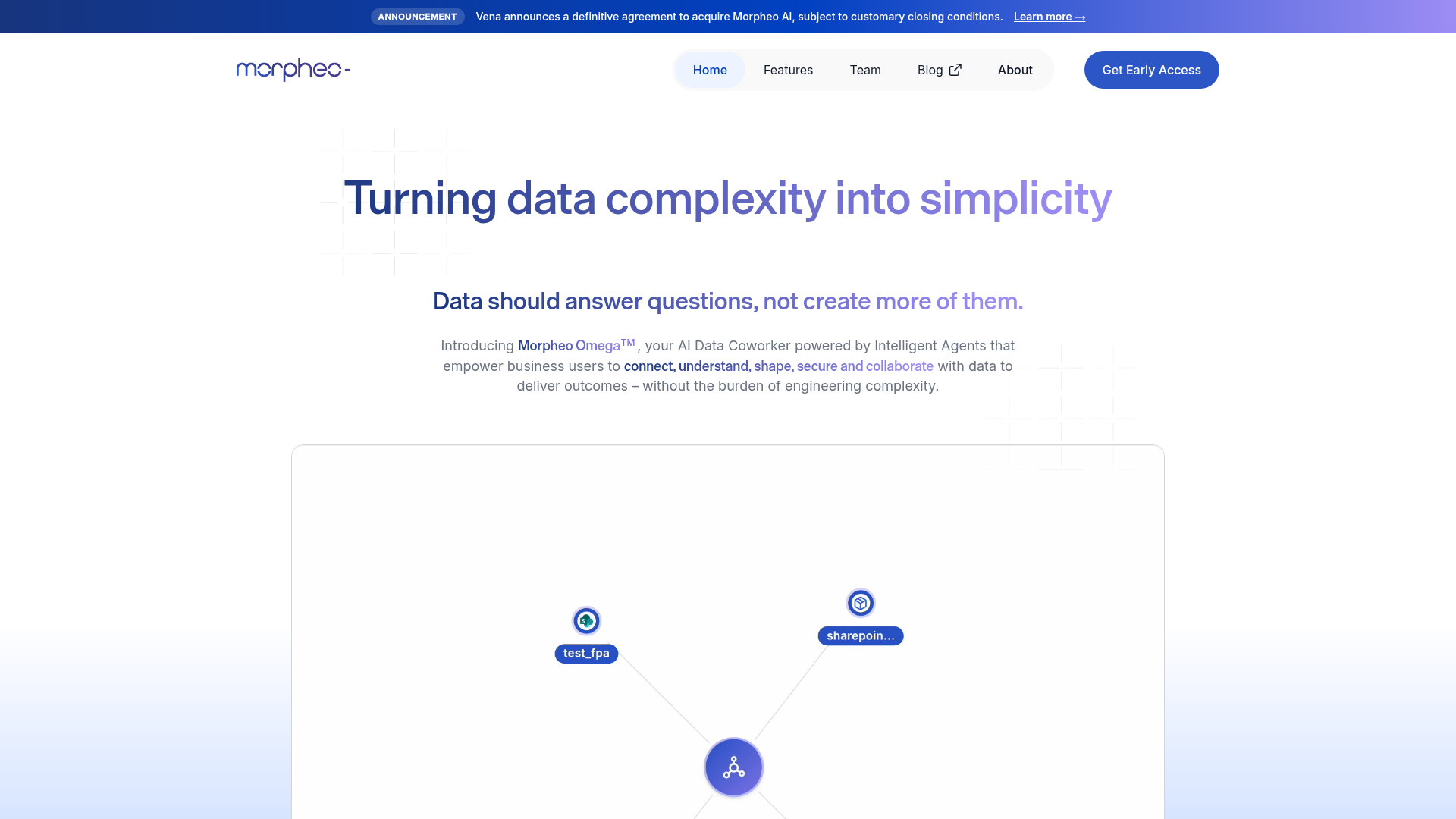

Financial planning and analysis teams spend up to 70% of their time on data preparation—profiling, cleansing, mapping, and enforcing governance across fragmented systems—before a single forecast can be built. This is the hidden tax on every enterprise AI initiative, and it's precisely where Morpheo AI has aimed its Omega platform. Rather than building another BI dashboard or a faster ETL pipeline, Morpheo AI has created an agentic orchestration layer that connects, understands, shapes, secures, and collaborates on data so that business users can finally ask questions of their data without waiting on engineering. The company's recent acquisition by Vena Solutions, a Toronto-based FP&A software provider, is a strong signal that the market for AI-native data orchestration is consolidating around the financial planning use case.
The Data Preparation Tax That Cripples FP&A Teams
The core problem Morpheo AI addresses is not a lack of analytics tools; it's the decades-old bottleneck of data readiness. In any large enterprise, data lives in silos: ERP systems, data warehouses, data lakes, spreadsheets, and a patchwork of legacy applications. Before any AI model or BI dashboard can deliver insights, someone must profile the data, understand its lineage, clean it, transform it, and enforce governance—a process that is manual, slow, and error-prone. The result is that FP&A teams, who are supposed to be strategic partners to the business, spend their days wrestling with data pipelines instead of analyzing scenarios or building forecasts.
Morpheo AI's thesis is that this work—the 'last mile' of data engineering—can be automated and made conversational. Instead of requiring business users to learn SQL or understand metadata, Omega acts as an 'AI Data Coworker' that learns the language of the business. When a finance analyst asks a question, Omega does the hard part: it prepares, curates, and structures the data so it's ready for reporting, BI, or advanced AI. The company claims this reduces data investment by 60–80% and speeds up data activation cycles by 4x—bold numbers that, if true, would transform the economics of enterprise data operations.
Omega's Architecture: Agents, Data Products, and Human-in-the-Loop Governance
Omega's architecture is built around four layers: a Data Layer, an Orchestration Layer, an Agent Layer, and an Experience Layer. The Data Layer manages 'Data Products'—curated, governed datasets that are ready for consumption. The Orchestration Layer handles workflows and 'Smart Contracts,' which are machine-readable agreements that define how data can be accessed and used. The Agent Layer contains vertical/industry-specific agents and meta-context intelligence, while the Experience Layer provides conversational interfaces with human-in-the-loop feedback.
What distinguishes Omega from a traditional ETL tool is its emphasis on context and governance. The platform automatically infers relationships, origins, and meaning from datasets, and presents these for human validation. It also embeds governance at every layer—security, privacy, and compliance are not add-ons but the backbone of the system. This is critical for enterprises that are wary of AI black boxes. By keeping a human in the loop, Omega ensures that every data action is transparent, traceable, and policy-aware. The company also states that customer data is not used to train models, and it has initiated SOC 2 compliance, addressing two major enterprise concerns: data privacy and auditability.
Why Legacy ETL and Data Catalogs Can't Keep Up with AI-Native Workflows
Morpheo AI is entering a market crowded with incumbents: Informatica, Talend, and Microsoft's Power Query have long dominated the data integration space, while data catalogs like Collibra and Alation focus on metadata management. However, these tools were designed for a pre-AI world—they require significant manual configuration, technical expertise, and ongoing maintenance. They are also siloed: integration, quality, and governance are separate products that require separate teams and separate budgets.
Omega's bet is that AI-native orchestration can collapse these categories into a single platform. Instead of a data engineer writing transformation scripts, an agent learns the data's context and generates the necessary workflows. Instead of a governance team manually tagging sensitive data, Smart Contracts enforce access policies automatically. This is a fundamentally different approach, and it's why the company positions itself as 'agentic' rather than just another automation tool. The risk, of course, is that enterprises are conservative and may be reluctant to trust AI agents with critical financial data. Morpheo AI's human-in-the-loop design is a direct response to this concern, but it remains to be seen whether the market will embrace this level of automation.
The Vena Acquisition: A Shortcut to Enterprise Distribution
In a move that validates the platform's potential, Vena Solutions announced a definitive agreement to acquire Morpheo AI in early 2025. Vena is a well-established player in the FP&A software market, offering a platform that integrates with Excel and is used by thousands of finance teams. The acquisition is a clear signal that Vena sees agentic data orchestration as the next competitive battleground in financial planning. By integrating Omega into its platform, Vena can offer its customers an AI-native data layer that automates the heavy lifting of data preparation—a key pain point for FP&A teams.
For Morpheo AI, the acquisition provides what every startup dreams of: instant distribution. Instead of building a sales team from scratch, Omega will be offered to Vena's existing customer base, which includes mid-market and enterprise companies. This is particularly important because Morpheo AI's early customers—EQ Bank, Canadian Opera Company, IMAX, and an unnamed FP&A partner—are a mix of mid-market and enterprise, suggesting that the platform is already proving its value in real-world deployments. The acquisition also gives Morpheo AI access to Vena's expertise in financial workflows, which could help refine Omega's vertical-specific agents.
Commercial Realities: Pricing, Deployment, and the Road to Scale
Public materials do not disclose Morpheo AI's pricing, but given its enterprise focus, it likely follows a SaaS subscription model with tiered pricing based on data volume, number of users, or features. The company offers early access and a 'Get Started' contact form, indicating a sales-led motion rather than self-serve. This is typical for enterprise data platforms, where deals are complex and require proof-of-concept pilots.
The acquisition by Vena will likely change the go-to-market strategy. Rather than selling Omega as a standalone product, it may become a premium feature within Vena's platform, or it could be offered as an add-on module. This could accelerate adoption but also risks diluting the Morpheo brand. The company's tagline, 'Turning data complexity into simplicity,' will need to resonate within Vena's larger product ecosystem.
Looking ahead, the success of Omega will depend on its ability to scale beyond FP&A. The platform's architecture is industry-agnostic, and the company has hinted at vertical-specific agents. If Vena can leverage Omega to expand into adjacent use cases like supply chain or HR analytics, the acquisition could be transformative. However, the competitive landscape is intensifying: tech giants like Microsoft and Google are embedding AI into their data platforms, and startups like Databricks and Snowflake are adding agentic features. Morpheo AI's head start in agentic orchestration, combined with Vena's distribution, gives it a fighting chance, but the next 3–5 years will be critical.