NomadGo
Wave an iPad to count inventory in minutes: NomadGo's on-device AI for retail and restaurants.
NewName Editorial
Editorial Team
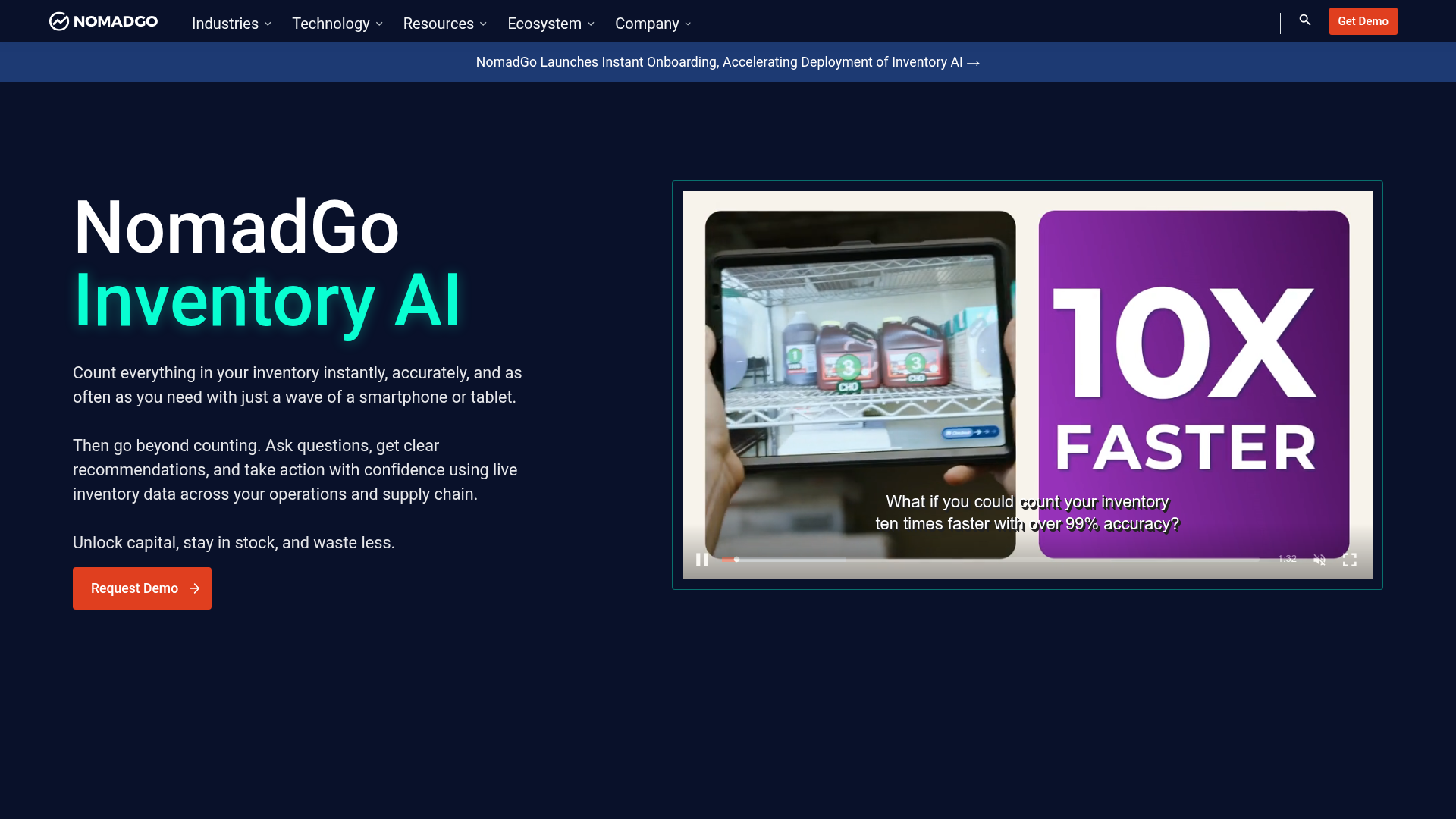
The most interesting piece of hardware in retail inventory management right now might be the iPad Pro. Not because Apple designed it for stockrooms, but because NomadGo, a Seattle-area startup, has built its entire counting system around waving that tablet at shelves. The pitch is disarmingly simple: open the app, scan your backroom or walk-in, and let on-device computer vision and augmented reality tally the stock in minutes instead of hours. No fixed cameras, no barcode scanners, no cloud dependency. Just a mobile device that most stores already own.
That simplicity is both NomadGo's strength and its risk. The company claims counts that are 10x faster and 99% accurate, and it has designed the experience to feel less like a chore and more like a video game. But the recent news that Starbucks scrapped a co-developed AI inventory tool, leaving NomadGo 'blindsided,' is a reminder that even the most elegant counting tool lives inside the messy reality of enterprise procurement and pilot programs. This is the story of a product that wants to make inventory counting as easy as taking a photo, and the market forces that might not be ready for it.
The iPad Pro as an Inventory Auditor
NomadGo's core insight is that the iPad Pro, with its LiDAR scanner and powerful neural engine, is already a capable spatial computer. Why install a network of fixed cameras or require staff to carry dedicated RFID readers when a device in their pocket can do the job? The company's Spatial Vision technology uses the iPad's sensors to build a 3D model of the shelf, recognize individual items, and overlay counts in augmented reality. The user is part of the loop, confirming what the AI sees, which builds trust and catches errors in real time.
This approach eliminates the capital expenditure of traditional inventory systems. NomadGo's website emphasizes '$0 Fixed Hardware & Installation Costs,' a claim that resonates with multi-location restaurants and retailers that have been burned by expensive, shelf-mounted sensor projects. The on-device processing also means the tool works in low-connectivity environments, like a basement storage room or a food truck, without needing a stable Wi-Fi connection. For a category that has long been dominated by clunky handheld scanners and manual spreadsheets, the iPad Pro is a Trojan horse of modern UX.
Counting at the Speed of a Wave, Not a Walkthrough
The headline metric is 10x faster counts. A manual inventory that takes an hour can be done in 10 to 12 minutes, according to the company's materials. That's not just a labor saving; it changes the frequency of counting. If a count takes an hour, a manager might do it weekly. If it takes ten minutes, they might do it daily. NomadGo's 'Inventory Reasoning Engine' then turns those frequent counts into actionable insights, like reorder suggestions and waste reduction tips. The company's ROI calculator, which uses restaurant benchmarks, projects a 339% first-year ROI for a typical multi-location operator, though the assumptions behind that number are not fully disclosed.
The accuracy claim of 99% is bold, but it comes with the 'user-in-the-loop' caveat. The AR interface asks the user to confirm what the AI sees, which likely catches edge cases like crushed boxes or overlapping items. That human validation is what makes the 99% figure plausible, but it also means the count isn't fully autonomous. It's a collaborative process between human and machine, which is a smart way to build trust but also a limitation if the goal is to remove labor entirely.
The 10x/99% Promise and the Skeptic's Question
Any vendor can claim 99% accuracy, but in inventory, the cost of a 1% error can be significant. A single missed case of chicken wings or a miscounted pallet of canned goods can lead to a stockout or over-order. NomadGo's answer is the AR overlay: the user sees the count in real time and can correct it immediately. That feedback loop is what separates this from a passive camera system that just records what it sees.
Still, the skeptic might ask: what happens when the shelf is a mess? Real-world stockrooms are not pristine. Boxes are stacked haphazardly, labels are torn, and products look similar. NomadGo's Spatial Vision is designed to handle row-by-row counting, but the company doesn't disclose how it handles occluded items or mixed SKUs on the same shelf. The 99% figure likely comes from controlled tests, not the chaos of a Friday night rush. The company would be wise to publish more details on its testing methodology.
Where NomadGo Sits in the Retail Workflow
NomadGo isn't trying to replace the ERP or the back-office system. It's a front-end data capture tool that feeds verified counts into existing software. The company lists integrations with PAR, Clearview, and Crunchtime, which are common in the restaurant world. That's a smart go-to-market strategy: don't ask customers to re-platform; just make their existing systems smarter.
The workflow is straightforward: open the app, scan the inventory, sync the counts, and let the reasoning engine suggest next steps. For a restaurant manager, that might mean a recommendation to order more avocados or to move expired product to the front. For a retail store, it might be a planogram compliance check. NomadGo's website highlights use cases across restaurants, food management, retail, and healthcare, but the restaurant focus is clear from the ROI calculator and the integration partners.
The Starbucks Episode: A Cautionary Tale in Enterprise AI
In early 2026, GeekWire reported that Starbucks scrapped an AI inventory tool called 'Automated Counting,' which was built in partnership with NomadGo. The tool used iPad Pros with computer vision and AR to scan backroom storage shelves. The report described NomadGo as 'blindsided' by the decision. This is a pivotal moment for the startup. Losing a marquee customer like Starbucks is a blow, but it also validates that a major enterprise saw enough potential to invest in a pilot.
The reasons for the scrapping are not fully public, but it's a reminder that enterprise AI projects are fragile. Pilots can be cancelled due to budget shifts, internal politics, or a change in strategy. For NomadGo, the challenge is to convert the Starbucks experience into a case study of what was learned, not what was lost. The company's website still highlights its partnership with Stratix, a mobile device management firm, which suggests it is pivoting toward a channel model.
Naming the Nomad: Branding That Fits the Shelf
The name 'NomadGo' is a clever fit for a product that is inherently mobile. A nomad moves from place to place, and that's exactly what the counting tool does: it travels with the user from shelf to shelf, store to store. The 'Go' suffix adds a sense of speed and action, reinforcing the 10x faster promise. The domain nomad-go.com is clean and memorable, though it's a hyphenated compound that might be slightly harder to type than a single word.
The brand positioning is consistent: 'Count everything in your inventory instantly, accurately, and as often as you need with just a wave of a smartphone or tablet.' The language is confident and action-oriented, but it stops short of overpromising. The company's tagline, 'AI-powered inventory counting tool for retail,' is functional but a bit dry. The visual identity, with its clean logo and product-focused imagery, suggests a modern tech company rather than a legacy inventory vendor.
In a category dominated by names like 'Zebra' and 'Honeywell,' NomadGo stands out as approachable and human. It doesn't sound like a hardware company; it sounds like a software startup that happens to use hardware. That's a strategic choice that could help it win over younger operations managers who are tired of clunky enterprise tools.
NomadGo's future depends on whether it can turn the Starbucks setback into a stepping stone. The product is genuinely innovative, and the on-device approach is a differentiator in a market that is still largely manual. But the enterprise sales cycle is long, and trust is hard to earn. If NomadGo can land a few more restaurant chains and prove the ROI with real data, it could become the default way to count inventory. If not, it risks being a cautionary tale about the gap between a great demo and a scalable business.