Impact-Site-Verification: 41b53a0c-6d04-458b-a457-fe9e29acde1a

SaaS & Productivity·Unknown··7 min read

Nventory

Event-driven inventory sync that updates every channel in under 5 seconds, preventing oversells and cancellation emails.

NN

NewName Editorial

Editorial Team

Nventory product image 1
Nventory product image 2

The most expensive word in e-commerce operations is not "oversold"—it's "later." A customer buys the last unit on Amazon at 2:00 PM, and your Shopify store still shows it available at 2:14 PM. The order comes in, the fulfillment team can't find the stock, and the cancellation email goes out. That delay is the quiet killer of margins and trust. Nventory, a multichannel inventory sync platform, has built its entire pitch around eliminating that gap: it promises to update every connected channel in under 5 seconds, using event-driven synchronization rather than the periodic batch syncs that most tools rely on.

That 5-second promise is more than a technical spec—it's a positioning statement. It tells sellers that Nventory understands the specific pain of overselling, and it sets a performance bar that generic inventory tools rarely meet. But Nventory is not just a sync engine. The platform has expanded into a broader operations suite, with AI agents, automations, and even a WhatsApp interface for stock checks and order dispatch. The question is whether that expansion strengthens the core value or dilutes it.

The 5-second promise: what event-driven sync actually changes

The typical multichannel inventory tool syncs on a schedule—every 15 minutes, every hour, or worse, twice a day. That means there's always a window where your channels disagree about what's in stock. Event-driven sync flips the model: the moment a sale happens on one channel, an event fires, and every other channel is updated immediately. Nventory's claim of under 5 seconds is a bold number, but it's the right number for the problem. In the time it takes to brew a coffee, your inventory is consistent across all channels.

Why does this matter? Because overselling isn't just a lost sale—it's a cascade of costs: cancellation emails, customer service tickets, negative reviews, and the administrative work of reconciling stock levels. For a seller moving hundreds of orders a day, even a 15-minute sync window can produce multiple oversells per week. Nventory's event-driven approach is designed to make that window effectively zero.

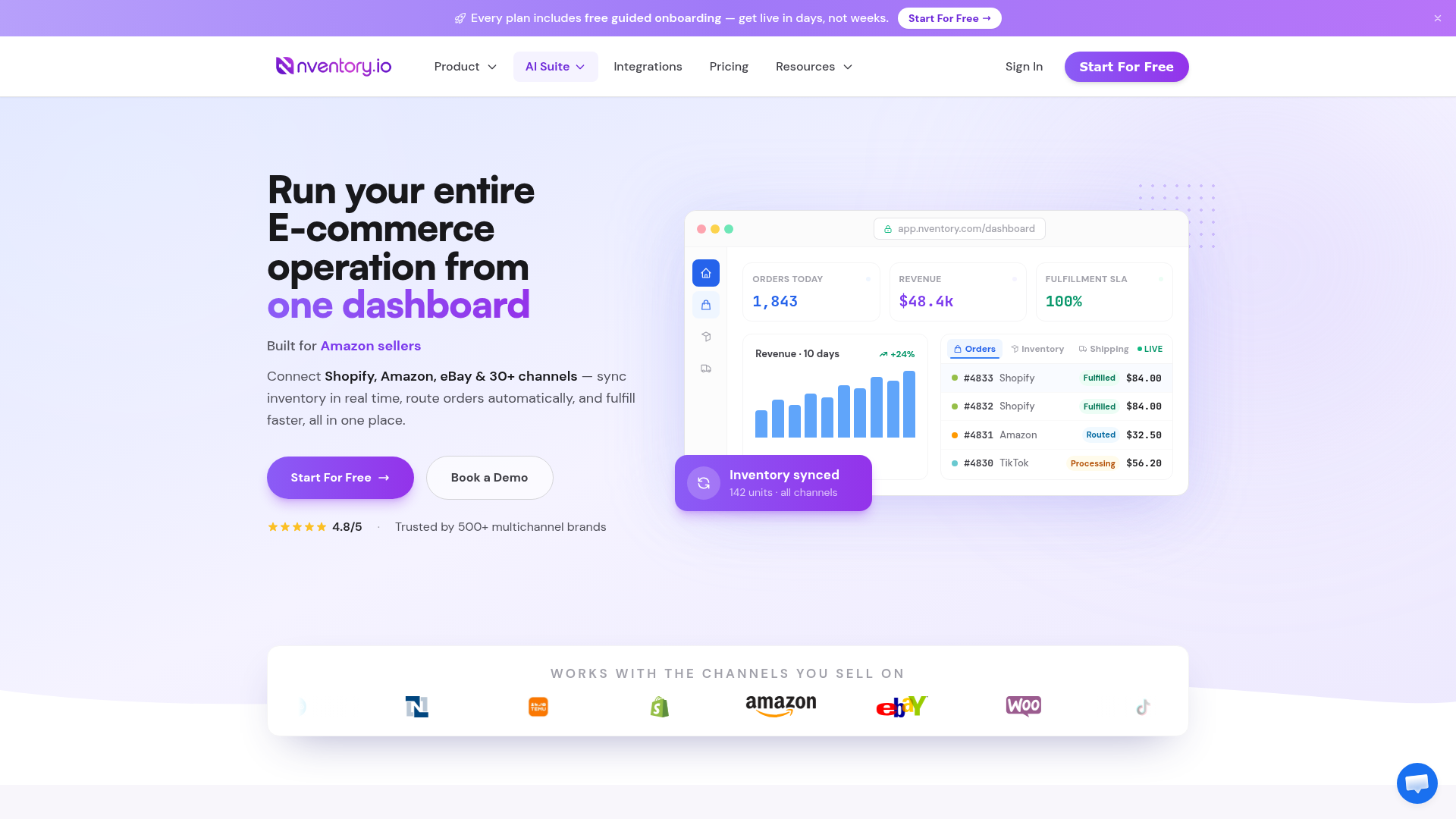
The website's dashboard mockup reinforces the point: "Inventory synced: 142 units · all channels" sits right next to a live order feed. The implication is that the numbers you see are always true, always current. That's the trust a seller needs when they're deciding whether to promise next-day delivery.

From dashboard to WhatsApp: Nventory's AI operations layer

Nventory's core sync engine is the foundation, but the platform is clearly pushing toward something bigger: an AI-powered operations layer. The "AI Suite" includes AI Agents that run operations 24/7, Automations built by AI, an Integration Builder that connects tools by describing them, Micro Apps for custom tools, and even AI Commerce for selling on AI surfaces. The most concrete example on the homepage is the WhatsApp integration.

A mock chat shows a user asking "Stock check — Blue Denim Jacket?" and receiving "42 units · East" in seconds. The AI then goes on to generate a label, dispatch the order, and confirm via WhatsApp—all in 1.8 seconds. This is a compelling vision: instead of logging into a dashboard, you run your inventory operations from your messaging app. For a small team that's on the go, that's genuinely useful.

But there's a tension here. The AI suite is flashy, but it's also unproven. The website doesn't provide details on how the AI agents handle edge cases, what guardrails are in place, or how they integrate with the core sync engine. The risk is that Nventory becomes a jack-of-all-trades, promising AI magic that distracts from the reliability that matters most. For now, the AI suite reads as a roadmap more than a finished product—but the WhatsApp demo is a taste of where multichannel operations are heading.

The pricing ladder: from free tier to 25,000 listings

Nventory's pricing is structured to capture sellers at every stage. The Free plan is genuinely free forever, with unlimited orders, 1 user, 100 product listings, and 1 sales channel. That's enough for a solo seller to test the platform without commitment. The Starter plan at $29/month (or $25/yearly) adds 3 users, 2,000 listings, and 3 channels—a natural step up for a growing business.

The Pro plan at $99/month (or $79/yearly) is marked "Most popular," and it's easy to see why: 10 users, 10,000 listings, 10 channels, and advanced automation. That covers the vast majority of established sellers. The Business plan at $199/month (or $149/yearly) targets high-volume operations with 20 users, 25,000 listings, unlimited channels, and custom integrations. There's also a fifth plan not shown on the homepage, suggesting even higher tiers exist.

This ladder is smart because it aligns pricing with the complexity of the seller's operation. A seller with 3 channels doesn't need unlimited channels, and a marketplace leader doesn't want to be capped. The yearly discounts (up to 33%) are a clear incentive to commit, and the free plan removes the barrier to entry. The website also emphasizes "no lock-in" and "cancel anytime," which builds trust in a category where sellers have been burned by contracts.

Naming the category: what 'Nventory' signals and hides

The name "Nventory" is a deliberate misspelling of "inventory"—a common trick in SaaS to create a distinctive brand. It's short, memorable, and clearly tied to the product's core function. The domain nventory.io is clean and professional, though the .io TLD is more common among developer tools than e-commerce platforms. That's a subtle signal: Nventory is positioning itself as a technical, API-friendly solution, not just a simple app.

The name also hints at the ambition to own the category. By dropping the "i," Nventory creates a unique word that can be trademarked and searched. But it also risks being seen as a typo. For a seller searching for "inventory software," the name might not immediately register. The branding compensates with a clear tagline: "Event-driven inventory sync for e-commerce." That's precise and informative, even if it's not catchy.

What the name hides is the AI and automation ambitions. "Nventory" sounds like a tool for tracking stock, not for running WhatsApp conversations or AI agents. The company's expansion into a broader operations platform might eventually outgrow the name. But for now, the name anchors the brand in the problem it solves best: keeping inventory in sync.

Where the edge is sharp: integrations and the WooCommerce listing

Nventory's integration list is its moat. The homepage shows logos for Shopify, Amazon, eBay, WooCommerce, TikTok Shop, Walmart, BigCommerce, Etsy, Magento, Squarespace, Wix, Square, Stripe, and more—30+ in total. That's a wide net, but the depth matters more. The website highlights that Nventory is "officially listed & verified" on the WooCommerce Marketplace, with a dedicated plugin that offers two-way sync. That's a concrete trust signal: a third-party marketplace has vetted the integration.

The WooCommerce listing is a smart go-to-market move. WooCommerce powers a huge portion of independent e-commerce, and its marketplace is a discovery channel where sellers actively look for tools. Being listed there gives Nventory credibility that a simple website can't. The plugin connects via API keys and syncs stock, orders, and products—exactly what a WooCommerce seller needs.

Beyond marketplaces, Nventory integrates with shipping carriers (FedEx, UPS, USPS, DHL) and accounting tools (QuickBooks, Xero, NetSuite). That's a full-stack approach: inventory sync is only useful if it connects to the rest of the operation. The website also mentions a REST API for custom integrations, which is essential for larger sellers with bespoke systems.

The risk: AI features vs. core sync reliability

Nventory's biggest risk is that it tries to do too much. The core value proposition—event-driven sync in under 5 seconds—is clear and compelling. But the AI suite, WhatsApp integration, and micro apps are a lot of surface area. Each feature adds complexity, and complexity can undermine reliability. If a seller's inventory sync fails even once, the trust is broken, and they'll look elsewhere.

The website doesn't disclose uptime statistics beyond a 99.9% SLA in the FAQ, and there's no mention of the tech stack or how the event-driven architecture is implemented. For a product that promises speed, transparency about performance would be reassuring. The AI features are also unproven—there's no case study or detailed documentation on how they handle real-world scenarios.

That said, the core sync engine is the foundation, and if it works as promised, Nventory has a strong product. The free plan and quick onboarding ("15 minutes to connect channels") lower the barrier to trial. For a multichannel seller tired of overselling and spreadsheet reconciliation, Nventory is worth a look. The 5-second promise is a bold claim, but in a category where every second of delay costs money, it's the right bet.