Impact-Site-Verification: 41b53a0c-6d04-458b-a457-fe9e29acde1a

AI & Machine Learning·Seed··5 min read

Oak Lab

Oak Lab: Building superintelligence on 20 watts through real-time, experience-driven learning.

NN

NewName Editorial

Editorial Team

Oak Lab product image 1

In an AI landscape obsessed with ever-larger datasets and exponential compute, Oak Lab is a deliberate counterweight. The boutique research lab, co-founded by Richard Sutton—a name synonymous with reinforcement learning—is betting that the future of intelligence lies not in curated data but in real-time experience. Its stated ambition is audacious: a trillion-parameter AI agent running on just 20 watts of power. That's roughly the energy budget of a human brain, and it's a target that flies in the face of every scaling law the industry has come to worship.

Oak Lab's thesis is simple yet radical: the path to superintelligence is not through memorizing the internet but through learning from the flow of experience, just as animals and humans do. This article unpacks the lab's research agenda, its architectural vision, and the philosophical roots that make it one of the most intriguing bets in AI today.

The 20-Watt Counterweight to Data-Centric AI

The dominant paradigm in AI is data-hungry and energy-profligate. Large language models are trained on trillions of tokens, consuming gigawatts of electricity and requiring data centers the size of small cities. Oak Lab's 20-watt target is not just a technical aspiration; it's a philosophical rebuke. The lab argues that intelligence does not require vast stores of data, but rather the ability to learn continuously from a stream of experience—something that can be done with remarkable efficiency.

This vision is rooted in the 'Big World Hypothesis,' a concept Oak Lab has articulated in its research. The hypothesis posits that the world is too vast and complex to be captured in any finite dataset. Therefore, an agent must learn by interacting with the world in real time, updating its knowledge incrementally, without the need for replaying past experiences. This is a direct challenge to the experience-replay techniques used in many reinforcement learning systems, which Oak Lab sees as a crutch that limits scalability and efficiency.

Learning from Experience: Oak Lab's Core Breakthrough

At the heart of Oak Lab's research is a focus on 'real-time learning' with 'batch-size one' algorithms. Traditional machine learning trains on large batches of data, making gradient updates that average over many examples. This is efficient but requires storing and replaying data. Oak Lab's approach is different: it develops algorithms that can learn from a single experience at a time, updating the model's parameters immediately. This is how biological brains work, and it is the key to achieving the low power consumption Oak Lab envisions.

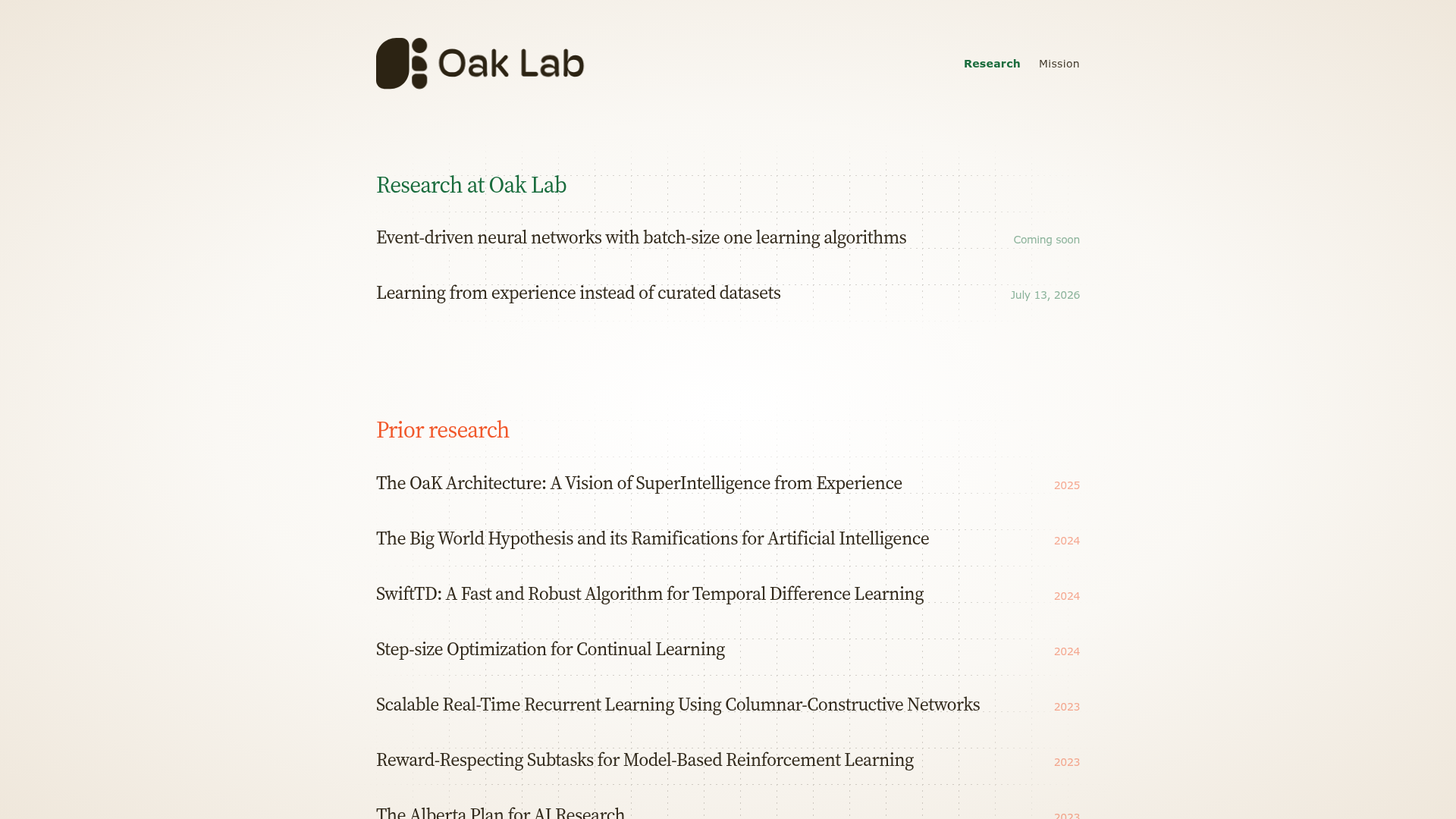
One of the lab's key contributions is 'SwiftTD,' a fast and robust algorithm for temporal difference learning, a core technique in reinforcement learning. SwiftTD is designed to be stable and efficient, making it suitable for real-time, continual learning scenarios. Another line of work explores 'Columnar-Constructive Networks,' which are neural networks that can grow and adapt their structure in response to new experiences, rather than being fixed at training time. These are not just incremental improvements; they represent a fundamental shift in how learning algorithms are designed.

The OaK Architecture: A Blueprint for Superintelligence

In 2025, Oak Lab published a paper outlining 'The OaK Architecture: A Vision of SuperIntelligence from Experience.' This is the lab's grand blueprint, a theoretical framework for building an AI that can achieve superintelligence by learning from experience alone. The architecture is named after the lab itself, and it embodies the principles of real-time, event-driven computation. The paper describes a system that processes information as events occur, rather than in batch, and that learns continuously without a separate training phase.

The OaK Architecture is not a concrete system yet, but rather a research vision. It draws on ideas from neuroscience, such as the importance of temporal dynamics and the efficiency of sparse, event-driven computation. The goal is to create an agent that can perceive, act, and learn in a unified loop, much like a living organism. This is a stark contrast to the current paradigm of training on static datasets and then deploying the model in a fixed state.

Richard Sutton's Legacy and the Alberta Plan

Oak Lab is co-founded by Richard Sutton, one of the most influential figures in reinforcement learning. Sutton is a professor at the University of Alberta and a research scientist at DeepMind, and he has been a pioneer in the field for decades. His 'Alberta Plan for AI Research,' published in 2023, outlines a research agenda focused on learning from interaction, rather than from data. Oak Lab is a direct embodiment of that plan, and Sutton's presence lends the lab significant credibility and intellectual weight.

The lab's other co-founder, Khurram Javed, is a researcher who has worked on continual learning and real-time recurrent learning. Together, they have assembled a team of researchers who share a common vision: that the future of AI lies in experience, not data. This is a contrarian position, but it is one that has a rich history in AI research, from the early work on reinforcement learning to the more recent focus on continual learning.

The Name 'Oak Lab': Rooted in a Philosophy

The name 'Oak Lab' is not arbitrary. It evokes strength, endurance, and growth—qualities that align with the lab's long-term vision. An oak tree grows slowly but steadily, developing deep roots and a robust structure. Similarly, Oak Lab aims to build AI that learns incrementally, layer by layer, from experience. The name also suggests a natural, organic process, in contrast to the industrial, data-center-based approach of many AI labs.

The domain, oaklab.ai, is clean and memorable, and it reinforces the lab's identity. The name is short, easy to spell, and has a natural association with knowledge and wisdom (as in the 'wisdom of the oak'). This is a strategic choice that helps differentiate Oak Lab from the more generic AI lab names that are common in the field. It signals a return to fundamentals, to a more grounded and principled approach to AI research.

What's Missing: The Road Ahead for Oak Lab

Oak Lab is still in its early stages. The website lists several papers as 'coming soon,' and the lab has not yet released a public demonstration of its technology. The 20-watt superintelligence is a long-term goal, and it is unclear how close the lab is to achieving it. The research is theoretical and experimental, and it may take years to produce practical applications.

Moreover, the lab's approach is a hard sell in an industry that is heavily invested in the data-centric paradigm. It will need to demonstrate concrete results to attract funding and talent. However, the lab's focus on energy efficiency is timely, as concerns about AI's environmental impact grow. If Oak Lab can make even a small step toward its 20-watt goal, it could have a significant impact on the field.

For now, Oak Lab is a research lab to watch. Its contrarian vision, its distinguished founder, and its ambitious goals make it a unique player in the AI landscape. Whether it succeeds or not, it is asking the right questions about the future of intelligence.