One More Letter
One letter per turn, endless spatial word puzzles—no timers, no luck, just foresight.
NewName Editorial
Editorial Team
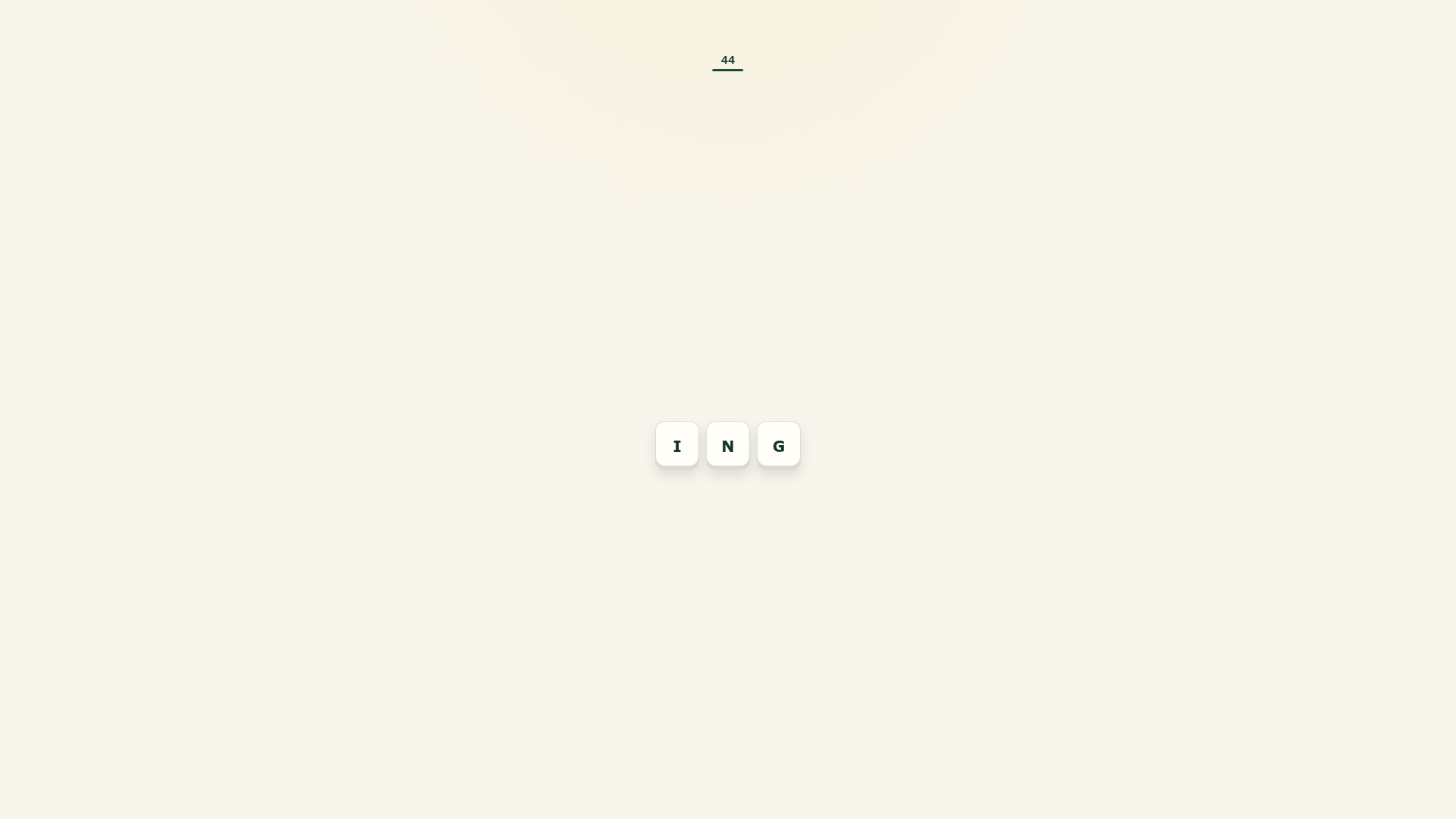
One More Letter arrives on Hacker News with little more than a name and a promise. The name itself is the entire premise: each turn, you add one more letter to a growing grid of words. That's it. No timers, no power-ups, no daily streaks—just the quiet, escalating tension of a board that fills up one character at a time.
It's a concept so simple it could be dismissed in a single screenshot. But the more you sit with it, the more you realize that the simplicity is the product. One More Letter isn't trying to be the next viral word game with a million modes. It's betting that a single, well-designed constraint can carry an entire experience.
The radical bet: one letter, no timer, no luck
The core rule—add one letter per turn—is the kind of design decision that sounds trivial until you try to break it. Every move is a commitment: you're not just placing a letter, you're shaping the board for every subsequent turn. A single 'Q' dropped in the wrong spot can doom a run; a well-placed 'S' can open up three new words at once.
This is the opposite of games like Scrabble or Boggle, where you're juggling racks of letters and racing against a clock. One More Letter strips away all that noise. You have one letter, one choice, and an entire board of possibilities. The constraint forces a kind of focused deliberation that's rare in casual games. It's not about speed; it's about foresight.
The game also sidesteps the classic problem of word games: the luck of the draw. Since you're not pulling tiles from a bag, there's no randomness to blame. Every loss is purely a failure of planning, which makes each victory feel earned.
Why the constraint is the game, not the limitation
A single-letter-per-turn rule could easily feel restrictive, even boring. But One More Letter turns that restriction into the source of its tension. Each move is a small commitment with outsized consequences—one letter changes the board's geometry, opening some words while closing others. The constraint isn't a wall; it's a tightrope.
This is a deliberate design philosophy. By removing the noise of timers and random draws, the game forces you to engage with the board itself. The constraint becomes the puzzle. It's the same logic that makes Tetris or 2048 work: a simple rule, applied relentlessly, creates complexity that feels bottomless.
The game also trusts its players to figure things out. There's no hand-holding, no tutorial that over-explains. You learn by doing, which is the purest form of game design.
The hidden depth: geometry over vocabulary
If the rule is simple, the puzzle is anything but. The real depth of One More Letter lies in spatial reasoning. A letter isn't just a letter—it's a node in a growing web of intersecting words. Placing an 'E' might complete a horizontal word, but it could also block a vertical one you were planning three turns later.
The game rewards players who think in multiple dimensions at once. You're not just asking "what word can I make with this letter?" but "where does this letter belong to maximize future options?" It's a chess-like calculation, but with a vocabulary twist. The best moves often aren't the ones that score the most points immediately, but the ones that set up a cascade of possibilities.
This positional depth is what separates One More Letter from a simple word puzzle. It's a game about geometry as much as language. The board becomes a map of your own decisions, and every new letter redraws the terrain.
The Show HN launch as a design statement
One More Letter launched with a bare-bones Show HN post—no elaborate pitch, no feature list, just a link and a name. That's a bold move in a landscape where apps scream for attention with tutorials and onboarding flows. But for a game this pure, the restraint is the point.
Hacker News is a notoriously tough crowd, but it's also a place that rewards clever constraints. A game that can be explained in a single sentence has a huge advantage: it's instantly shareable. You don't need a video to understand One More Letter; you just need one turn. That immediacy is what makes minimal games like this travel well. They're easy to try, easy to grasp, and easy to talk about.
The launch also signals a certain confidence. The creator, hmate9, isn't hiding behind a wall of marketing. They're letting the game speak for itself. In an era of bloated apps and feature creep, that's a refreshingly honest approach.
What One More Letter demands from its players
This is not a game for passive consumption. One More Letter demands a particular kind of attention—a willingness to slow down and think. It asks you to hold a mental model of the board, to anticipate consequences, and to accept that a single misplaced letter can unravel everything.
That's a high bar for a casual game, but it's also what makes it rewarding. There's a meditative quality to the gameplay, a rhythm of placing letters and watching the board evolve. It's the kind of game you can play for five minutes or fifty, and each session feels different.
The game also trusts its players to figure things out. There's no hand-holding, no tutorial that over-explains. You learn by doing, which is the purest form of game design.
The quiet ambition of a single-letter mechanic is that it can support endless variations—different board sizes, timed modes, or even multiplayer. For now, One More Letter stands as a testament to the power of subtraction. In a world of games that pile on features, it dares to do less, and in doing so, it achieves something rare: a game that is instantly understandable, endlessly replayable, and quietly addictive.