Impact-Site-Verification: 41b53a0c-6d04-458b-a457-fe9e29acde1a

AI & Machine Learning··6 min read

OpenRelay

A distributed GPU network that routes around failure, delivering inference across every chip.

NN

NewName Editorial

Editorial Team

OpenRelay product image 1
OpenRelay product image 2

OpenRelay wants to be the Akamai of AI inference. The company, backed by Y Combinator, calls itself an "Inference Delivery Network" — a phrase that deliberately echoes the content delivery networks that made the web fast and resilient. But instead of caching static files at the edge, OpenRelay routes LLM inference requests across a distributed mesh of GPUs, from consumer RTX 4090s to enterprise H100s. The pitch is simple: one API, every chip, automatic failover.

The ambition is large, but the idea is not entirely new. GPU marketplaces like Vast.ai and RunPod have offered access to distributed GPUs for years. What OpenRelay claims to add is a network layer that treats node failures as routine, not exceptional. In a world where centralized clouds treat a single failed node as an outage, OpenRelay's architecture is designed to absorb failures before users notice. Whether that's enough to displace the hyperscalers remains an open question.

The Inference Delivery Network: A New Category or a Clever Repackaging?

The term "Inference Delivery Network" is a deliberate construction. It borrows the CDN playbook — a distributed network of servers that delivers content based on geographic proximity and health — and applies it to GPU compute. OpenRelay's website describes a three-layer architecture: an Infrastructure Distribution Network (IDN) that sources fragmented GPU supply, a Compute Delivery Network (CDN) that routes requests, and a Unified Platform that presents a single API.

This framing is smart. It positions OpenRelay not as another GPU rental service but as a new category of infrastructure. The company even uses the term "CDN of inference" in its blog and about page. For developers, the mental model is familiar: just as a CDN makes websites fast and reliable, OpenRelay aims to make AI inference fast and reliable.

But the category is still nascent. The website claims "100B+ tokens processed every week" and "2.5x faster autoscaling than other providers," but these are self-reported metrics without independent verification. The real test is whether developers will trust a network of heterogeneous, consumer-grade GPUs for production workloads.

Designed for Failure: The Overlay Network Ethos

OpenRelay's about page is explicit: "Centralized clouds treat a failed node as an outage. We treat it as a Tuesday." This is the company's core thesis. The network expects nodes to drop and routes around them before users notice. The website illustrates a typical scenario: a node becomes unreachable, health checks flag it within milliseconds, and traffic reroutes to the nearest healthy GPU in 38ms.

This fault-tolerant design is not just a feature; it's the foundation. OpenRelay's values list "Fault Tolerance First" and "Decentralized by Design" as guiding principles. The architecture includes automatic failover and load balancing, with an SLA-backed uptime timeline for dedicated capacity.

The implications are significant. If OpenRelay can truly deliver on this promise, it could offer reliability comparable to centralized clouds at a fraction of the cost. But the proof is in the execution. The website mentions "SLA-backed uptime" but does not disclose specific SLA terms or historical uptime data. Early adopters will need to test the network's resilience themselves.

From Consumer GPUs to Global Mesh: How OpenRelay Sources Compute

OpenRelay's network is built on two pillars: owned GPU infrastructure and a global distributed network. The company's "Become a Provider" page invites anyone with idle GPUs to contribute compute and earn. This is a classic supply-side play: instead of building massive data centers, OpenRelay aggregates fragmented GPU supply from around the world.

The GPU catalog lists a range of hardware, from RTX 4090s at $0.29/hr to H100s at $2.60/hr. The pricing is metered per minute, with no egress fees and no commitments. This is competitive with other GPU clouds, but the real value proposition is the network effect: more providers mean more capacity and better routing.

The environmental angle is also present. A blog post argues that reusing existing consumer GPUs for AI inference is greener than building new data centers. This is a compelling narrative, though it remains to be seen if it resonates with enterprise buyers.

One API, Three Workloads: Serverless, Dedicated, and Batch

OpenRelay offers three ways to consume compute: serverless inference, dedicated GPUs, and batch jobs. All are accessible through a single API, which is OpenAI-compatible, meaning developers can point their existing OpenAI SDK at OpenRelay's endpoint and change nothing else.

The serverless option is the most accessible: hosted models behind one endpoint, with capacity scaling to traffic and pay-per-token pricing. The dedicated option gives developers a full GPU VM with SSH access and persistent volumes, metered per minute. Batch jobs queue heavy workloads at a lower price than interactive traffic.

This flexibility is a key differentiator. Many GPU clouds focus on either serverless or dedicated, but OpenRelay aims to be a one-stop shop. The API also includes a CLI tool, orl, which wraps the same API for scripting and CI integration.

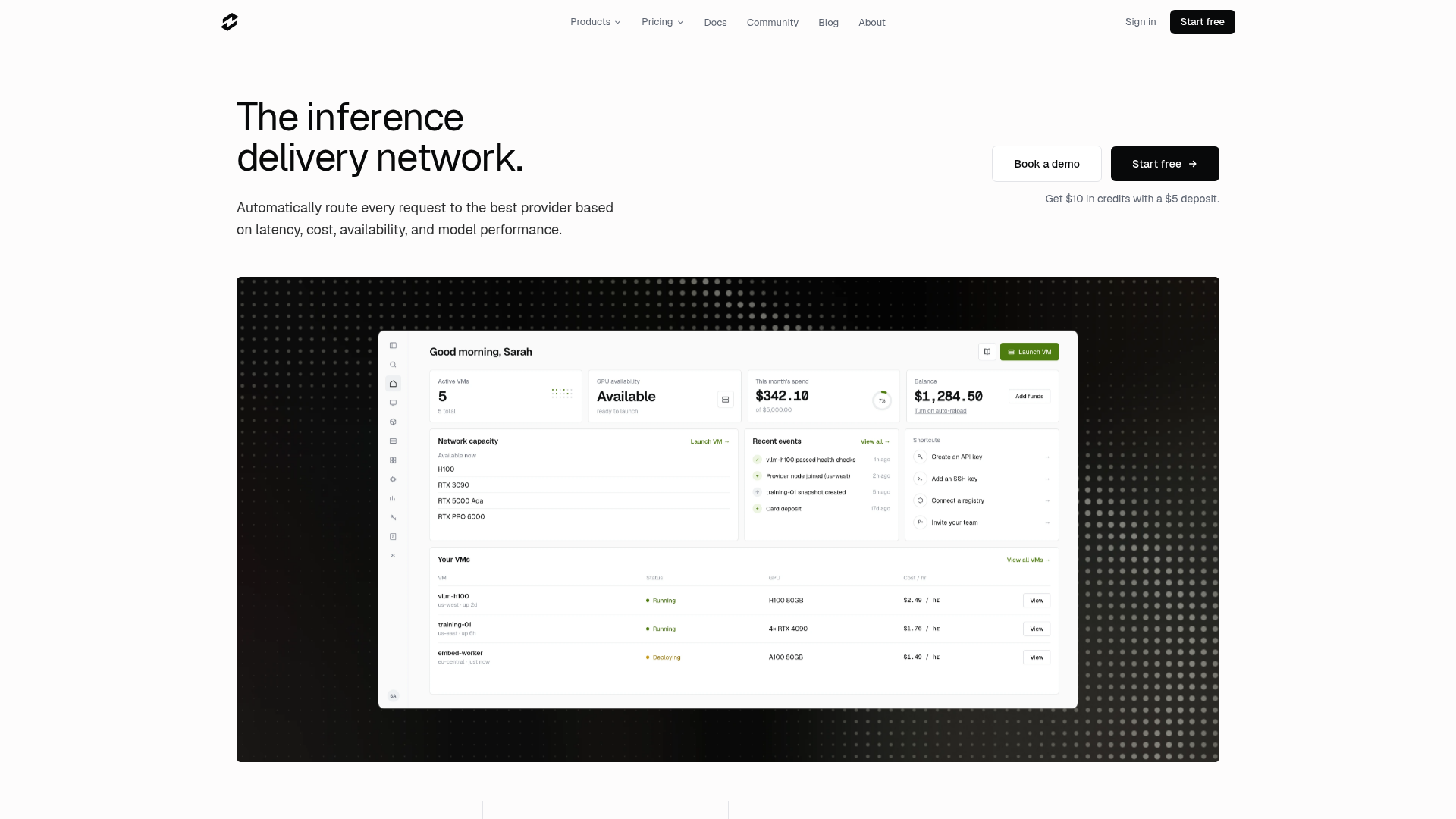
For developers, the workflow is straightforward: create a VM, deploy a model, or run a batch job — all from the same dashboard. The website shows a clean console with GPU selection, runtime, and deployment summary. The promise is that you can start with serverless and graduate to dedicated without switching providers.

The Name as a Promise: OpenRelay and the CDN Analogy

The name "OpenRelay" is a compound of "open" and "relay," evoking both open participation and the relay of data across a network. It positions the company as an open, neutral intermediary — a stark contrast to the closed ecosystems of hyperscalers. The domain, openrelay.inc, is short and memorable, though the .inc TLD is less common than .com or .io.

The CDN analogy is central to the brand. The tagline "The Inference Delivery Network" reinforces this, and the company's blog describes itself as "the CDN of inference." This framing helps developers understand the value proposition quickly, but it also invites comparison to established CDNs like Cloudflare or Akamai, which have years of reliability data.

There is a risk that the name overpromises. "Open" suggests a fully open network, but OpenRelay is a commercial entity with owned infrastructure. The "relay" metaphor implies speed and efficiency, but the actual performance depends on the quality of the distributed nodes. Early adopters will judge the name by the network's real-world behavior.

Who Should Care and What Remains Unproven

OpenRelay is aimed at teams that have outgrown the hyperscaler bill — startups and scale-ups that need GPU compute for inference but are frustrated by the cost and rigidity of AWS, GCP, or Azure. The website's case study about cutting $4,000/month in Vercel build costs is a concrete example, though it focuses on CI runners rather than inference.

The company's Y Combinator backing adds credibility, but the technology is still young. Public materials do not disclose funding amounts, customer counts, or detailed uptime statistics. The network's resilience is claimed but not independently verified.

The biggest open question is whether a distributed network of consumer GPUs can match the performance and reliability of centralized data centers for production workloads. OpenRelay's answer is that the network's fault tolerance makes it more reliable, not less. But this is a bold claim that will take time to prove.

For developers who are willing to experiment, OpenRelay offers a free tier with $10 in credits for a $5 deposit. That's a low barrier to entry. The real test will be whether the network can deliver on its promises at scale — and whether the "Inference Delivery Network" becomes a category that others follow.

Tags