Palette
An AI-native media platform that unifies the creative workflow into a single, high-quality generation engine.
NewName Editorial
Editorial Team


The generative video market is crowded with flashy demos and single-purpose tools. Palette, a Y Combinator and OpenAI-backed startup, is taking a different bet: instead of another model, it's building a studio that wraps around multiple models, routing requests and managing the creative workflow from prompt to final output. The pitch is simple—"Your entire studio in one prompt"—but the implications are significant. If Palette succeeds, it could become the layer that makes generative video practical for teams, not just tinkerers.
The thesis: one conversation instead of a toolchain
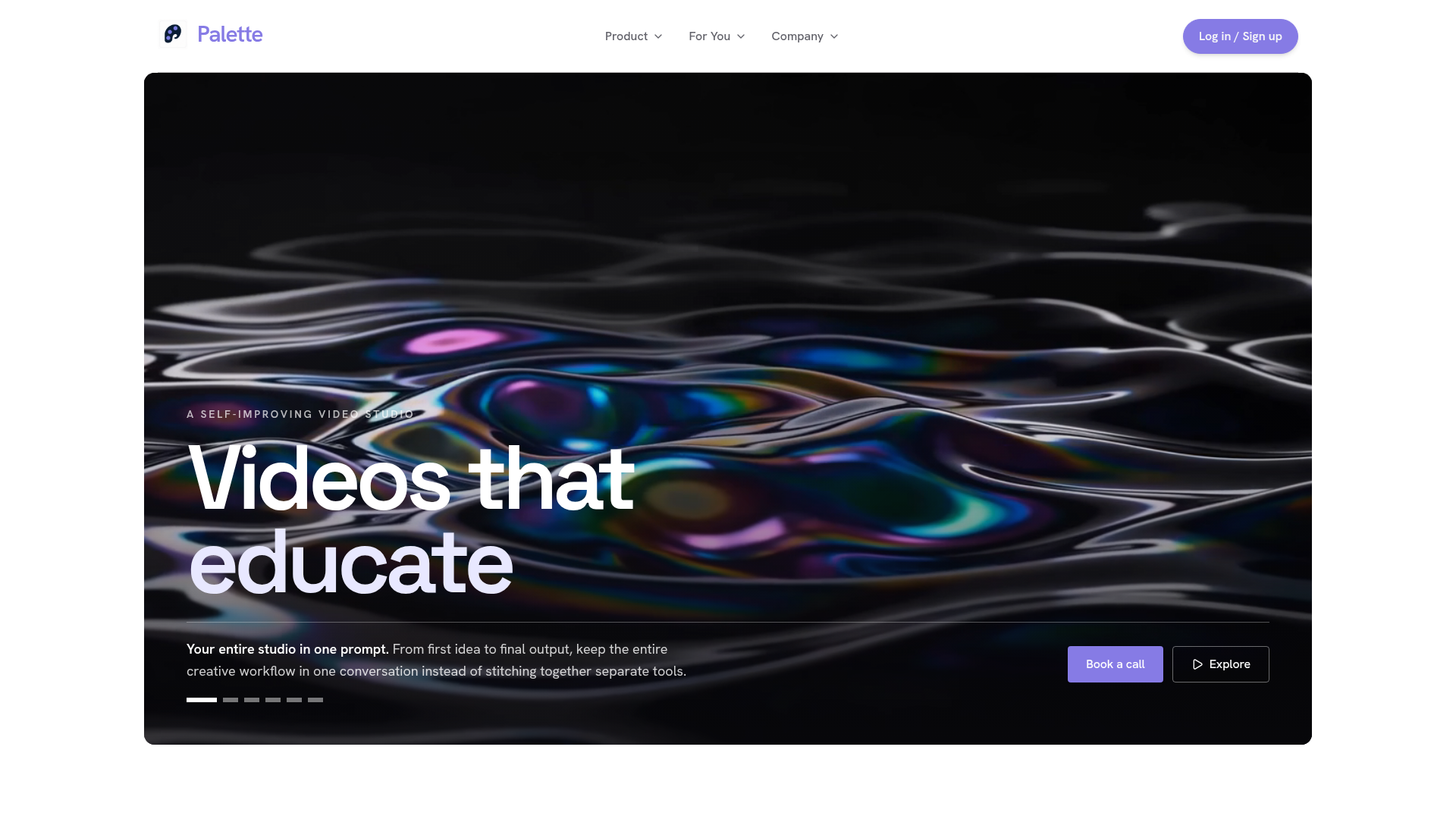
Palette's core proposition is to unify the creative workflow into a single conversation. Instead of stitching together separate tools for ideation, generation, editing, and post-production, Palette aims to keep the entire process in one place. The website describes it as "From first idea to final output, keep the entire creative workflow in one conversation instead of stitching together separate tools." This is a response to a real pain point: generative video today often requires juggling multiple platforms, each with its own prompt syntax, output formats, and limitations. Palette wants to be the connective tissue, allowing users to start with a prompt, image, document, or reference and generate video, visuals, and structured content without rebuilding the idea each time.
The tagline "An AI-Native Media Platform" and the headline "Videos that educate" suggest a focus on practical, instructional content, but the target industries listed—marketing, entertainment, learning & development, customer support, product, manufacturing, healthcare, retail, field service, safety training—indicate a broader ambition. This is not just a toy for creative agencies; it's aimed at any team that needs to produce video content at scale.
What 'self-improving' actually means in Palette's workflow
Palette describes itself as "self-improving," a term that could easily be dismissed as marketing fluff. But the website provides a concrete mechanism: "It analyzes the materials and the workflow behind every iteration, so the studio keeps improving the outcome with each pass." This suggests that Palette learns from user interactions—not in a model-training sense, but in a workflow-optimization sense. By tracking how users prompt, edit, and route requests, Palette can refine its recommendations and routing decisions over time.
The "Edit" feature reinforces this: "Change the work with words." Users can restyle a scene, replace an object, or revise a sequence using natural language, and Palette "keeps the source and context connected while the format changes." This is a form of persistent context management, which is crucial for iterative work. The "Storyboard" feature adds another layer: users can set audience, format, pacing, and visual intent, and Palette "routes the request through the right generation workflow." This is about controlling the outcome, not just the prompt.
The model router: a quiet but decisive bet
One of the most interesting aspects of Palette is its model routing. The website lists several models: Kling O3 Edit, Google Veo 3 Fast, Wan 2.7, ByteDance Seedance 2.0, Google Veo 3.1, Kling 3.0 Pro, MiniMax Hailuo 02, and LTX Video. Users can either pick a model or let Palette choose the "Best Fit." The site claims that Palette's routing delivers "35% faster generation, 50% lower generation cost, 100% task-capable routing on our internal benchmark, and 130+ automated regression tests." While these numbers are self-reported and lack external validation, they signal a serious engineering effort.
The model router is a strategic bet: rather than betting on a single model, Palette is building an abstraction layer that can adapt as the model landscape evolves. This is a defensible position in a fast-moving market. It also aligns with the "self-improving" narrative—the router can be continuously tuned based on performance data.
Character consistency as a wedge for narrative control
A common pain point in generative video is maintaining character consistency across shots. Palette addresses this with a dedicated "Characters" feature: "Define the character and creative constraints once, then carry the same visual language through multiple shots and formats." The website showcases several character design sheets (juliette, kagemi, zlatia, shigure, suseka, jane, sasimi, erika), demonstrating a clear use case for narrative content.
This is a smart wedge. Character consistency is a technical challenge that many tools struggle with, and solving it well could attract storytellers, game developers, and marketing teams who need cohesive branded content. The feature also ties into the "Storyboard" and "Edit" capabilities, creating a workflow that is more than just prompt-to-video.
The API and the credit system: a developer-friendly path
Palette offers an API for developers, with endpoints for images, videos, music, and tools. The API uses a credit system, with credits shared between the Studio and API. The pricing page shows "Individual" at $0.01/credit, with 1,000 credits estimated to create a full character reel (character sheet, storyboard, 15s of character-consistent video). This is a concrete, understandable unit for users.
The API is well-documented in the provided materials, with clear examples (e.g., creating a video via curl). This suggests a developer-first approach, which could help Palette build an ecosystem of integrations. The "Enterprise" tier offers end-to-end services, including ad generation, launch operating systems, UGC for influencers, and L&D platforms—indicating a move upmarket.
Naming: 'Palette' as a promise of creative control
The name "Palette" is a deliberate choice. A palette is a tool for mixing colors, suggesting creativity, control, and the ability to create a wide range of outputs. It's a familiar term in creative industries, which lowers the barrier to understanding. The domain palettelabs.com reinforces the experimental, lab-like nature of the product. The name is memorable and category-appropriate, though it is also used by other products (e.g., color palette tools), which could create some confusion. However, in the context of AI media, "Palette" feels fresh and evocative.
The branding is consistent across the site: a clean, modern design with a focus on visual examples. The use of "labs" in the domain suggests a technical, research-driven identity, which aligns with the MIT and multimodal AI researcher background mentioned on the site.
Open questions and the road ahead
Palette has a compelling vision, but several questions remain. The site does not disclose pricing for the Enterprise tier, and the "Individual" tier is the only publicly listed option. The self-reported metrics (35% faster, 50% lower cost) need independent verification. The "About" page returns a 404, which is a minor red flag for a company that wants to build trust. The blog and docs pages also return 404, suggesting that the site is still under construction.
More fundamentally, the success of Palette will depend on execution. The model router is only as good as the models it routes to, and the "self-improving" loop requires a large user base to generate meaningful data. The API and credit system are promising, but they need to be reliable and well-documented.
For now, Palette is a bold bet on the idea that the future of generative video is not in any single model, but in the orchestration layer that makes models useful. If it can deliver on its promise of a unified, self-improving studio, it could become an essential tool for teams producing video at scale. The name "Palette" suggests a blank canvas—the question is whether Palette can paint a masterpiece.