Pelaris
Adaptive AI coaching that periodizes across sports and adapts to your life.
NewName Editorial
Editorial Team
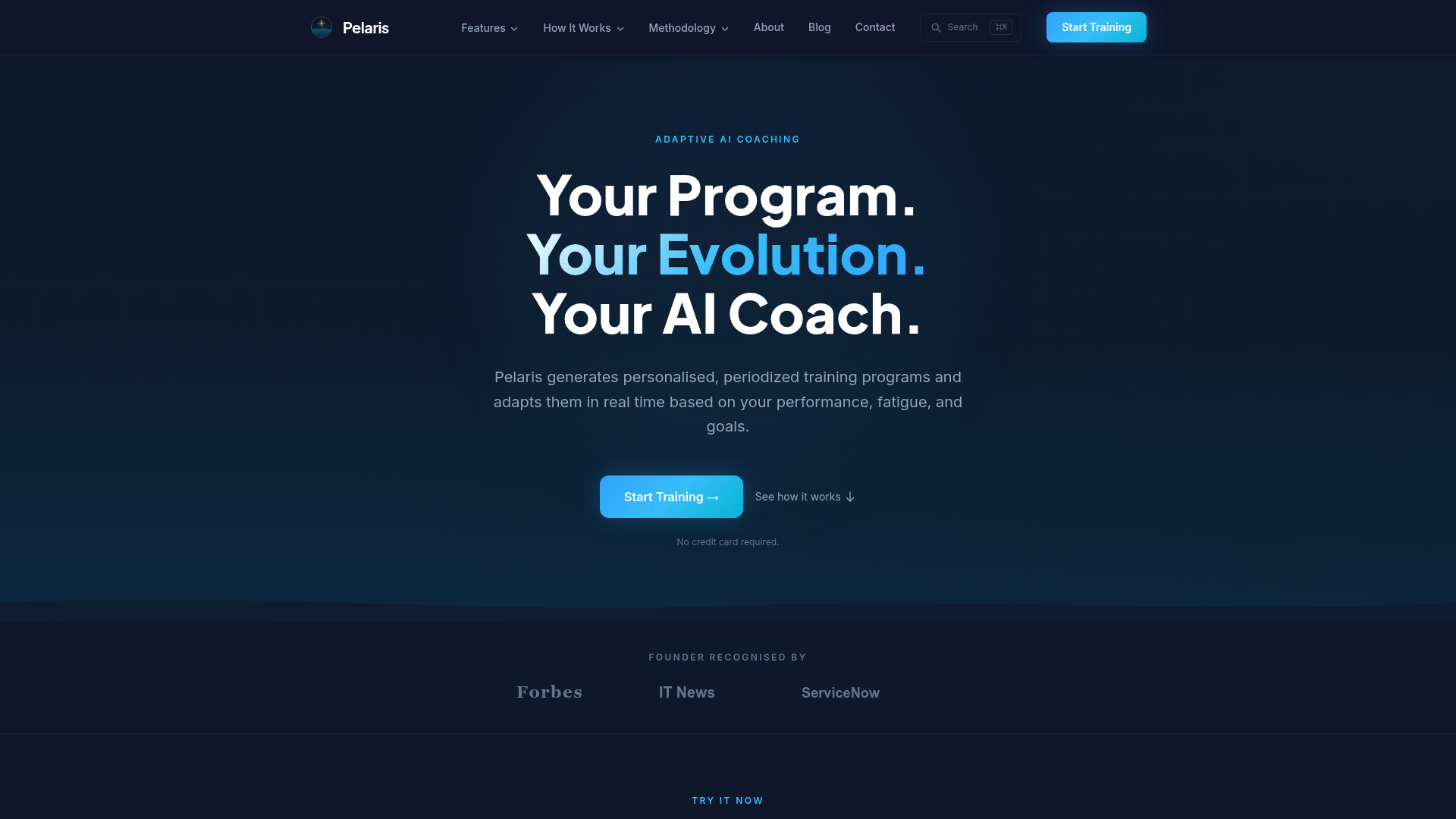

Pelaris enters a crowded fitness app market with a bold claim: it's not another tracker, but an AI coach that decides what you should do next. The pitch is familiar—personalized training—but the mechanism is unusually specific. Pelaris uses a 5-layer LLM pipeline to generate periodized programs that adapt in real time to performance, fatigue, and goals. The site's language is careful: "Not a template. Not a spreadsheet." But the real distinction lies in the architecture and the ambition to coach across multiple sports simultaneously.
The 5-Layer LLM Pipeline: Why Pelaris Isn't a Spreadsheet
Most training apps rely on static templates or simple algorithms. Pelaris claims to be "the only training app using a 5-layer LLM pipeline" to generate programs. The five layers are athlete profiling, methodology selection, periodization architecture, session construction, and exercise prescription. This is a meaningful departure from the rule-based systems that power most competitors. Instead of a one-size-fits-all plan, Pelaris builds a program from sports science methodologies across 10 sport categories, with each phase, week, and session accompanied by coaching rationale explaining the "why." The depth of the pipeline suggests a serious investment in AI infrastructure, but the site doesn't disclose technical details or performance benchmarks. Still, the structure implies a level of personalization that goes beyond simple input-output.
Multi-Sport Periodization: Training for a Marathon, Swimming, and Football in One Plan
A standout feature is the ability to train for multiple sports in one cohesive program. The homepage demonstrates a 16-week plan for a triathlon, open water swimming, and weekend football. The generated plan includes phases like Base Building, Endurance Development, Threshold & Tempo, Race Specificity, and Taper & Peak. The weekly schedule shows a mix of running, swimming, and football, with a note that Sunday's long run follows Saturday's match day, adjusting hydration and nutrition accordingly. This is not just a gimmick; it's a practical solution for hybrid athletes who juggle different disciplines. The site lists support for strength, running, swimming, cycling, triathlon, Hyrox, CrossFit, tennis, general fitness, and team sports like rugby, AFL, soccer, basketball, cricket, and netball. The breadth is impressive, but the real test is whether the AI can balance training loads effectively without overtraining. The site doesn't provide case studies or user testimonials, so the effectiveness remains unproven.
Real-Time Adaptation: When Life Happens, the Program Adjusts
Pelaris emphasizes real-time adaptation: "Every session informs the next." The coach remembers injuries, preferences, and goals, adjusting volume, intensity, and exercise selection as you train. The workout tracker shows progressive overload, with weights auto-adjusting based on the last session, and PR detection feeding back into program intelligence. The example of a bench press PR shows the AI noting: "85kg for 8 reps is a new 8RM PR. Your estimated 1RM is now 107.5kg, up from 102.5kg. I will adjust next week accordingly." This is a clear demonstration of the adaptive loop. However, the site doesn't specify how the AI handles missed sessions or injuries beyond the general claim. The FAQ might address this, but the provided materials don't include it.
From Tracker to Coach: The MCP Integration with ChatGPT and Claude
A unique angle is the integration with AI assistants via the Model Context Protocol (MCP). Users can connect Pelaris to Claude or ChatGPT, allowing the coach to live inside the conversation. The site shows 21 tools available, from daily check-ins to exercise swaps to full program generation. The example conversation shows a user asking "How's my training going?" and the AI responding with a daily check-in, getting coach insight, and logging a workout. This is a clever way to meet users where they already are, reducing friction. It also positions Pelaris as a backend intelligence layer for AI assistants, rather than a standalone app. The integration is early-stage, but it's a forward-thinking move that could expand the product's reach.
Privacy-First Coaching: PII Scrubbing and Data Ownership
Pelaris makes a strong privacy commitment: "Privacy-first by design. PII scrubbing protects your identity from AI. Your data is never sold or shared. Ever." This is a differentiator in an era of data-hungry apps. The site doesn't provide details on how PII scrubbing works or what data is collected, but the claim is bold. For athletes who are wary of sharing health data, this could be a deciding factor. The site also mentions that Strava sync is temporarily unavailable due to Strava's API changes, which shows transparency but also a dependency on third-party integrations.
Naming and Positioning: Pelaris as a Guiding Star in Fitness AI
The name "Pelaris" evokes Polaris, the North Star, suggesting guidance and navigation. The tagline "Stop Tracking. Start Navigating." reinforces this metaphor. The name is distinctive and memorable, though it might be confused with other brands. The domain pelaris.io is clean and professional. The positioning as a coach rather than a tracker is clear, but the market is crowded with AI fitness apps. Pelaris's multi-sport focus and MCP integration are differentiators, but the lack of social proof or user numbers is a risk. The site is well-designed, with a modern aesthetic and clear messaging, but the real proof will be in the results.
Pelaris is a promising entry into the AI fitness space, with a sophisticated approach to program generation and adaptation. The 5-layer LLM pipeline and multi-sport support are ambitious, and the MCP integration is innovative. However, the lack of user testimonials and performance data means the claims are unverified. For athletes who train across multiple sports and value privacy, Pelaris is worth a try. The free tier, with no credit card required, lowers the barrier to entry. The question is whether the AI can truly deliver on its promise of adaptive, periodized coaching that evolves with the athlete. Only time and training data will tell.