Pennant
Pennant is the AI-native proxy voting platform for institutional investors, advisors, and companies, built by former BlackRock and State Street hands.
NewName Editorial
Editorial Team
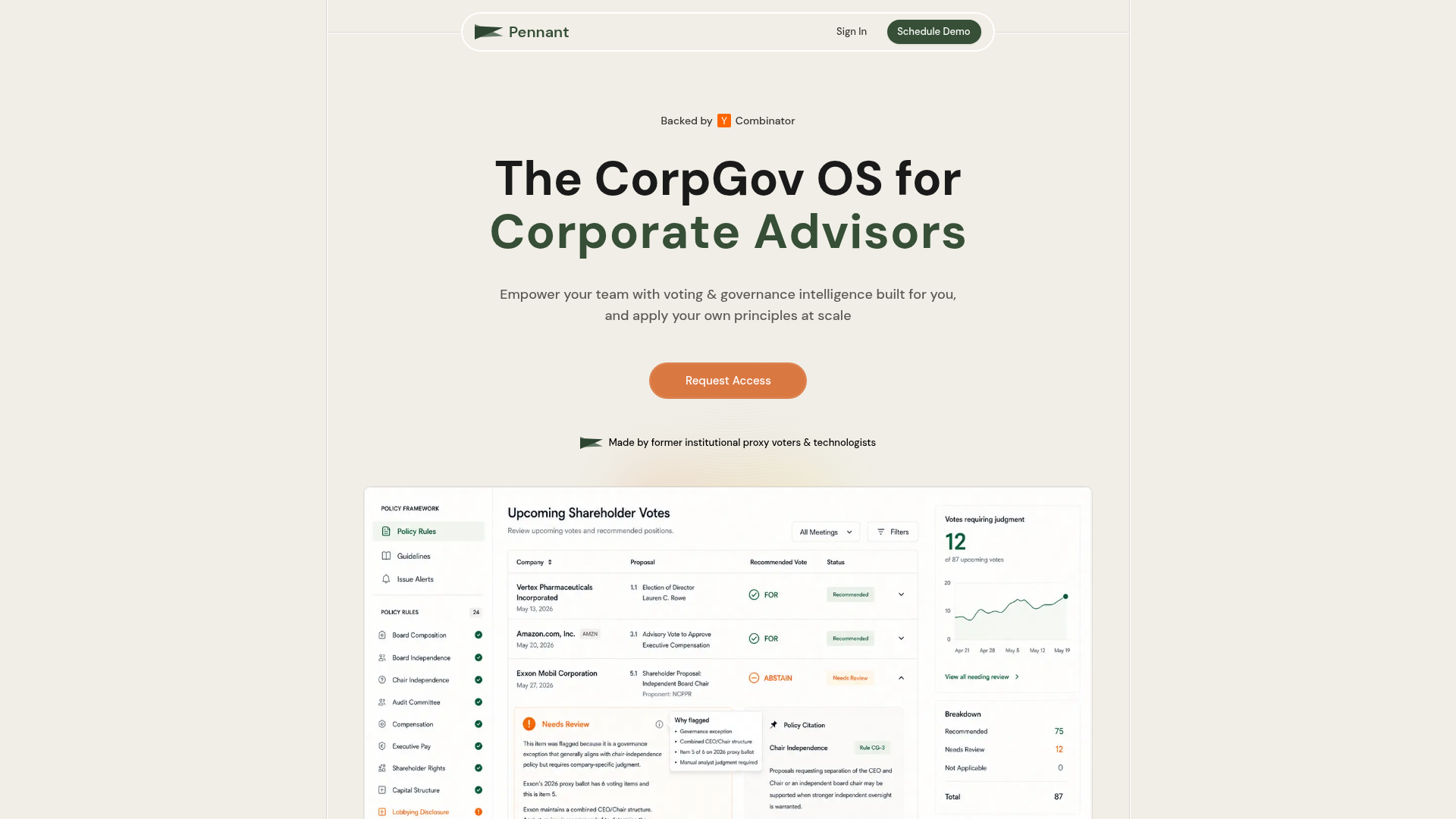
Proxy voting is the quiet machinery of public markets — thousands of annual meetings, each with a stack of filings, a ballot of proposals, and a deadline that cannot slip. For the institutions that vote on behalf of clients, it is also a compliance obligation with a paper trail that regulators can subpoena. Pennant, a Y Combinator-backed startup, is building what it calls the "Corporate Governance OS for Public Markets" — an AI-native platform that promises to pull meetings, filings, proposals, and vote results into one workspace, apply a firm's own voting guidelines, and generate audit-ready records. The pitch is not that AI will decide how to vote; it's that AI can make the surrounding workflow — the part that actually consumes analyst hours — dramatically faster.
The founders, Ryan Nowicki Stewart and Tomas Taylor, met as deskmates at BlackRock and later worked at State Street and PJT Partners respectively. That pedigree is central to the product's thesis: this is software written by people who have lived the pain of manual proxy analysis, not by technologists who discovered the category last quarter.
The Proxy Vote Is a Paperwork Problem Before It Is an AI Problem
A single annual meeting generates a DEF14A proxy statement, often hundreds of pages long, plus 8-K filings, no-action requests, exempt solicitations, and a stream of amendments. For an institutional investor covering thousands of portfolio companies, the volume is staggering. The core problem Pennant addresses is not "what should we vote?" — that's a policy question — but "how do we get from raw filings to a defensible vote recommendation without drowning?"
Pennant's platform is built around the lifecycle of a proxy item: track live filings, analyze policy and precedent, coordinate review, and export client-ready output. The screenshots on the site show a meeting notice for NVIDIA's 2026 annual meeting, complete with the record date and the four stockholder proposals. That's the raw material. Pennant's job is to turn that into a structured, searchable, reviewable object.
Who Pennant Is Actually For (and Why the Three Audiences Share One Workflow)
Pennant targets three distinct audiences: corporate advisors, institutional investors, and public companies. On the surface, these are different markets. But they all orbit the same workflow: someone must analyze a proposal, compare it to precedent, apply a policy, and document the rationale.
- Corporate Advisors — firms like proxy solicitors or governance consultants — need multi-client research workspaces and client-ready reports. They are the outsourced brain for companies that don't have in-house stewardship teams.
- Institutional Investors — asset managers and owners — need policy-aligned recommendations, governance risk insight, and N-PX exports for SEC filings. They are the voters.
- Public Companies — corporate secretaries and IR teams — need to track proposals filed on their own company, search no-action precedent, and prepare for AGM engagement. They are the targets.
Pennant's bet is that all three can share the same underlying data layer — proposals, proponents, precedents — and merely see different views. That's a smart architecture, but it also means Pennant is selling to three different buying committees, each with its own procurement cycle. The site's "custom pricing" for all three tiers suggests Pennant is still in the land-and-expand phase, tailoring scope per client.
From DEF14A to N-PX: The Paper Trail Pennant Automates
The most concrete value Pennant offers is automating the paper trail that governance teams currently assemble by hand. The platform pulls in filings from SEC EDGAR, court records from Justia and UniCourt, and data from Bloomberg, FactSet, and Broadridge. It tracks no-action activity, litigation, and proponent behavior over time.
For compliance teams, the killer feature is the N-PX export. Mutual funds must file their proxy voting records annually on Form N-PX. Producing that filing manually is a nightmare of spreadsheet wrangling. Pennant claims to automate the export and maintain a complete vote record trail, which is exactly what an auditor wants to see.
The site also emphasizes "source-linked intelligence": every data point is tied to its source document. That's a subtle but crucial design choice. In a field where decisions are scrutinized by clients, boards, and regulators, an AI summary without a citation is worthless. Pennant's interface shows the NVIDIA notice with a table of contents — a nod to the fact that analysts need to jump from a summary to the original filing in one click.
The AI Is in the Recommendation, Not the Decision
Pennant is careful to position AI as an assist, not an oracle. The workflow shows a governance analyst flagging a director with 14 years of tenure as above a 12-year independence threshold. The head of stewardship then notes that after direct engagement, they're confident to continue supporting the director. The chief stewardship officer approves an override, with rationale on file.
That example is the heart of Pennant's design philosophy: AI surfaces the risk, but humans make the call. The platform translates a firm's voting guidelines into recommendations with "clear rationale and human review." It flags pay-for-performance concerns — "CEO pay jumped 40% — and returns were flat" — but leaves the final vote to the team.
This is a deliberate counter to the fear that AI will replace governance professionals. Pennant's pitch is that AI handles the grunt work — reading 500-page proxies, comparing precedent, flagging outliers — so analysts can focus on the meetings that matter. The recommendation engine is a starting point, not a verdict.
Why 'Built by Former Proxy Voters' Matters More Than the Model Behind It
The founders' backgrounds are not just a biographical footnote; they are the product's credibility. Ryan spent over a decade at State Street and PJT Partners, advising boards and voting shares. Tommy built agent infrastructure at his previous startup, Mindware, and contributed to AutoGPT. That combination — domain expertise plus AI engineering — is rare.
The site's FAQ hints at the questions buyers ask: "Is Pennant a proxy advisor?" (No, it's a software platform.) "Which AI model providers does Pennant use?" (The site doesn't specify, but the question implies a concern about model reliability.) "Is my data secure?" (A standard enterprise question.)
Pennant's answer to the proxy advisor question is important. Traditional proxy advisors like ISS and Glass Lewis provide voting recommendations. Pennant does not. It provides the infrastructure for investors to make their own recommendations, aligned with their own principles. That's a meaningful distinction in a market where asset managers are under pressure to demonstrate independent judgment.
The Governance Arena and Other Signals of a Category Play
Pennant's footer links to three experimental products: ProxyGuessr, Proposal Pilot, and Governance Arena. These are not core offerings; they are public experiments designed to generate buzz and gather data. Governance Arena, for example, appears to be a battle-style comparison of governance scenarios. These tools serve a dual purpose: they educate the market and they feed Pennant's models with real-world questions.
This is a classic Y Combinator move — build a suite of free tools that attract the exact audience you want to sell to. A governance analyst who plays ProxyGuessr is a potential Pennant customer. The strategy also signals that Pennant is thinking beyond a single workflow, aiming to become the default operating system for corporate governance.
Pennant is entering a market dominated by incumbents like Broadridge and Glass Lewis, but it is attacking from a different angle: not the vote execution or the recommendation, but the analysis and record-keeping layer. If the future of proxy voting is more transparency, more data, and more scrutiny, then the tools to manage that complexity will be in demand. Pennant's bet is that the team that used to do this by hand is the one best positioned to build the software that replaces the manual work.
The company is still early — pricing is custom, and the site does not disclose customer names or metrics. But the product is coherent, the founders are credible, and the problem is real. For institutional investors drowning in proxy season, Pennant offers a lifeline. Whether it becomes the OS for corporate governance depends on execution, but the direction is right.