Photosynthesis
Fuse your iPhone's lenses for real optical detail, no AI upscaling.
NewName Editorial
Editorial Team


For years, smartphone photography has been a game of compromise. You either get the wide field of view of the main lens or the reach of the telephoto, but rarely both in one shot. Digital zoom fills the gap with interpolation, and more recently, generative AI fills it with hallucinated pixels. Photosynthesis, an upcoming iPhone app, takes a different route: it fires two lenses simultaneously and fuses the captures into a single photo. The result, the company claims, is real optical detail across the entire frame—no AI upscaling, no invented texture. It's a compelling pitch, and one that hinges on a simple question: why hasn't anyone done this before?
The last untapped hardware on your iPhone
Every iPhone since the 11 has carried at least two rear lenses, and the Pro models carry three. Yet the camera app treats them as separate tools, not as a combined resource. You switch between them, but you never use them together. Photosynthesis sees this as a missed opportunity. The app's core idea is to capture from two lenses at once and merge the results, keeping the best of each: the detail of the zoom lens and the breadth of the main lens. For two-lens iPhones, it pairs the main camera with the ultra-wide, offering a wider field of view without sacrificing detail. For three-lens Pro models, you can choose between 1x + Zoom and 1x + 0.5x, and the site notes that combining all three is currently in beta.
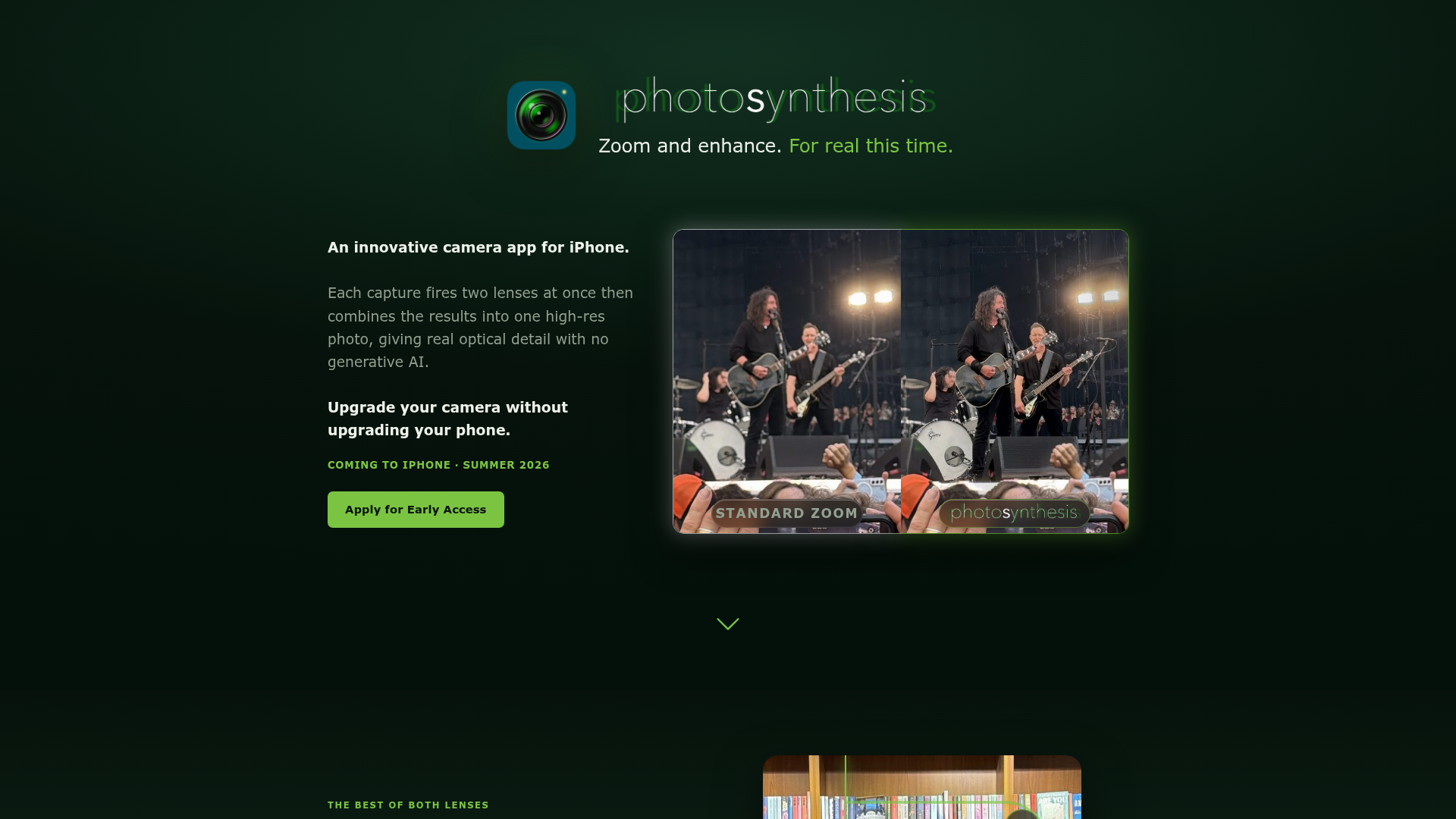
This is not a new concept in computational photography—multi-frame super-resolution has been around for years—but Photosynthesis's approach is distinct. It doesn't take multiple shots over time; it captures two lenses simultaneously. That allows for fusion even during motion, which is critical for live events. The app's viewfinder shows green brackets indicating the area covered by the more detailed lens, guiding you to frame your subject within that zone. Press the shutter, and the app aligns and color-matches the two captures, producing a single high-resolution photo.
Two lenses, one shutter: the fusion mechanic
The mechanics are straightforward, but the devil is in the alignment. The two lenses are physically separated on the phone, so their perspectives differ slightly. Photosynthesis uses machine learning to calculate the best alignment and color match between the captures. This is the only AI in the pipeline, and it's used for processing, not for generating detail. The result is a photo where the center—the part covered by the telephoto—has the optical resolution of the zoom, while the edges retain the wide-angle context. The site's example photos, from a bookshop shelf to a festival stage, show the difference: text is readable, faces are sharp, and the field of view is preserved.
The app also includes a custom editor designed for these two-lens photos. You can adjust exposure, contrast, and other standard parameters, but you can also tweak the alignment of the inner lens and 'paint' over errors to correct ghosting or doubled subjects. This is a thoughtful touch, acknowledging that fusion isn't always perfect. The editor also supports cropping, which is where the real benefit shines: you can capture the widest possible frame and then re-frame later without losing detail, because the center is already at full optical resolution.
Why 'no generative AI' is the sharpest edge
In an era where every phone maker is touting AI-enhanced zoom, Photosynthesis's insistence on 'no generative AI' is a deliberate counter-position. The site repeats it like a mantra: 'Every pixel Photosynthesis delivers is captured by your camera, with no generative AI use whatsoever.' This is a direct appeal to photographers who have grown wary of AI's tendency to invent details. When you zoom into a photo taken with AI upscaling, you might see textures that aren't really there. Photosynthesis promises that what you see is what the lens actually captured. That's a powerful trust signal, especially for documentary or archival work where authenticity matters.
The tradeoff is that the detail is only as good as the lens you have. Photosynthesis doesn't create detail; it combines it. So the benefit is most pronounced on Pro iPhones with a telephoto lens, where the center of the frame gets a genuine optical boost. On two-lens iPhones, the advantage is more about widening the field of view without losing the main camera's detail. That's still valuable, but it's a subtler upgrade.
The tradeoff: framing, focus, and the close-up problem
Photosynthesis makes some deliberate sacrifices to achieve fusion. The viewfinder doesn't allow digital zoom, because the app wants you to keep the full frame for the wide lens. Instead, you frame your subject inside the brackets and crop later. This changes the shooting workflow—you can't compose tightly in the moment. The app also defaults to center focus to optimize alignment, and there's no manual focus control, as it would fight against the lens alignment. For close-up shots, the physical separation of the lenses makes alignment harder; the site admits that if the photos don't align, you can export each lens's image separately. So this is not a macro photography tool.
These constraints are honest, and they're clearly communicated in the FAQ. The app is designed for a specific use case: capturing detail from a distance, like a stage performance or a cityscape, where the telephoto's reach matters. For those scenarios, the tradeoff is worth it.
A launch strategy built on scarcity
The website is a single-page product pitch, with a clear call to action: 'Coming to iPhone · Summer 2026' and an 'Apply for Early Access' button. There's no pricing page, no blog, no about page—just a 404 for those routes. This is a classic pre-launch strategy, building anticipation with a limited beta. The site does outline a freemium model: everything is unlocked for the first 14 days, then you get unlimited capture and editing but only 5 exports per month. A paid 'Unlimited' tier offers unlimited exports, professional formats like PSD and spatial photos, and custom themes. There's also a lifetime unlock option.
The early-access application suggests the developer is looking for a community of testers to refine the app before the public launch. Given the technical complexity of lens fusion, this is a sensible approach. The site's tone is confident but not hypey, with a focus on showing, not telling—the gallery of example photos is the main evidence.
What the name promises—and what it risks
The name 'Photosynthesis' is a clever metaphor: just as plants combine light and carbon dioxide to create something new, this app combines two lens captures into a single, richer image. It evokes organic growth, natural process, and a sense of alchemy. The domain, photosynthesis.camera, is descriptive and memorable. However, the name also carries a risk: it's a well-known scientific term, so it might be hard to trademark or to rank for in search. But for a niche photography app, the poetic resonance outweighs the practical concerns. It positions the app as something that enhances, not replaces, the natural capabilities of the camera.
The brand's visual identity is minimal—a simple wordmark and a clean interface—which reinforces the focus on the technology. The tagline, 'Upgrade your camera without upgrading your phone,' is a strong value proposition that speaks directly to the target audience of iPhone users who want better photos without buying a new device.
Photosynthesis is a bold bet on a specific hardware capability that most users take for granted. If it works as advertised, it could become an essential tool for concert-goers, travelers, and anyone who wants to capture detail from a distance. The no-AI stance is a differentiator in a market increasingly dominated by generative features. The app's success will depend on execution—on the quality of the fusion algorithm and the reliability of the editing tools. The early-access program will be the first test. For now, the promise is tantalizing: real optical detail, no compromise.