Plaudit
Automate review requests after every job, turning happy customers into fresh reviews.
NewName Editorial
Editorial Team
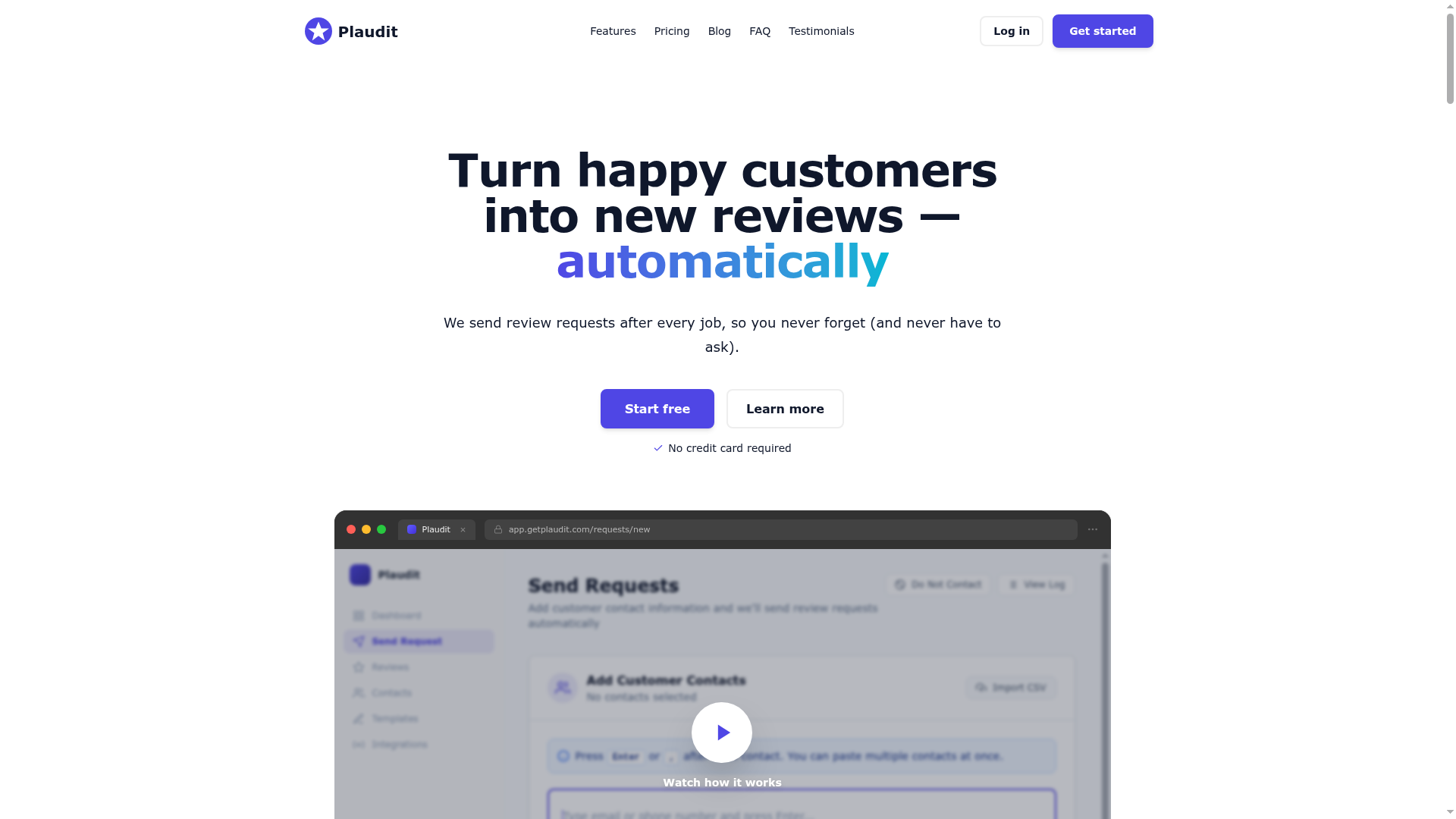

Most small businesses don't have a review problem. They have a timing problem. Customers leave satisfied, maybe even delighted, and then nothing happens. The review never materializes, not because the service was poor, but because the moment passed. Plaudit, a review automation tool for trades and service businesses, is built on a simple thesis: the ask is the bottleneck, and the ask can be automated.
The review gap isn't about happiness—it's about timing
Think about the typical customer journey for a plumber or electrician. The job gets done, the customer pays, and both parties move on. The customer might think, "That was great," but they don't think about leaving a review unless prompted. The business owner, meanwhile, is juggling the next job, and asking for a review feels awkward or simply slips their mind. The result is a gap between customer satisfaction and online reputation. Plaudit's website captures this: "Asking for reviews usually means copying links, switching between platforms, and figuring out how to contact each customer." The product's core promise is to eliminate that friction by sending review requests automatically after a job is completed, an invoice is sent, or a payment is received.
The moment Plaudit automates: from job done to review requested
Plaudit's mechanism is straightforward but strategically placed. It integrates with tools like Xero, QuickBooks, HubSpot, Stripe, and Shopify, so that a review request is triggered by a real operational event—not by a business owner's memory. The website shows a typical flow: a plumber named John uses Plaudit to send a review request to a customer named Sarah after an invoice is paid. The email is friendly, personalized, and includes a direct link to leave a Google review. The timing is key: "Most businesses send requests right after a job is completed, an invoice is sent, or a payment is received—when the experience is still fresh." This is the core value proposition: Plaudit doesn't just make asking easier; it makes asking happen at the exact moment when the customer is most likely to respond positively.
The product also offers smart reminders—email and SMS nudges spaced to maximize completions without spamming. This is a delicate balance. Too many reminders can annoy customers and even violate platform policies. Plaudit's approach is to space them out, respecting the customer's attention while still increasing the likelihood of a review.
Why the 'ask' is the bottleneck for trades and services
The target customer is clear: plumbers, electricians, cleaners, landscapers, personal trainers, hairdressers, and similar service providers. These are businesses where trust is paramount and local reputation directly drives bookings. The website lists dozens of trades, from roofers to vets to IT support. For these business owners, the challenge isn't just finding time to ask for reviews—it's that asking feels awkward. One testimonial from a personal trainer puts it bluntly: "Asking clients for reviews always felt awkward. Plaudit just handles it automatically after sessions." The product removes the social friction, turning a potentially uncomfortable ask into a seamless, automated process.
Moreover, these businesses often lack the marketing sophistication of larger companies. They don't have a dedicated person to manage online reputation. Plaudit's appeal is that it's set-and-forget: "Set it once and forget it," says an electrician in a testimonial. The product is designed for people who are busy doing the actual work, not managing their digital footprint.
Plaudit's compliance stance: the fine line between nudging and spamming
Review automation is a category that lives under a regulatory cloud. Google and other platforms have strict policies against fake reviews, incentivized reviews, and spammy solicitation. Plaudit is careful to position itself as fully compliant: "We don't scrape reviews, create fake reviews, or use unfair gating—review requests are sent only to real customers." This is a critical differentiator, as some competitors have faced backlash for questionable practices. Plaudit also includes opt-out and consent tracking, respecting customer preferences. This compliance focus is not just ethical; it's a practical necessity. If a business gets penalized by Google for review manipulation, the damage to their local SEO could be severe. Plaudit's stance is a selling point for risk-averse business owners.
Naming and positioning: 'Plaudit' as a quiet category play
The name "Plaudit" is an interesting choice. It means "an expression of praise or approval," which is exactly what the product aims to generate. It's a word that is not commonly used in everyday language, which gives it a distinctive, almost literary quality. Unlike names like "ReviewPush" or "ReviewTrackers," which are descriptive and functional, "Plaudit" is more abstract and evocative. This could be a double-edged sword. On one hand, it's memorable and unique, standing out in a sea of generic SaaS names. On the other hand, it might not immediately convey what the product does to a potential customer who is not familiar with the word. The tagline, "Turn happy customers into new reviews—automatically," does the heavy lifting of clarification, but the name itself requires a bit of explanation. The domain, getplaudit.com, is clean and action-oriented, reinforcing the "get" aspect of acquiring reviews.
Where Plaudit sits in the review automation landscape
Plaudit is entering a market with established players like Birdeye and Podium, which offer comprehensive reputation management platforms. The website even includes comparison pages for these competitors, indicating that Plaudit positions itself as a simpler, more affordable alternative. While Birdeye and Podium are full-featured suites with social media management, messaging, and analytics, Plaudit focuses narrowly on review collection. This is a classic wedge strategy: start with a single, painful problem and solve it exceptionally well, then potentially expand later. The pricing reflects this: Starter at $19/month for up to 100 review requests, Growth at $39/month for automation and integrations, and Pro at $79/month for agencies and multi-location businesses. This is significantly cheaper than enterprise-level competitors, making it accessible to small businesses that might be priced out of the bigger platforms.
Plaudit's growth strategy appears to be content-driven, with a blog offering guides on getting more Google reviews and responding to reviews. It also offers free tools like a Review QR Code generator and an AI Review Response generator, which can serve as lead magnets. The website lists badges from directories like ListMySaaS and Startup Fame, suggesting early-stage promotion. Public materials do not disclose funding or founding team, so it's unclear how much traction Plaudit has gained, but the product's focus and execution suggest a clear understanding of its niche.
The open question for Plaudit is whether it can expand beyond its initial wedge without losing simplicity. As it adds features like white-labeling and multi-location support, it risks becoming as complex as the competitors it aims to undercut. For now, Plaudit's value proposition is refreshingly clear: automate the ask, respect the customer, and let the reviews roll in. For a small business owner who has never had a systematic way to collect reviews, that's a compelling pitch.