PlyrPulse
Real-time player intelligence and action tools for iGaming operators to reduce churn and risk.
PlyrPulse
Submitted by the team
The Cost of a Two-Hour Delay in iGaming
The iGaming industry runs on speed. A player's first deposit, a sudden spike in betting frequency, a VIP's quiet week — each is a signal that decays in value within hours. Yet most operators still rely on analytics dashboards that refresh overnight and CRM tools that batch actions into daily campaigns. By the time a risk flag surfaces or a churn alert lands, the player has already moved on, either to a competitor or into a pattern that will cost the operator far more in compliance penalties than in lost revenue.
PlyrPulse, an early-stage back-office intelligence platform, is built to close that gap. Instead of another reporting layer, it positions itself as an "operator action layer" — a single interface where behavioral data, value scoring, and risk indicators are not just visualized but immediately actionable. The commercial thesis is straightforward: in a market where player lifetime value is measured in months and regulatory scrutiny is tightening, the operator who can act on a signal in seconds instead of days gains a structural edge.
From Passive Dashboard to Operator Action Layer
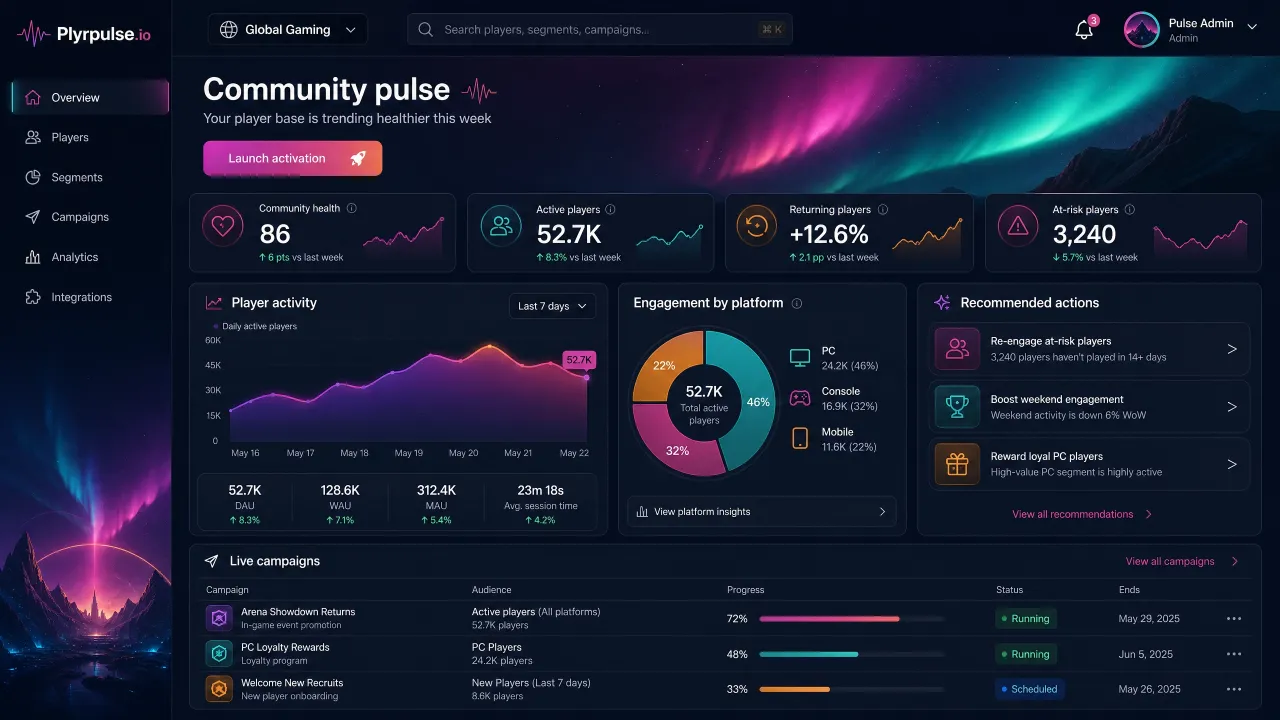
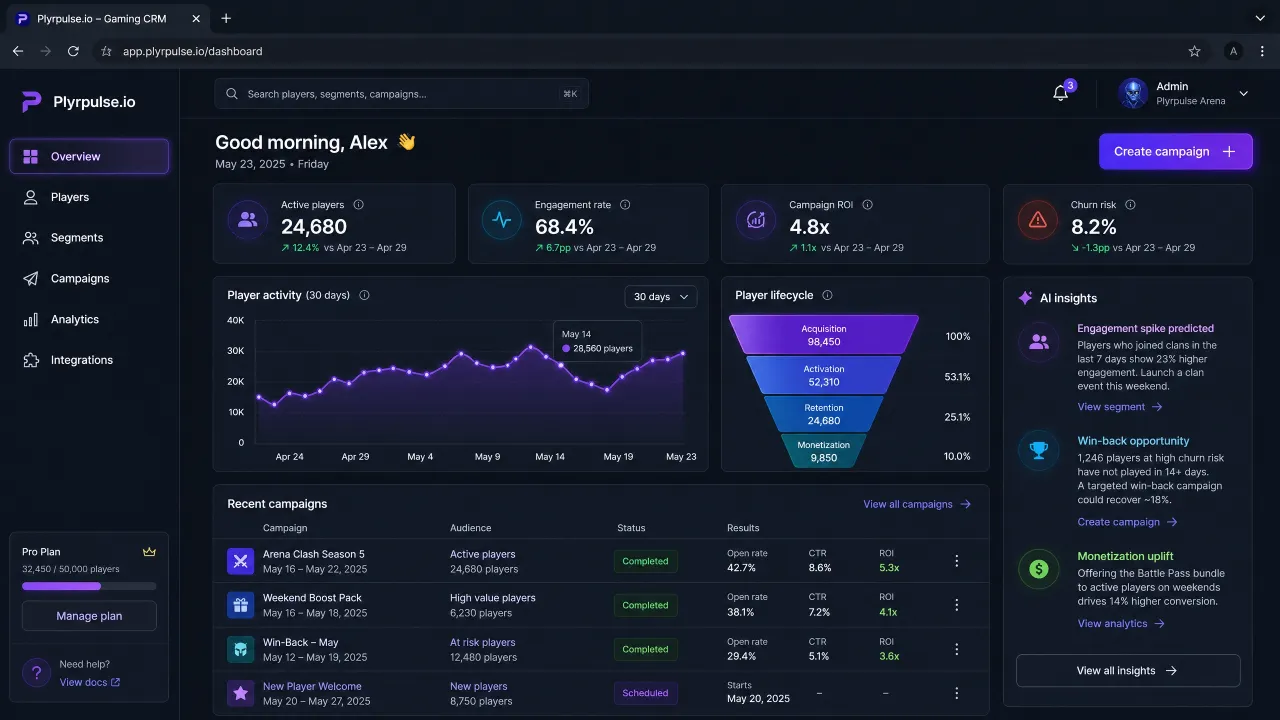
PlyrPulse's core product is a 360-degree player view that aggregates session depth, game preferences, engagement patterns, and financial behavior into one profile. That much is familiar. What differentiates the platform is the action layer: from the same dashboard, a back-office manager can deploy a bonus, set a deposit limit, send a message, or flag an account for review. This collapses the workflow that traditionally spans multiple tools — analytics, CRM, risk management, and messaging — into a single click.
The underlying architecture appears designed to ingest raw player event streams in real time, apply scoring models for risk and customer lifetime value (CLV), and surface alerts as they happen. The website's emphasis on "instant plyrpulse" and "auto-generated reports" suggests the platform also automates the documentation burden that plagues compliance teams, producing audit-ready summaries from live data. For operators, the value proposition is not just visibility but the elimination of manual handoffs between departments.
Why Legacy Analytics and CRM Suites Miss the Real-Time Window
Incumbent solutions in this space fall into two broad categories: business intelligence platforms like Tableau or Power BI, and CRM systems like Salesforce or HubSpot, often customized for gaming. Neither is built for the operational tempo of iGaming. BI tools require data engineering to connect and model, and they present historical trends, not real-time triggers. CRMs are designed for long sales cycles, not for flagging a player who just tripled their deposit velocity in ten minutes.
There are also specialized iGaming analytics providers, but many still operate on batch processing, delivering daily or hourly updates. The result is that risk and VIP teams often work from stale data, reacting to yesterday's problems. PlyrPulse's edge is the integration of real-time scoring with immediate action — a combination that legacy suites would need significant re-architecture to match. The platform's built-in risk and CLV scoring also reduces the need for operators to build custom models in-house, a costly and time-consuming process.
Risk and CLV Scoring as a Compliance and Retention Lever
Regulatory pressure is the tailwind PlyrPulse is riding. Markets like the UK, Sweden, and Germany are imposing stricter requirements on operators to identify problem gambling behavior early and intervene. Failure to do so can result in fines that dwarf any short-term revenue gains. PlyrPulse's risk scoring, which flags accounts based on behavioral patterns, gives compliance teams a defensible, data-driven basis for action.
At the same time, the platform's CLV scoring helps operators focus retention efforts on players who matter most. By segmenting players from first deposit to VIP, PlyrPulse enables lifecycle management that is both proactive and personalized. The combination of risk and value scoring in one system is rare; most tools specialize in one or the other. This dual focus is a strategic differentiator, allowing operators to avoid the common pitfall of treating all high-value players the same, regardless of their risk profile.
Pricing, Deployment, and the Early-Access Go-to-Market
Public materials do not disclose PlyrPulse's pricing, which is likely enterprise-quoted, given the complexity of deployment and the need for customization. The company is currently in early access, with a "request access" model that suggests a high-touch sales process. This is typical for B2B SaaS in regulated industries, where security, compliance, and integration requirements demand a consultative approach.
The go-to-market motion appears to be direct, targeting back-office teams — player account managers, risk and compliance officers, and marketing professionals. The website's promise of "faster operator onboarding" and "reports that write themselves" speaks to a pain point: the training burden of complex analytics tools. By reducing the time to value, PlyrPulse lowers the barrier to adoption, which is critical for a new entrant.
Unit economics are unclear, but the platform's value is tied to the size of the operator's player base and the cost of manual interventions. For a mid-sized casino with tens of thousands of active players, even a small reduction in churn or a single avoided regulatory fine could justify a six-figure annual contract. The challenge will be proving ROI quickly enough to convert early adopters into long-term customers.
The 3-5 Year Trajectory: From Back-Office Tool to Industry Standard
The iGaming analytics market is consolidating, with larger players like Optic Odds and BetConstruct expanding into player intelligence. PlyrPulse's survival will depend on its ability to maintain a real-time edge and to expand its integrations with payment processors, game providers, and CRM systems. The website lists integrations with Slack, Discord, and even Spotify, which are likely illustrative rather than actual, but they signal an intent to embed into the operator's existing workflow.
Over the next three to five years, the platform could evolve from a back-office tool to a central nervous system for iGaming operations, feeding data into marketing automation, fraud detection, and responsible gambling programs. The key risk is that larger incumbents will replicate its features, or that operators will build similar capabilities in-house as they mature. To stay ahead, PlyrPulse must continuously refine its scoring models and expand its action layer to cover more use cases, such as automated bonus optimization or dynamic limit-setting.
If it succeeds, PlyrPulse could become the standard for real-time player intelligence in iGaming, much as Palantir became for data integration in defense. If it fails, it will likely be because it couldn't scale beyond early adopters or because the market chose a more integrated solution from a larger vendor. For now, the company's focus on the intersection of risk and value, combined with a genuine action layer, gives it a credible wedge in a market where every minute of delay costs money.