PortaSale
A creator-first marketplace that keeps 90% of sales, with instant publishing and seller-controlled refunds.
NewName Editorial
Editorial Team


The creator economy runs on a familiar bargain: platforms provide the audience, and in exchange they take a cut that can range from 30% to 60% of every sale. PortaSale is trying to break that bargain with a simple promise: keep 90% of every sale, no approval queues, and full control over your digital storefront. But as with any marketplace, the real question isn't just the fee—it's whether the platform can deliver buyers, visibility, and a sustainable ecosystem. PortaSale's answer is a mix of aggressive seller-friendly policies and a surprising niche focus that could either be its secret weapon or its Achilles' heel.
The 90% That Changes the Math for Digital Sellers
Most digital marketplaces—think CodeCanyon, Envato, or even Gumroad—take a significant slice of each transaction. PortaSale's headline number is a flat 10% commission, meaning sellers keep 90% of every sale. That's not just a small improvement; it's a structural shift in a seller's economics. For a product priced at $30, a seller keeps $27 on PortaSale versus $21 on a 30% platform—a 28% increase in per-sale revenue. Over hundreds of sales, that difference compounds quickly.
The site's own calculator reinforces the point: at $49 per product with 150 sales a month, PortaSale estimates a payout of $6,615 after fees, compared to $5,145 on a 30% platform. That's a $1,470 monthly gap—enough to justify switching for serious sellers. The message is clear: PortaSale is positioning itself as the low-fee alternative, and it's a message that resonates in a market where creators often feel nickel-and-dimed.
Instant Publishing, No Approval Queue: The Anti-CodeCanyon Move
One of the most frustrating parts of selling on established marketplaces is the approval process. CodeCanyon, for example, is known for its rigorous review queues that can take days or even weeks. PortaSale eliminates that entirely. The site promises instant publishing: upload your product, set your price, and go live the same day. No approval queues, no delays.
This is a deliberate contrast to the incumbent platforms. For creators who want to capitalize on a trend or launch a timely product, the ability to publish instantly is a huge advantage. It also lowers the barrier to entry—anyone can sign up and start selling without waiting for a gatekeeper's blessing. The tradeoff, of course, is quality control. Without a review process, the marketplace risks becoming a dumping ground for low-quality or even plagiarized content. PortaSale's answer seems to be a trust-and-verify model, but the site doesn't yet detail how it polices content beyond basic terms of use.
Beyond Commissions: Custom Refunds and Seller-Controlled Rules
PortaSale's differentiation goes beyond the fee structure. It gives sellers control over refund policies, a feature that's rare in digital marketplaces. Sellers can set a custom refund period—7, 14, or 30 days—or disable refunds entirely for specific products. This is a significant shift in power. On most platforms, refund policies are dictated by the marketplace, often favoring buyers to maintain trust. PortaSale's approach lets sellers decide what works for their product type, which is particularly useful for digital goods like code scripts or templates where refunds can be abused.
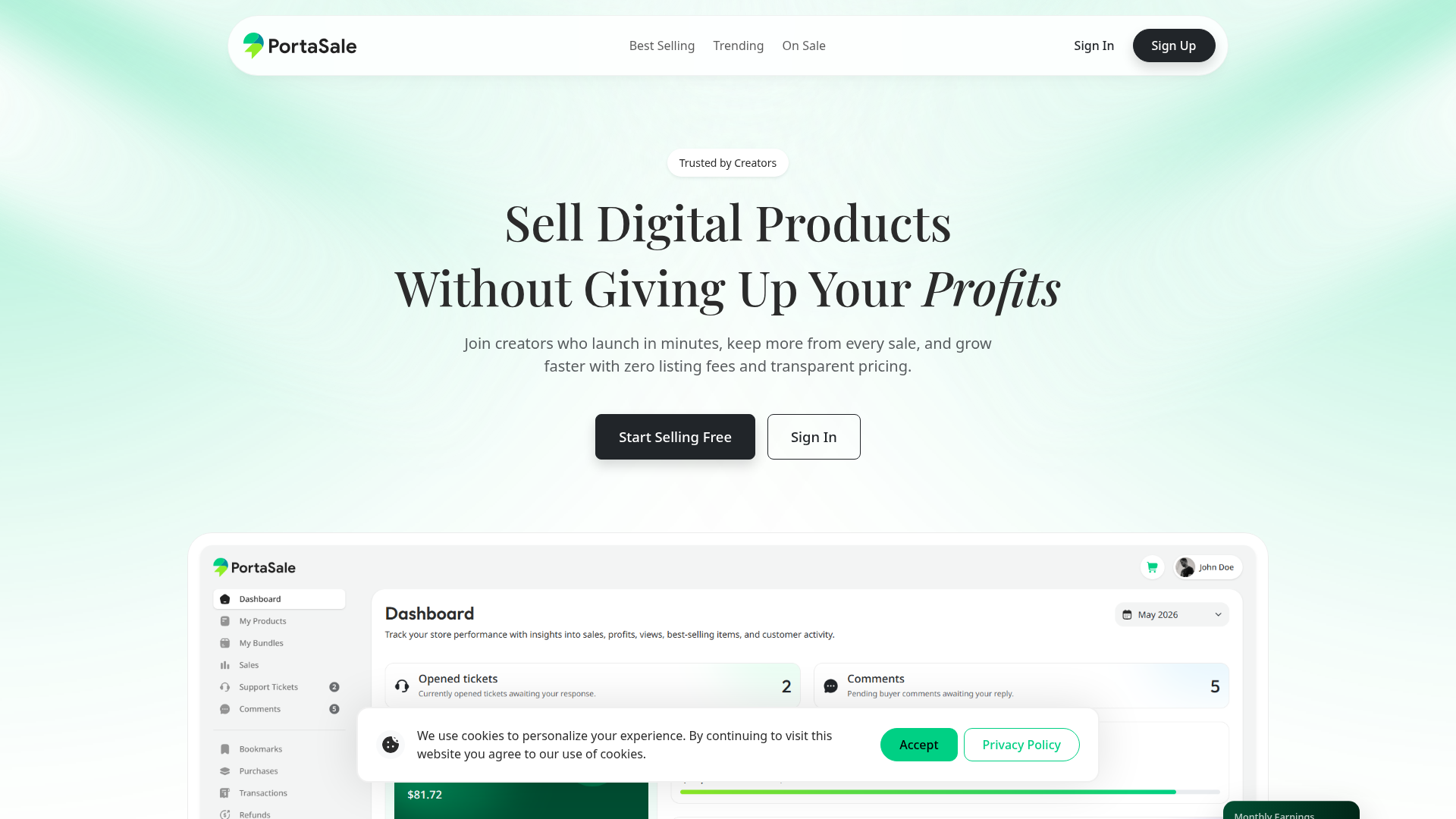
The site also includes a built-in support ticket system for every seller, so buyer queries are managed within the platform rather than through external tools. This is a practical addition that reduces friction for sellers and improves the buyer experience. Combined with custom refunds, it suggests PortaSale is thinking about the operational realities of selling digital products, not just the transaction.
The Sngine Ecosystem: A Niche Bet in a General Marketplace
Scroll through PortaSale's trending products, and you'll notice a pattern: many of them are add-ons for Sngine, a PHP social network script. Products like "EchoBot — Command Center for Sngine," "StoryBoost — Modern Stories for Sngine," and "Level System for Sngine" dominate the listings. This is a strategic niche bet. Sngine has a dedicated user base of developers and site owners, and PortaSale is positioning itself as the go-to marketplace for Sngine extensions.
This focus is both a strength and a limitation. On one hand, it creates a tight-knit community and a clear value proposition for Sngine users. On the other, it narrows the marketplace's appeal. If you're not a Sngine developer, the trending page might feel irrelevant. PortaSale's tagline promises a marketplace for all digital products—scripts, templates, ebooks, and more—but its current catalog suggests a heavy tilt toward Sngine-related items. Whether that's a deliberate launch strategy or a reflection of early adopters remains to be seen.
Equal Exposure and QR Tools: Marketing Without Paying for Placement
One of the most common complaints about marketplaces is that visibility is skewed toward top sellers or those who pay for promotion. PortaSale claims to offer "equal exposure," with trending, new, and free products all getting featured equally. This is a noble goal, but it's also a hard one to execute. Algorithms and human curation tend to favor popular items, and PortaSale's "Trending" section already shows a pattern of bestsellers. Still, the commitment to fairness is a differentiator, especially for new sellers trying to get their first sales.
The site also offers QR code tools, allowing sellers to generate custom-designed QR codes for their products. This is a clever marketing feature—it makes it easy to share products offline or in printed materials, and it tracks stats. For creators who sell at events or through physical collateral, this is a practical addition that most marketplaces overlook.
What PortaSale Doesn't Tell You (Yet)
For all its seller-friendly features, PortaSale's public materials leave several questions unanswered. The site doesn't disclose its payment processing fees, which could eat into the 90% revenue share. It also doesn't detail how it handles disputes beyond the custom refund system, or what happens if a seller's product is stolen and resold. The "equal exposure" promise is vague—there's no explanation of how the algorithm works or how new products get discovered.
More importantly, PortaSale's success depends on attracting buyers. A marketplace with great seller terms but no audience is just a ghost town. The site's testimonials and dashboard screenshots suggest some traction, but there's no public data on total sellers, buyers, or transaction volume. As a new entrant, PortaSale faces a classic chicken-and-egg problem: sellers want buyers, and buyers want selection. The niche Sngine focus might be the key to solving this—it provides a ready-made community to seed the marketplace.
PortaSale is a bold experiment in creator-first economics. Its 90% revenue share, instant publishing, and seller-controlled refunds are genuinely different from the incumbents. But the marketplace's long-term viability hinges on whether it can build a broad buyer base and maintain quality without the gatekeeping that other platforms use. For now, it's a promising alternative that's worth watching—and for Sngine developers, it might already be the best deal in town.