Postlia
Write once, publish to seven networks, and keep it human—built by two people.
NewName Editorial
Editorial Team
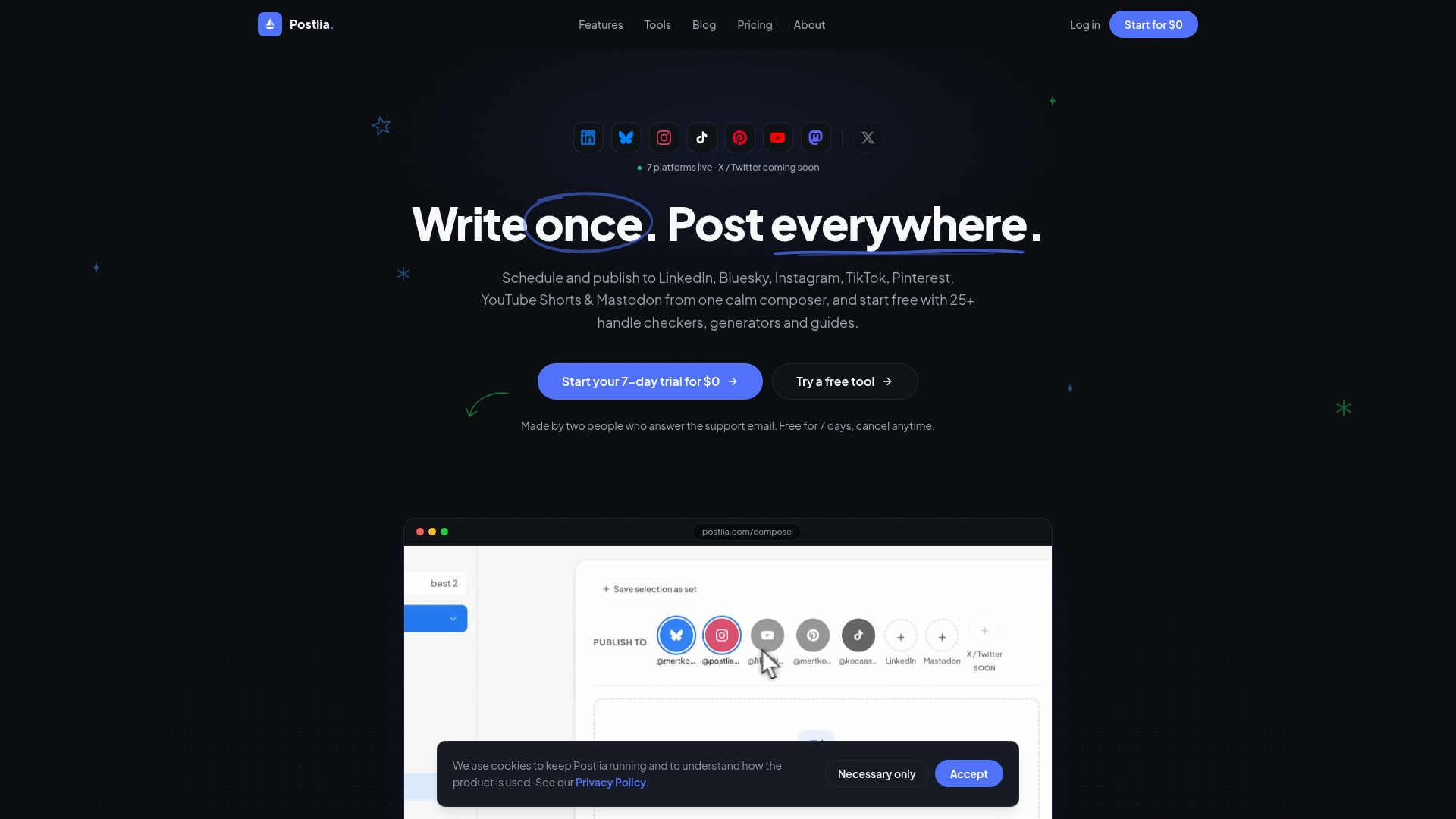

Postlia is a social media scheduler that wants to end the five-tab ritual. Instead of logging into LinkedIn, Bluesky, Instagram, TikTok, Pinterest, YouTube Shorts, and Mastodon separately, you write once in a single composer and publish everywhere at once. The pitch is simple—"Write once. Post everywhere."—but the execution carries a distinctly indie flavor: the company is two people, the free tools are many, and the AI features are designed to keep your content sounding human.
This is not just another Buffer or Hootsuite clone. Postlia is making a bet that a small team can out-hustle the incumbents by being more focused, more transparent, and more willing to ship features that big companies would overthink. Whether that bet pays off is an open question, but the product's early choices reveal a clear thesis worth examining.
The calm composer vs. the five-tab ritual
The core workflow is deceptively simple. You connect your accounts—LinkedIn, Bluesky, TikTok, Instagram, Pinterest, YouTube Shorts, and Mastodon are live now, with X/Twitter coming soon—and then you write a post in one place. Postlia reformats it for each network, and you can tweak the caption per platform if you want. A LinkedIn post and a TikTok caption shouldn't read the same, and the tool lets you adjust tone and length without copy-paste-rewrite.
The scheduling layer is equally straightforward. A visual calendar shows your week, and you can queue posts to go out at the "best time" for your audience. The recording on the homepage shows a real dashboard with a week of content queued in minutes. For solo creators and indie founders, this is the core value: reclaiming the time lost to context-switching.
But the calm composer is not just about convenience. It's a deliberate design philosophy. The interface is sparse, with no clutter, and the copy is direct. This is a tool built by people who were tired of the "one tab per network" workflow and decided to fix it for themselves first. That origin story is visible in every design decision.
Free tools as the front door: a two-person growth engine
Postlia's most distinctive go-to-market move is its arsenal of 25+ free tools, most of which require no signup. There's a handle checker that validates usernames across Instagram, TikTok, X, and more; a hashtag generator that returns 30+ relevant tags; a caption writer; an A/B caption generator; a bio optimizer; and a content repurposer. These are not gated behind an account, which is a bold choice in a category where lead capture is the norm.
The strategy is clear: these tools are the front door. They attract people who are searching for "Instagram handle checker" or "hashtag generator," and they convert those visitors into users once they see the value. The site even says, "They're how most people find Postlia." This is a classic content-led growth play, but executed with a twist—the tools are genuinely useful and free, not just SEO bait.
For a two-person company, this is a smart allocation of resources. Instead of spending on ads, they're building small utilities that solve real problems and earn trust. The tools also serve as a product demo: once you use the caption writer or the repurposer, you've seen the quality of the AI, and you're more likely to try the full composer.
First Draft and the slop gate: AI that respects your voice
AI is everywhere in social media tools, but most of it is generic. Postlia's approach is different. The Pro plan includes a feature called First Draft, which plans your posting week from your own material: your ideas, your past posts, your feeds. It writes every post in your voice, and each one lands in Drafts as a first draft. Nothing publishes until you approve it.
The key detail is the "slop gate"—a scoring system that "throws out the ones that read like AI." This is a direct response to the flood of generic, AI-generated content that has made social feeds feel soulless. Postlia is betting that users want AI assistance, but not at the cost of their authentic voice. The slop gate is a differentiator that speaks to a growing concern among creators: how to use AI without sounding like a robot.
This feature is part of the Pro plan, which also includes unlimited accounts, advanced analytics, and client approval links. The pricing is $49/month, which is competitive with tools like Buffer or Hootsuite, but the AI features add a layer that those tools are only starting to explore.
The MCP server: letting AI agents run your social
Perhaps the most forward-looking feature is the MCP server. Postlia ships an MCP server on every plan, including free, which means you can connect Claude, ChatGPT, Cursor, or any MCP client to your Postlia account. With one command, your AI agent can draft, schedule, and publish to all seven networks, and then verify each post actually went live.
The MCP server is a signal that Postlia is thinking about the future of social media management, where AI agents are the primary users. The delivery receipts are a clever touch: your agent can confirm a post went live instead of assuming it did. This is a feature that big incumbents are likely to copy, but Postlia is shipping it now, and it's free on every plan.
For a two-person company, this is a bold move. It positions Postlia as a tool for the AI-native era, not just a scheduling app. The public API and MCP access are also included in the free plan, which lowers the barrier for developers and power users to experiment.
Naming and positioning: 'Postlia' and the indie underdog
The name "Postlia" is a portmanteau of "post" and "lia" (possibly from "liaison" or "publish"), which suggests a bridge between you and your audience. It's short, easy to spell, and has a friendly, approachable sound. The domain postlia.com is clean and memorable, which is a plus in a crowded market.
The positioning is equally clear: "Write once. Post everywhere." This is a value proposition that anyone who manages multiple social accounts will understand instantly. The tagline "Made by two people who answer the support email" reinforces the indie underdog angle, which is a deliberate choice to build trust through transparency.
This positioning is a double-edged sword. On one hand, it differentiates Postlia from the corporate giants. On the other, it may raise questions about reliability and long-term support. The founders are betting that the personal touch—same-day email replies, one-click cancel, easy export—will win over users who are tired of faceless support.
What Postlia still has to prove
The biggest question is whether a two-person team can sustain this pace. The product is feature-rich, but every new feature adds maintenance burden. The MCP server, the AI tools, the analytics—all of these require ongoing development and support. The founders seem aware of this, and they're using the free tools as a low-maintenance funnel, but the risk is real.
Another open question is the X/Twitter integration. The site says "coming soon," but X has been notoriously difficult for third-party tools due to API restrictions. If Postlia can crack that, it would be a major win, but it's not guaranteed.
Finally, the market is crowded. Buffer, Hootsuite, Later, and Publer are established players, and Postiz is a direct open-source competitor. Postlia's differentiation lies in its AI features, its free tools, and its indie ethos. Whether that's enough to carve out a sustainable niche remains to be seen.
For now, Postlia is a compelling option for solo creators, indie founders, and small agencies who want a simple, human-centric tool that doesn't break the bank. The free tools are worth trying even if you never sign up for a paid plan. And if the founders can keep shipping at this pace, Postlia might just become the underdog story of the social scheduling category.