PrepGo
Master AP exams with expert study guides, smart flashcards, and mock tests.
PrepGo
Submitted by the team
The AP Prep Fragmentation Problem
The Advanced Placement exam market is a multi-million-dollar pressure cooker. Every May, over a million high school students sit for AP tests, hoping to convert course rigor into college credit and admissions advantage. Yet the preparation ecosystem they rely on is remarkably fragmented. A typical student juggles a thick Barron's or Princeton Review book, a stack of Quizlet flashcards, YouTube explainers, and past free-response questions scraped from College Board's website. Each tool covers a slice of the journey, but none integrates content, retention, and exam simulation into a single workflow. This fragmentation creates a structural inefficiency: students waste hours switching contexts, teachers cannot recommend a coherent supplement, and parents pay for multiple subscriptions that overlap in quality and coverage.
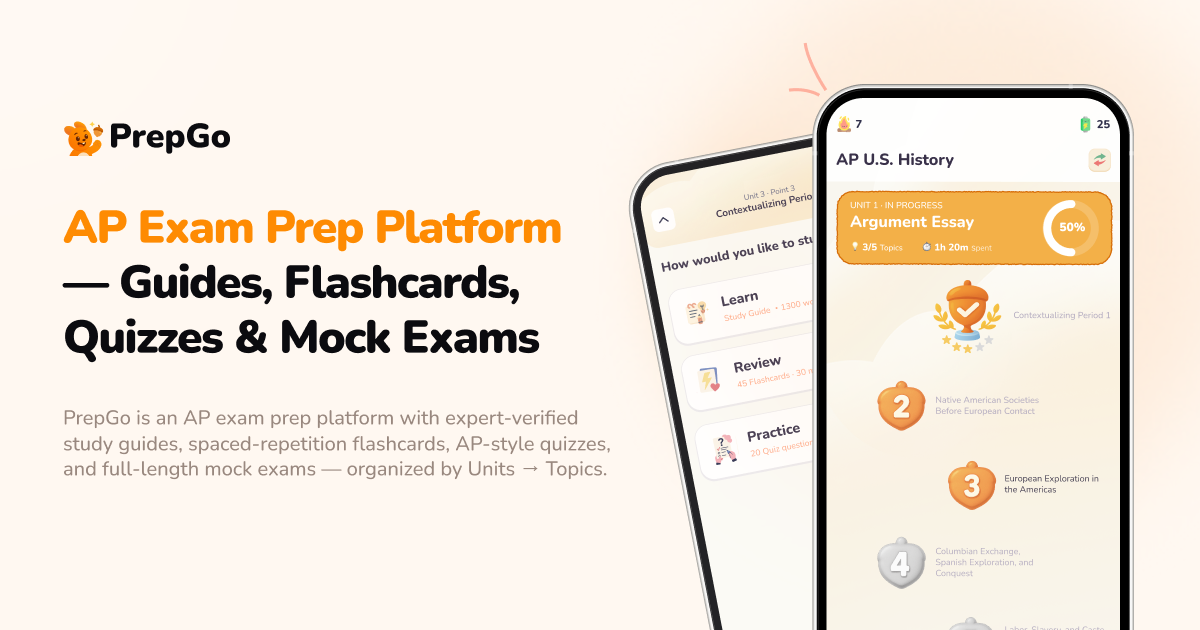
PrepGo enters this gap with a simple but ambitious thesis: consolidate the entire AP prep stack into one curriculum-aligned platform. Instead of forcing students to assemble their own toolkit, PrepGo offers a structured path from study guides to flashcards to quizzes to full mock exams, all organized by Units → Topics. The pitch is not just convenience; it is the promise of a more effective study loop, grounded in learning science like spaced repetition and formative testing. For a market that has long relied on static books and user-generated flashcard decks, PrepGo's integration is a meaningful departure.
PrepGo's Integrated Study Loop: Guides, Flashcards, Quizzes, and Mocks
PrepGo's core mechanism is a sequential study loop that mirrors how top students actually prepare. First, students consume expert-verified study guides, which break each subject into digestible units and topics. Unlike a textbook, these guides are designed for exam relevance, not comprehensive coverage. Next, smart flashcards use spaced repetition algorithms to schedule reviews at optimal intervals, targeting the forgetting curve. This is a proven technique, but it is rarely bundled with authoritative content; Quizlet offers the algorithm, but the decks are user-generated and often riddled with errors. PrepGo's third layer is AP-style practice quizzes, which test knowledge in the format and difficulty of real AP questions. Finally, unit and mock exams simulate the full testing experience, helping students build pacing and confidence.
What makes this loop powerful is the feedback between layers. Progress tracking visualizes mastery levels and identifies weak spots, so students know whether to review a guide, drill flashcards, or retake a quiz. Gamification elements like streaks and achievements provide the motivational nudge that self-study often lacks. For a high school student with limited time and high anxiety, this integrated flow reduces decision fatigue and creates a clear, measurable path to a score of 5. It is a fundamentally different experience from flipping through a book or browsing a shared deck.
The Competitive Landscape: From Barron's Books to Quizlet Decks
PrepGo's competitors fall into three buckets: traditional print publishers, digital flashcard and quiz platforms, and free online resources. Barron's, Princeton Review, and Kaplan dominate the print market, offering comprehensive review books and practice tests. These are trusted by teachers and parents, but they are static, heavy, and lack interactivity. Students cannot track their progress or get adaptive feedback. Digital platforms like Quizlet and Anki offer spaced repetition but rely on user-generated content that varies wildly in quality. Khan Academy provides free instructional videos and practice, but it is not AP-specific in depth and does not offer full mock exams. College Board's own materials are authoritative but limited in quantity and often feel like dry official practice.
PrepGo's wedge is the combination of expert-verified content and a structured, all-in-one workflow. It is not just a flashcard app or a test bank; it is a complete course companion. The closest analog might be modern test-prep platforms like UWorld or Blueprint, but those focus on medical and professional exams, leaving the AP market underserved. PrepGo's challenge is to convince students and parents that its content is as trustworthy as Barron's and its algorithm as effective as Anki. The Discord community and teacher involvement are early signals of building that trust.
Content as Moat: Expert Verification and the Teacher Network Effect
In the AP prep market, content is the moat. Students will not pay for a platform that has errors or outdated material. PrepGo's claim is that its study guides are created and vetted by experienced AP teachers and top-scoring students. This dual input is smart: teachers ensure curriculum alignment and pedagogical soundness, while high scorers ensure the content reflects what is actually tested. The platform also invites users to join the team, creating a potential network effect where the best students contribute to content quality. Over time, this could become a self-improving library, similar to how Wikipedia built authority through community editing, though PrepGo's vetting process adds a layer of quality control that Wikipedia lacks.
However, content is also a treadmill. The College Board updates curricula and exam formats periodically, and PrepGo must keep pace. For example, AP U.S. History has seen framework revisions, and AP Biology has changed its emphasis. A platform that lags in updates loses credibility. PrepGo's current catalog covers six popular subjects, but the full AP catalog includes dozens. Expanding while maintaining quality is a significant operational challenge. The teacher network is a potential solution, but it requires incentives and management.
Freemium Economics and the Path to Paid Conversion
PrepGo offers a free tier, which is typical for consumer edtech. The website's call-to-action is "Start For Free," and the FAQ likely outlines premium features. Public materials do not disclose specific pricing, so we can infer a freemium model where basic guides and limited quizzes are free, while advanced features like full mock exams, detailed analytics, and unlimited flashcards require a subscription. This model aligns with the target audience: high school students with limited budgets, but parents who are willing to pay for results. The conversion trigger is likely a student's desire for more practice tests or progress insights after using the free tier.
The go-to-market motion appears to be organic, leveraging the Discord community and teacher recommendations. The website's "Join the team" and Discord links suggest a community-led growth strategy. The challenge is scaling beyond early adopters. AP students are a seasonal audience—demand peaks in April and May—so PrepGo must acquire users year-round, perhaps by targeting students who are planning their course schedules. The unit economics depend on customer acquisition cost (CAC) versus lifetime value (LTV). If a student subscribes for one season, LTV is limited; if PrepGo can retain users across multiple AP courses (e.g., from sophomore to senior year), LTV improves. The platform's multi-subject catalog supports cross-selling, but it requires students to take multiple AP classes.
Risks and the Road to Scale: Content Depth vs. Curriculum Changes
The biggest risk for PrepGo is the depth-versus-breadth tradeoff. With only six subjects, it cannot yet claim to be a comprehensive AP platform. Students taking AP Computer Science or AP Art History will not find their courses. Expanding to all 38 AP subjects is a massive content production effort. The company must decide whether to prioritize popular subjects (e.g., Calculus, Biology, History) or cover the long tail. Another risk is the seasonal nature of the business. Revenue will spike in spring, but the platform must sustain engagement throughout the year. Gamification and community features can help, but they are not enough to retain students who have finished their exams.
Competitive response is also a threat. Established players like Quizlet could add expert-verified content, or Barron's could launch a digital subscription with interactive features. College Board itself could expand its official practice materials, though it has historically avoided competing with third-party prep. Finally, the rise of AI tutoring tools could disrupt the market, offering personalized explanations and adaptive practice. PrepGo's advantage is its structured, curriculum-aligned approach, but it must innovate to stay ahead.
Looking ahead, the market for AP prep is likely to shift toward digital, integrated platforms. Students already expect mobile-first, gamified experiences. PrepGo is well-positioned to capture this shift, but its success depends on content quality, subject expansion, and effective seasonal marketing. If it can build a trusted brand among students and teachers, it could become the default AP prep app, much like Duolingo for language learning. The next 3-5 years will be critical for scaling content and converting free users into loyal subscribers.