Prescience
Prescience rebuilds employer health insurance by itemizing PEO waste and funding HSAs just in time.
NewName Editorial
Editorial Team
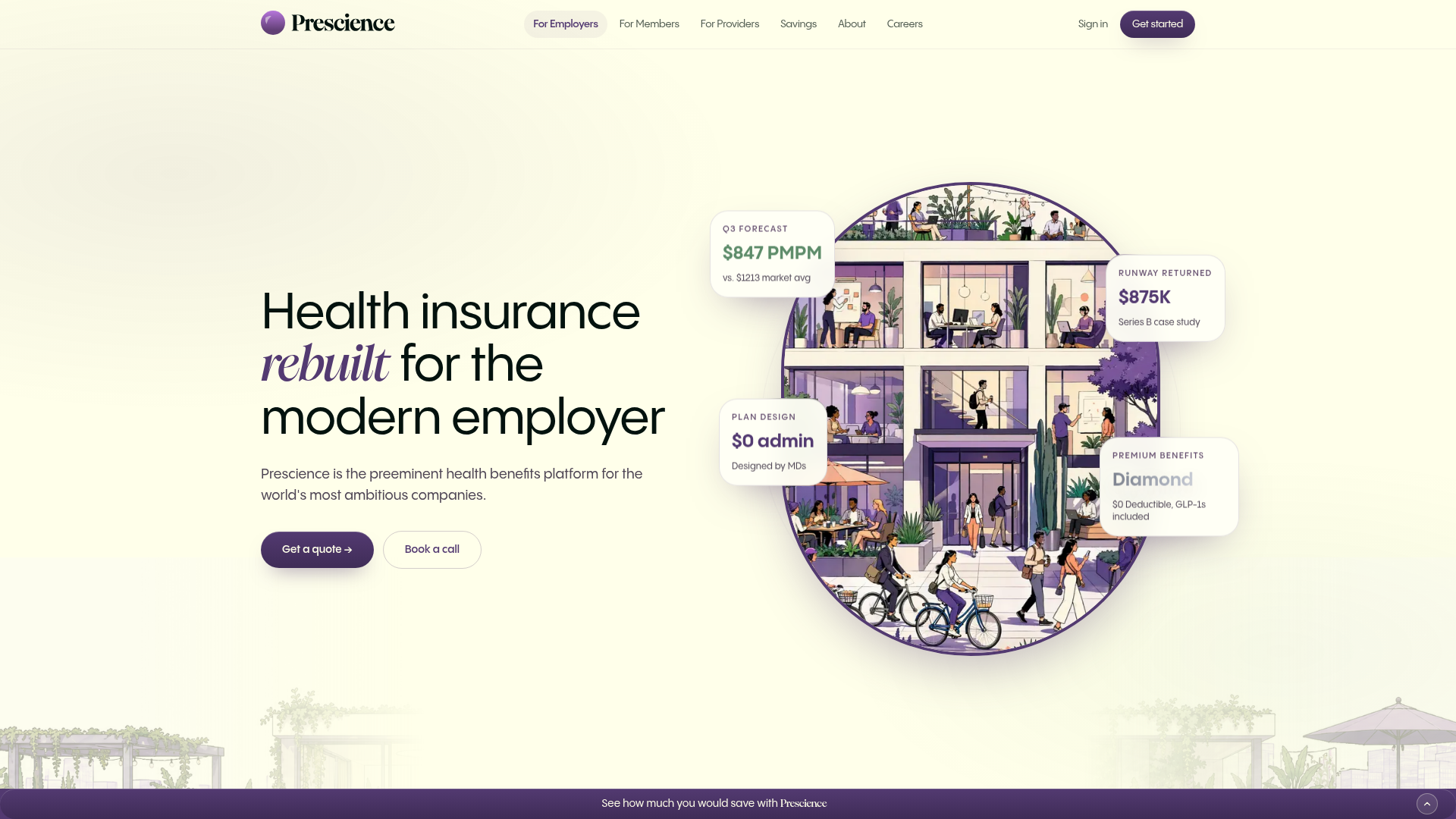

Prescience wants to be the health plan that finally makes employers angry at their PEO. The homepage doesn't lead with a promise of better doctor access or lower premiums—it leads with a mock receipt. A $2.9 million, line-by-line itemization of a 100–250 employee PEO health plan, complete with "PBM spread pricing," "carrier underwriting margin," and "open enrollment processing hours." The message is blunt: your money is leaking through a dozen hidden fees, and Prescience is the one holding the ledger.
It's a clever opening move, because it reframes the entire health insurance conversation. Instead of debating networks and deductibles, Prescience asks you to look at the plumbing. And then it offers a radical alternative: a plan that charges $0 admin, $0 broker commissions, and $0 PBM spread, while funding employee HSAs "just in time." The savings claim—$1.7M/year for a 100–250 person company—is eye-catching, but the real story is in the mechanism. Is this a genuine disruption of the PEO model, or a cleverly packaged self-insurance play?
The $2.9M receipt that sells Prescience
The centerpiece of Prescience's pitch is a detailed cost breakdown of a typical PEO plan. It's a rhetorical weapon: a line-item list of every fee, from "carrier underwriting margin" ($159K) to "pet insurance discount admin" ($8,750). The total: $2.9M, or $1,400 PMPM. Next to it, Prescience shows its own Diamond plan: $1.3M total, $600 PMPM. The difference is stark, but the comparison is also carefully constructed.
Prescience's plan cuts out the PEO middleman, the broker commission, and the PBM spread. It also replaces the "static HSA" (where employers seed a flat amount and eat the deductible) with a "just-in-time HSA" that funds accounts only when care is needed. The result is a leaner cost structure, but it's not a like-for-like comparison. The PEO plan includes dental, vision, and ancillary riders; Prescience's Diamond plan lists "GLP-1s included" and "gene sequencing included" as benefits, but doesn't itemize those costs. The $600 PMPM figure is compelling, but it's an illustrative comparison, not a quote—as the site itself notes.
Still, the receipt does its job. It makes the invisible visible. For an employer who has never questioned the PEO's bundled pricing, the breakdown is a revelation. It also sets up Prescience's core value proposition: radical transparency, even if the transparency is selective.
Just-in-time HSA: the quiet mechanism behind the savings
The most novel part of Prescience's model isn't the AI or the wearable—it's the HSA. Traditional HSAs are funded with a fixed employer contribution at the start of the year, which means the employer pays even if the employee doesn't use the money. Prescience flips this: instead of a static seed, it funds the HSA "just in time," at the point of care. The employee gets a debit card, the employer funds the account when a claim comes in, and any unused balance rolls forward.
This is a clever cash-flow optimization. The employer no longer pre-funds a year of potential claims; it only pays for actual care. The site claims this can reclaim up to $1,700 per employee per year, and that the tax advantages—pre-tax contributions, tax-free growth, tax-free withdrawals—benefit both parties. The employee gets a triple-tax-advantaged account that grows over time, and the employer avoids the "deductible top-ups" that plague static HSAs.
The catch? The HSA is only as good as the care it funds. If Prescience's network is narrow or the AI routing is flawed, employees could end up with a high-deductible plan in disguise. The site says the Diamond plan has a $1,700 deductible and a $4,500 out-of-pocket max, but it also claims "$0 employee premium" and "employer-funded HSA at care." The math works only if the just-in-time funding is generous enough to cover the deductible. Prescience's response is to eliminate the deductible entirely: "No out-of-pocket deductible" is listed as a feature. That's a bold claim, and it hinges on the AI's ability to route care early and cheaply.
AI care routing: where 'Move 37' meets the MRI
Prescience's AI pitch is ambitious. The site describes a "foundation model" that predicts the ideal route for every patient, and even references "Move 37"—a nod to AlphaGo's famous unconventional move. The idea is that the AI can spot a potential ER visit months in advance and reroute the patient to a cheaper, more effective treatment path. The example on the site: a 34-year-old predicted to have an $8,200 ER visit and an $18,400 MSK surgery, totaling $26,600. The AI's "ideal route" is physical therapy and same-day imaging, costing $890. The cost avoided: $25,700.
This is the kind of claim that sounds great in a pitch deck but is hard to verify. The site doesn't provide clinical validation or outcomes data. It's a hypothetical illustration, not a case study. The "24/7 AI Care Companion" that incorporates wearable data and medical records is similarly promising but unproven. Prescience is essentially betting that its AI can outperform the traditional utilization management that insurers already use—but with a more consumer-friendly interface.
The "Move 37" reference is telling. It signals that Prescience sees its AI as a game-changer, capable of making non-obvious decisions that humans would miss. But in healthcare, the stakes are higher than a board game. An AI that routes a patient to physical therapy instead of an MRI might save money, but if it's wrong, the consequences are severe. Prescience's MD-led design team is a mitigating factor, but the site doesn't detail how the AI is validated or audited.
What the Diamond plan actually promises (and what it omits)
The Diamond plan is Prescience's flagship offering, and it's designed to be irresistible: $0 employee premium, $0 deductible, GLP-1s included, a free wearable, gene sequencing, and a 24/7 care companion. The benefits card mockup even shows "Wearable · GLP-1s · HSA funded at care." It's a benefits package that would make any FAANG recruiter jealous.
But the fine print is thin. The site mentions "Direct + Tier 1, curated" network, but doesn't specify how many providers are in-network. It claims "100% in-network coverage," but that's meaningless if the network is tiny. The "real wait times" and "upfront copay rates" are promised, but there's no evidence of provider participation. The HSA marketplace includes Eight Sleep, WHOOP, and Oura—nice perks, but not healthcare.
The biggest omission is the actual cost of the plan. The $600 PMPM figure is for a 100–250 person company, but the site doesn't disclose how that scales. It also doesn't mention what happens if claims are higher than expected. Prescience is likely self-insured or uses a captive, but the site doesn't say. The "high-cost claim protection" line item suggests there's a stop-loss policy, but the details are absent.
Prescience is selling a vision of health insurance that is transparent, proactive, and AI-driven. The receipt is a powerful prop, and the just-in-time HSA is a genuinely clever mechanism. But the proof is in the outcomes, and the site offers illustrations, not evidence. For now, Prescience is a promising pitch with a compelling cost breakdown—and a lot of unanswered questions about the network, the AI, and the real-world claims experience.