Promi
Synthetic customers from your own data to test product ideas before you build.
NewName Editorial
Editorial Team


Product teams have always faced a cruel arithmetic: the earlier you test an idea, the cheaper it is to change, but the less evidence you have. By the time you have real users, you've already built. Promi's answer is to manufacture customers — not from focus groups or panels, but from the behavioral traces your existing users leave behind. The pitch is simple: feed Promi your session recordings, click data, support tickets, and spending data, and it returns a population of synthetic personas — digital twins — that you can interrogate before writing a line of code.
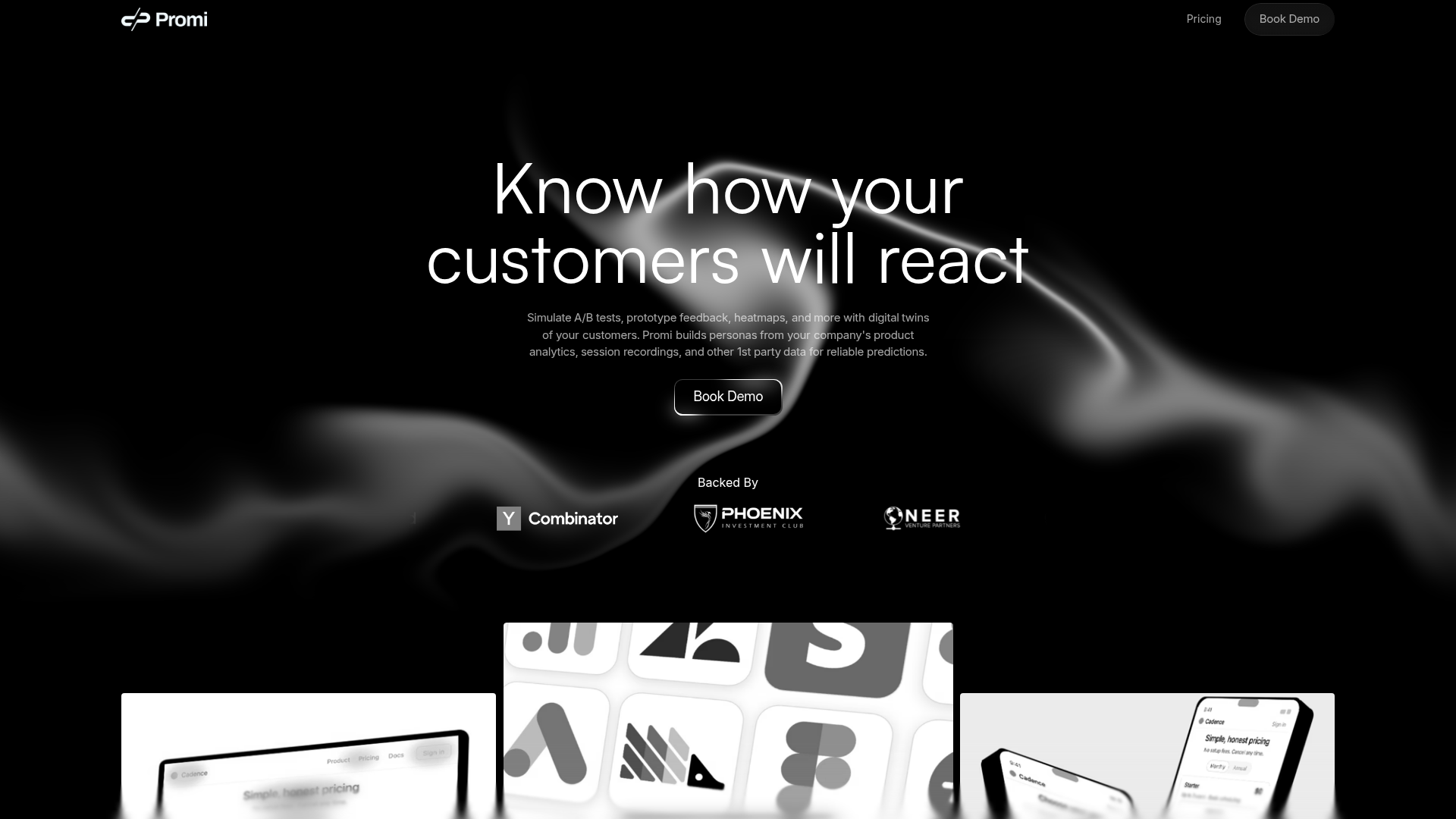
That's a bold claim, and the Y Combinator-backed startup knows it. The landing page promises "reliable predictions" and "results in minutes," with heatmaps, A/B tests, and qualitative feedback all simulated. But the deeper story isn't just about speed. It's about whether a model of your customer can ever be trustworthy enough to replace the real thing.
The feedback bottleneck that Promi is trying to break
Traditional product validation is a gauntlet of compromises. Surveys suffer from self-selection bias; focus groups are expensive and slow; beta programs take weeks to recruit and months to analyze. By the time you have statistically meaningful data, your roadmap has already moved. Promi's thesis is that your own product analytics are an underused asset — a historical record of how every segment of your user base actually behaves, not how they say they behave.
The company's positioning targets the gap between what users claim and what they do. A persona like "Caleb Weber" — a premium subscriber who visits three pages per session, talks frequently with support, and slowly adopts new features — is built from observed behavior, not demographic guesswork. That's a fundamentally different input than the traditional persona, which is often a composite of interviews and assumptions. Promi's twins are meant to be interrogated: you can ask them what they think of a new feature, run an A/B test against them, or watch a heatmap of their simulated clicks.
The implied workflow is seductive: instead of waiting for a beta cohort, you get instant feedback from a thousand synthetic Calebs. Instead of a single prototype review, you get a full distribution of reactions. The promise is that you can iterate on product concepts the way you iterate on code — fast, cheap, and with confidence.
How a digital twin is built from your own data
Promi's mechanism is the core of its pitch. The site lists the inputs: session recordings, click data, support tickets, spending data, and more. These are the raw materials of your existing product's usage. Promi then constructs personas that represent distinct behavioral segments — not just demographics, but patterns like "single use case customer" or "slow adopter of new features."
The output is a set of digital twins that you can test against. The landing page shows examples: a heatmap of where a twin's cursor would go, a written review of your prototype, a survey response. The idea is that you're not getting one opinion but a range — from your power users to your at-risk users — and you can see how each segment reacts.
This is where Promi differs from generic AI survey tools. A chatbot that asks "would you use this?" to a random sample is still a survey. Promi's twins are meant to be grounded in your actual usage data, which gives them a claim to representativeness that a random panel lacks. The startup's emphasis on "1st party data" is a deliberate contrast to third-party data brokers or generic persona libraries. Your customers are unique, the logic goes, so your synthetic customers should be too.
But there's an obvious question: how accurate are these simulations? The site doesn't provide validation metrics or case studies. The only evidence is the product's existence and the backing of Y Combinator. That's not a knock — it's early stage — but it means the burden of proof is on the product, not the marketing.
The pricing signal: $99 per seat and unlimited twins
Pricing is often a window into a startup's strategy, and Promi's is telling. The Standard plan is $99 per month per seat, with "Unlimited Twins" and a feature list that includes URL walkthroughs, reviews, focus groups, surveys, heatmaps, and a Figma plugin. Enterprise plans are custom.
The per-seat pricing suggests Promi is targeting product teams, not individual designers. At $99 a month, it's cheap enough for a team to adopt without a procurement cycle, but expensive enough to signal seriousness. The "unlimited twins" is a clever move — it removes a natural objection ("what if I need more personas?") and shifts the focus to the quality of the simulation.
The inclusion of a Figma plugin is a strategic choice. It places Promi inside the designer's workflow, where product concepts are born. Instead of exporting a prototype to a testing tool, you can simulate feedback without leaving your design canvas. That's a low-friction entry point, and it suggests Promi is thinking about adoption from the bottom up — get designers hooked, and the rest of the organization will follow.
The trust problem no synthetic customer can escape
The biggest challenge for Promi isn't technical; it's psychological. Product teams are conditioned to trust real user feedback. A beta tester's complaint carries weight because it's a human who struggled. A synthetic persona's opinion, no matter how well-grounded in data, will always carry the question: "but is that what real users would think?"
The site tries to preempt this by emphasizing that twins are built from real behavioral data. But the leap from "this is what your users did" to "this is what they would do with a new feature" is a model's inference, not a fact. The risk is that teams either over-trust the simulation (and skip real validation) or under-trust it (and dismiss it as a gimmick).
Promi's positioning as a tool to "evaluate product concepts" before you build is a careful one. It's not claiming to replace A/B testing on live traffic; it's claiming to replace the guesswork that happens before you have traffic. That's a narrower but more defensible promise. The question is whether the simulations are good enough to make product decisions, and that's a bar that will require evidence to clear.
What's missing from the public story
For a product that promises "reliable predictions," the public materials are thin on proof. There are no case studies, no testimonials, no before-and-after comparisons. The site lists "backed by" logos, but they're not named. The pricing page is straightforward, but there's no documentation or API reference. The about and blog pages are 404s.
That's not unusual for a startup at this stage, but it does mean the burden is on early adopters to be guinea pigs. The product's value proposition is entirely dependent on the quality of its simulations, and that quality is unproven. A single well-documented case study — "we simulated a feature launch and the twins predicted a 20% drop in retention" — would do more than any feature list.
Promi's ambition is clear: to make customer feedback as instant and iterative as code deployment. The mechanism is plausible, the pricing is accessible, and the timing is right — AI has made synthetic users feel possible. But the startup's fate will hinge on whether it can earn trust. In a category where the default is skepticism, Promi's real product might be the evidence it can produce, not the twins themselves.