PureBox.ai
Review-first AI cleanup for your real Gmail inbox.
NewName Editorial
Editorial Team
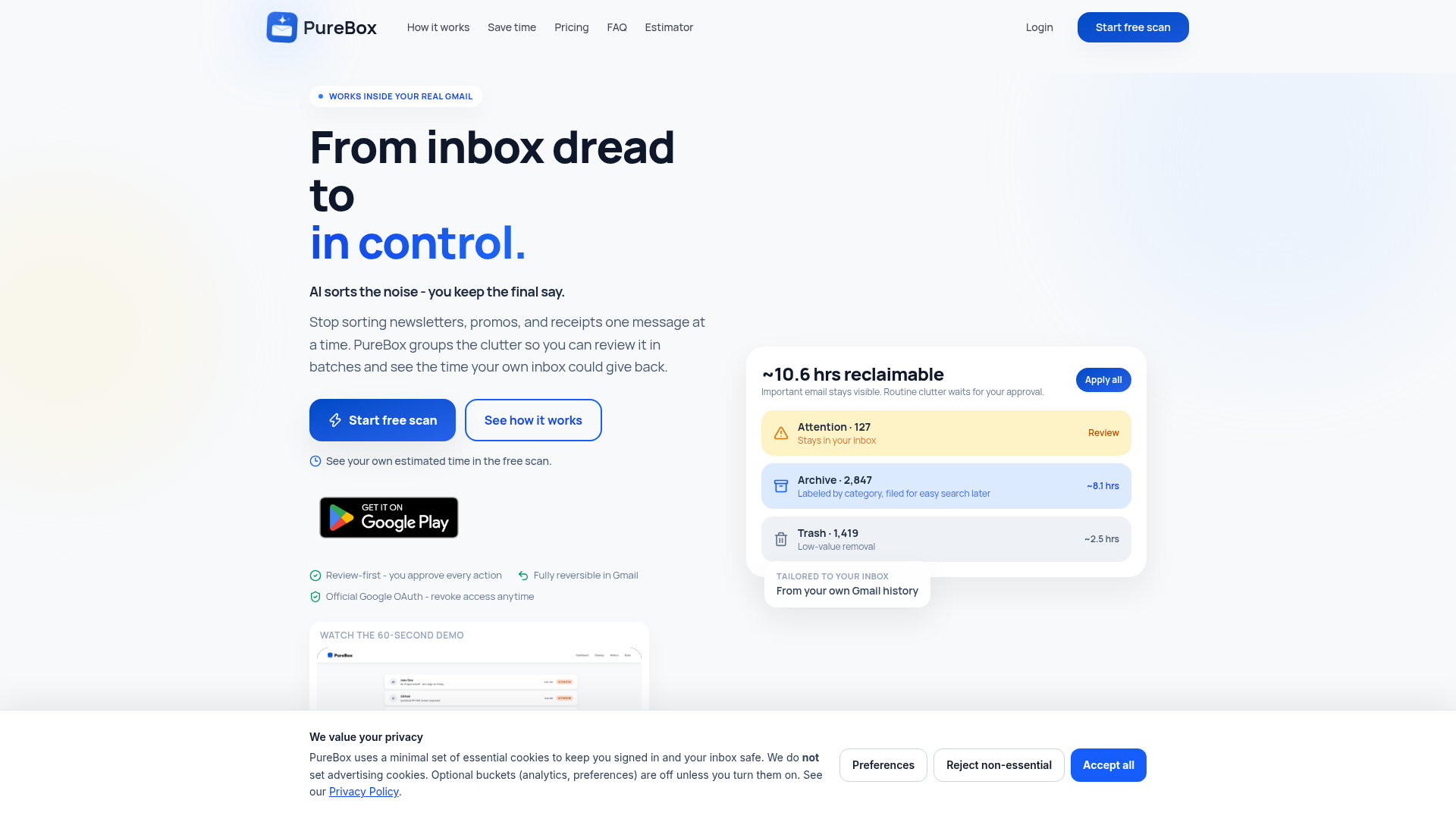
The inbox is a moral hazard. Every unread newsletter, every receipt, every promotional blast is a tiny decision that you defer, and the deferral compounds into a vague sense of dread. PureBox.ai, a new Gmail cleanup tool, doesn't try to solve that with a magic button that deletes everything. Instead, it makes a bet: that the problem isn't the clutter itself, but the lack of a safe, reversible way to clear it. Its answer is a review-first system that sorts your email into three tracks—Attention, Archive, Trash—and then waits for you to approve. The name 'PureBox' is the thesis: a promise of a clean inbox, but only after you've had the final say.
The inbox as a moral hazard
PureBox's landing page opens with a phrase that will resonate with anyone who has stared at a 10,000-email inbox: 'From inbox dread to in control.' The site claims that a typical first scan can reclaim about 10.6 hours—a figure it is careful to label as illustrative, based on a few seconds per email of manual triage. But the real insight is in the framing: 'It is not about emails. It is about hours.' PureBox is selling time, not tidiness. The product's entire architecture is built around the idea that the cost of inbox clutter is not storage space but attention. By grouping the noise into batches, it reduces the number of decisions from thousands to three.
Three tracks, one decision each
The core mechanic is deceptively simple. PureBox triages every message into three categories: Attention (bills, deadlines, people), Archive (receipts, confirmations, labeled for search), and Trash (low-value clutter). Each track is presented with a plain-language reason for every suggestion, and you can approve a whole track in one click or pick through individually. This is a radical departure from the 'inbox zero' apps that auto-archive or delete without asking. PureBox's design acknowledges a truth that many AI tools ignore: trust is earned, not assumed. By showing its work—'why this email is trash'—it invites you to audit its judgment, which is the only way you'll ever let it act on your behalf again.
The free scan as a proof engine
PureBox's go-to-market strategy is built around a free sample scan of up to 100 emails. No credit card required, results in a couple of minutes, and you see your real Attention/Archive/Trash split plus an estimated reclaimable time. This is a clever conversion mechanism: it turns the product into a diagnostic tool. You're not buying a promise; you're buying a number—your number. The free scan is a proof engine, and it's honest about its limits: it shows only a handful of emails, but it's enough to make the value tangible. The pricing page reinforces this: Free is 'proof of value,' Pro is 'your whole inbox + ongoing relief' at $4.99/month billed yearly. The entire funnel is designed to let the product sell itself, one batch at a time.
Why 'Pure' is a promise, not a color
The name 'PureBox' is a masterstroke of positioning. In a category crowded with names like 'CleanEmail' and 'Mailstrom,' 'Pure' suggests not just cleanliness but integrity—a pure process, a pure intent. The branding leans into this with phrases like 'Built on trust' and 'You stay in control of what, and when.' The color scheme, as far as can be inferred from the site, is clean and minimal, reinforcing the purity metaphor. But the name also carries a risk: 'pure' is an absolute. Any misstep—an email wrongly trashed, a privacy breach—would shatter the promise. The company seems aware of this, leaning heavily on 'review-first' and 'reversible' language throughout. The domain, purebox.ai, is short and memorable, and the .ai TLD signals the intelligence inside.
The MCP bridge: AI without the keys
One of the most distinctive features is the PureBox MCP Server. For users who already pay for ChatGPT, Claude, or other AI assistants, PureBox offers a way to let those assistants interact with your email through the Model Context Protocol—but without ever sharing your Gmail login or tokens. The assistant can ask PureBox about cleanup and use 'guarded' actions, subject to the same account checks and limits as the web app. This is a smart play: it positions PureBox not as a competitor to AI assistants but as a trusted layer between them and your inbox. It also future-proofs the product, recognizing that the next generation of email management will be conversational. The FAQ explicitly addresses this: 'Do I need this if I already pay for ChatGPT, Gemini, or Claude?' The answer—'They do different jobs'—is a clear-eyed positioning statement.
What PureBox leaves unsaid
For all its polish, PureBox has gaps. The site doesn't disclose who is behind it (founder Shaked I. is listed in the startup data, but not on the page), nor does it reveal funding or traction. The '10.6 hours' figure is illustrative, not a guarantee, and the free scan's 100-email cap might frustrate power users. There's also a philosophical question: does sorting email into three buckets actually solve the problem, or does it just defer the decision? PureBox's answer is that it reduces the cognitive load of triage, which is a real benefit. But the product's success will depend on whether users trust it enough to let it act autonomously—and whether the 'review-first' friction is worth the time saved. The name promises purity, but the real test is whether the process feels pure in practice. For now, PureBox is a thoughtful, trust-first entry in a category that often sacrifices control for convenience. It's worth a scan.