Impact-Site-Verification: 41b53a0c-6d04-458b-a457-fe9e29acde1a

AI & Machine Learning·Not specified··5 min read

QuillRank

SERP-informed AI articles that target the top 10, not just keywords.

NN

NewName Editorial

Editorial Team

QuillRank product image 1

Most AI writing tools treat SEO as an afterthought: generate a thousand words, sprinkle in a keyword, and hope for the best. QuillRank inverts that logic. Instead of starting with a blank page, it starts with the search engine results page (SERP) itself—pulling the top 10 results for your target keyword, dissecting what they cover, and only then writing an article designed to outrank them. It's a subtle but critical shift: the output is not just content; it's a competitive analysis rendered as prose.

The pitch is audacious: "AI articles that actually rank." Not "AI articles that sound good" or "AI articles that save time," but a direct claim about search visibility. That's a bold promise in a crowded market where tools like Jasper and Copy.ai have long focused on volume and versatility. QuillRank's bet is that the missing ingredient in AI content isn't creativity—it's context. And context, in the SEO world, is data.

The SERP-first premise

QuillRank's core assumption is that the top 10 results for any keyword already contain the blueprint for ranking. Google's algorithm has effectively curated a list of pages that satisfy user intent; why not reverse-engineer that list? The tool fetches those results, analyzes the topics they cover, extracts "People Also Ask" questions, and identifies related searches. This isn't just keyword stuffing—it's about matching the semantic depth and structure that the SERP rewards.

The approach is reminiscent of what tools like Clearscope and Surfer SEO have done for content optimization, but with a key difference: those tools typically require you to write first and optimize later. QuillRank compresses the entire loop—analysis, brief, and draft—into a single action. For a content marketer, this could mean the difference between spending hours on research and getting a first draft in under a minute.

From keyword to brief: the 60-second pipeline

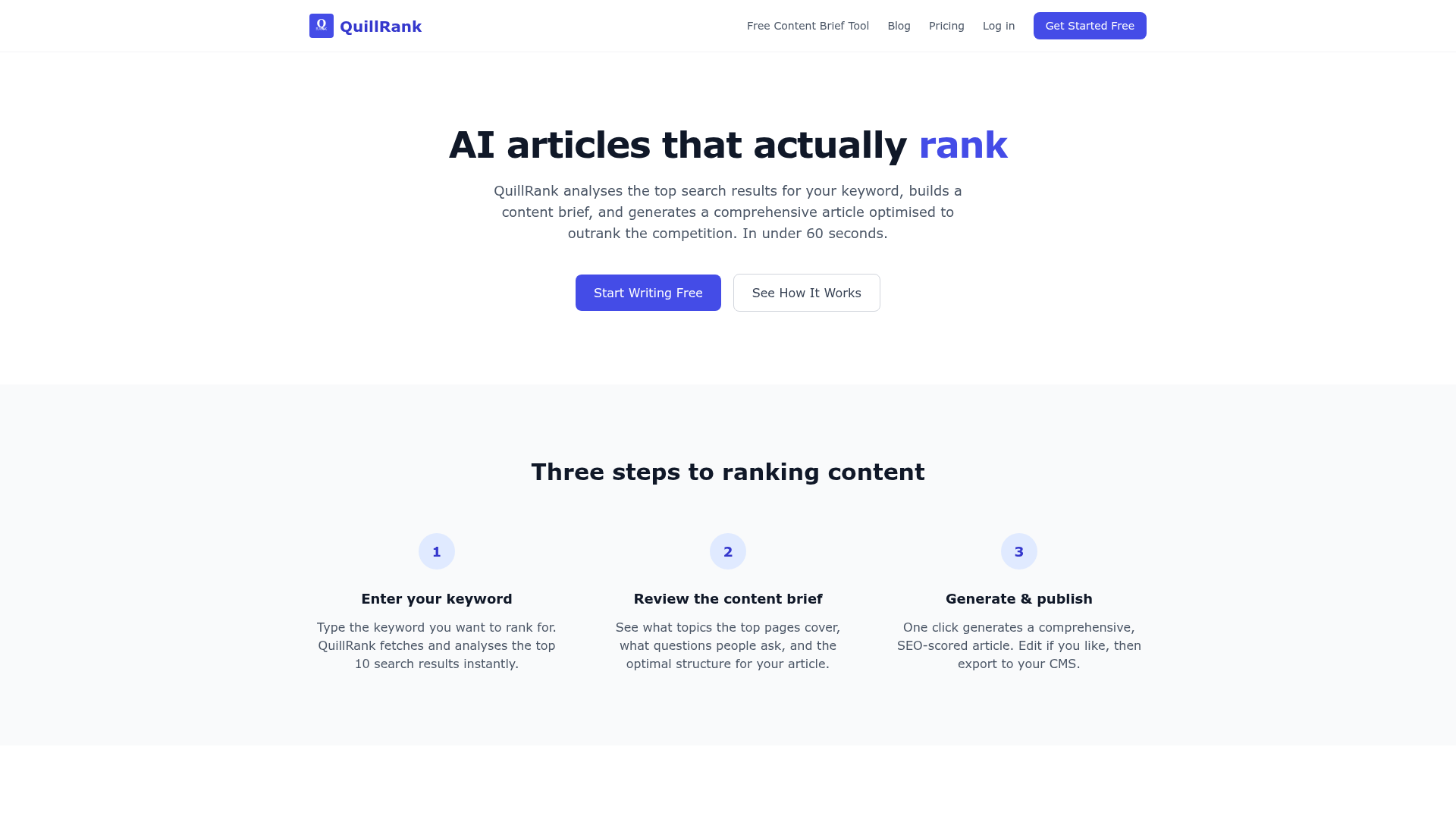
The workflow is deceptively simple. You enter a keyword, and QuillRank fetches the top 10 results instantly. It then generates a content brief that outlines the topics the top pages cover, the questions people are asking, and the optimal article structure. This brief is the strategic layer that most AI writers lack. It's not just "here's an article about X"—it's "here's what you need to cover to compete with the current champions."

After reviewing the brief, you can generate the full article with one click. The output includes an SEO score, a meta description, and can be edited in a split-view markdown editor before exporting as Markdown or HTML. The split-view editor is a thoughtful touch—it lets you see the brief alongside your draft, ensuring the content stays aligned with the data. For teams, bulk generation allows you to queue multiple keywords and process them sequentially, which is a nod to the reality of content production at scale.

The pricing ladder: from free to scale

QuillRank's pricing is refreshingly straightforward: no per-word charges, no hidden fees. The Free tier gives you 3 articles per month, which is enough to test the waters. The Starter plan at £19/mo (15 articles) adds advanced SERP analysis, content briefs, keyword suggestions, and HTML export. The Pro tier at £49/mo (50 articles) includes internal linking suggestions, bulk generation, and content gap analysis—features that suggest a focus on serious content teams. The Scale plan at £149/mo (200 articles) unlocks API access, white-label exports, team members, and dedicated support.

This ladder is designed to grow with a user's needs, but it also reveals a positioning choice: QuillRank is not targeting the casual blogger. The Pro and Scale tiers are priced for agencies and in-house teams that produce content regularly. The inclusion of white-label exports and API access at the top tier signals an ambition to become a backend for other tools or agencies, not just a standalone writer.

The name as a promise

The name "QuillRank" is a compound of "quill" (writing) and "rank" (search position). It's a clever portmanteau that encapsulates the product's thesis: writing that ranks. The name is short, memorable, and has a natural domain (quillrank.ai) that reinforces the AI angle. It also sets a high bar—if the content doesn't rank, the name becomes a liability. But that's the point: QuillRank is staking its brand on outcomes, not just output.

In a market where AI writing tools often have whimsical or abstract names (think Jasper, Copy.ai, Writesonic), QuillRank's functional name is a differentiator. It tells you exactly what the product does and what it promises. For a buyer evaluating tools, that clarity is valuable. It also makes the product easy to recommend: "Use QuillRank" is a sentence that carries meaning.

Where the model could break

QuillRank's approach is not without risks. The most obvious is that the SERP is not static. Google's algorithm changes, and the top 10 results for a keyword can shift due to algorithm updates, new content, or changes in user intent. A tool that analyzes the SERP at a single point in time may produce content that is already outdated by the time it's published. The tool's reliance on "People Also Ask" questions and related searches is smart, but those are also dynamic.

Another risk is the quality of the generated articles. While the brief ensures topical coverage, AI-generated prose can still be generic or lack the nuance that human writers bring. The SEO score is a useful heuristic, but it's not a guarantee of ranking. Google's algorithms are increasingly sophisticated at detecting thin or low-value content, and a tool that optimizes for SERP features might inadvertently produce content that is too formulaic.

Finally, there's the question of differentiation. As more tools adopt SERP analysis, QuillRank's edge may erode. The moat is not the concept but the execution—the quality of the analysis, the accuracy of the briefs, and the usability of the editor. Public materials do not disclose the underlying models or the depth of the SERP analysis, so it's hard to assess how much of a lead QuillRank has.

Who should care and what to watch

QuillRank is most compelling for content marketers, SEO specialists, and agencies that need to produce a high volume of articles that have a fighting chance of ranking. The free tier is a low-risk way to test whether the SERP-first approach resonates. For solo bloggers, the free tier might be sufficient, but the paid plans are better suited for teams.

What to watch: whether QuillRank can maintain the quality of its briefs as it scales, how it adapts to Google's algorithm updates, and whether it can build a community of users who validate the "actually rank" claim. If the tool delivers on its promise, it could become a staple in the SEO content stack. If not, it'll be another AI writer in a crowded field. The next few months will tell.