Rapidfolio
Deterministic AI agents that automate compliance, operations, and fraud workflows for fintechs and banks—with full audit trails.
NewName Editorial
Editorial Team
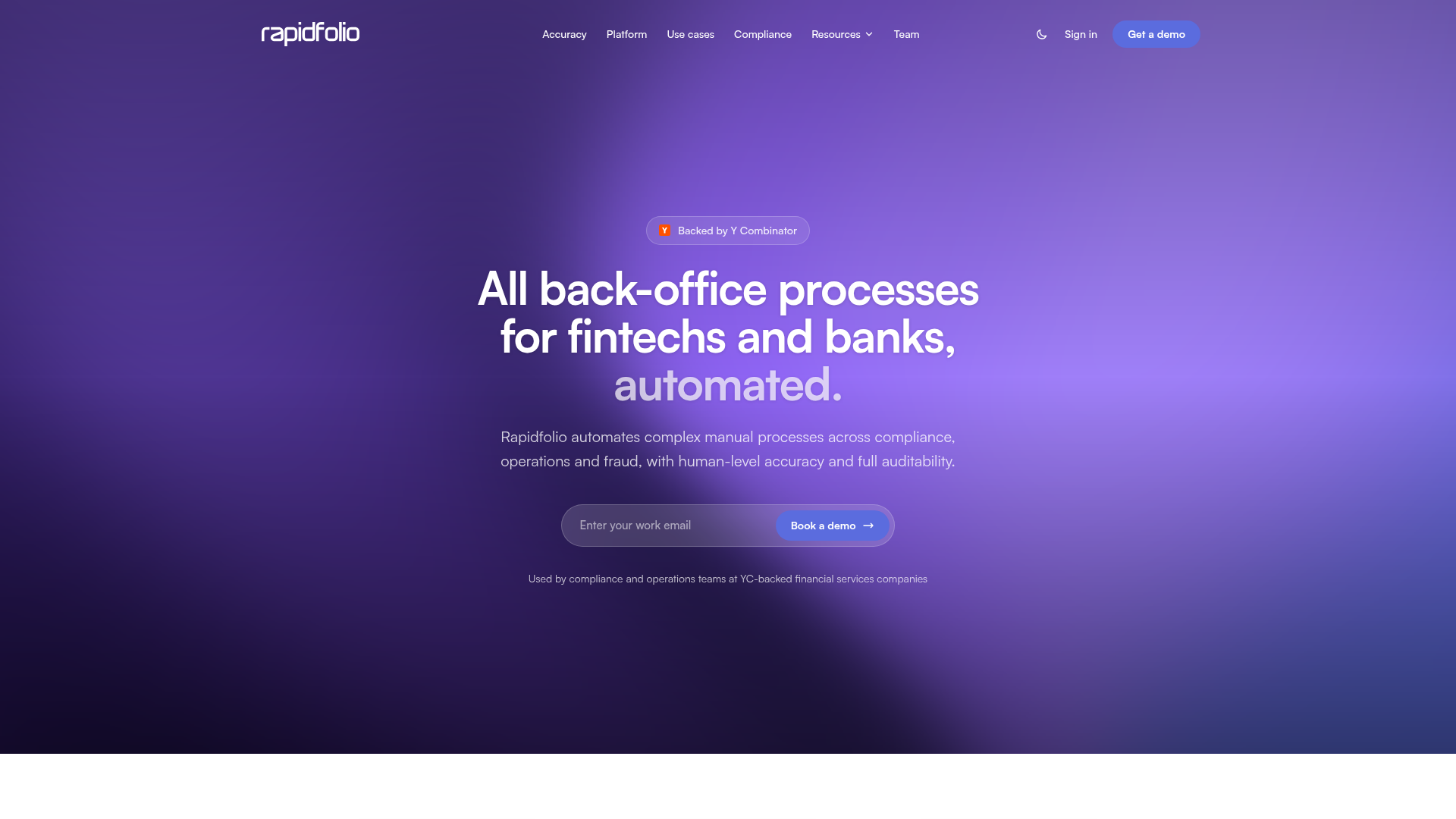

Rapidfolio is not another AI copilot that suggests next steps. It's a platform that takes the manual procedures your compliance and operations teams already follow, converts them into AI-run workflows, and then executes them with a level of obedience that would make a rule-following auditor smile. The pitch is simple: no hallucinations, no improvisation, just your exact procedure, every single run. For a regulated industry that has been burned by AI's tendency to make things up, that's a bold and necessary promise.
The compliance bottleneck that AI agents are finally allowed to touch
Fintechs and banks run on a mountain of manual back-office work: onboarding reviews, watchlist checks, fraud alerts, reconciliation. These tasks are repetitive, high-volume, and heavily documented—yet they've been notoriously resistant to automation. Why? Because the cost of a mistake isn't a bad recommendation; it's a regulatory fine, a failed audit, or a fraud loss. Generic AI tools that offer probabilistic answers are useless here. You need certainty.
Rapidfolio's website claims to deliver that certainty, with a headline of "99.9%+ task accuracy across complex, multi-step financial operations." That's a strong claim, and the company backs it with a specific example: a KYB workflow where the agent fetches a company record from Marqeta, checks sanctions lists via ComplyAdvantage, runs an adverse media search, verifies beneficial owners through Persona, generates a risk summary, and then approves the KYB. Each step is a deterministic tool call, not a guess.
Deterministic execution: the anti-hallucination design
The core design principle is what Rapidfolio calls "deterministic execution." The agents don't get to improvise. They follow a defined procedure, with every step, tool call, and branch specified in advance. This is a deliberate rejection of the freewheeling, chat-based AI assistant model. Instead, it's closer to a robotic process automation (RPA) tool, but with AI handling the judgment-heavy parts—reading documents, extracting data, making risk calls—within a tightly constrained framework.
This matters because the biggest objection to AI in compliance is the black box problem. If an AI agent approves a high-risk customer, you need to know exactly why. Rapidfolio's answer is full audit traceability: every execution is recorded, including inputs, outputs, tool calls, and the decision at each branch. You can pull up any run and show auditors exactly what happened, step by step. That's not an add-on; it's the whole point.
The website also emphasizes that "your data doesn't train our models" and that workflows stay in your environment. For a bank or fintech, that's a non-negotiable requirement. The company is SOC 2 compliant and offers role-based access control, end-to-end encryption (AES-256 at rest, TLS 1.3 in transit), and human review checkpoints. You can pause any run for human approval, and the log records who approved, when, and what they reviewed.
From procedure to workflow: the four-step loop
Rapidfolio's platform is built around a simple loop: bring in your procedure, test it, deploy it, and analyze the results. The first step is to convert your existing manual procedure into an AI-run workflow. This is where the platform's speed claim comes in: "in minutes, not months." The second step is automated testing—the platform generates dozens of test cases for your workflow, so you can deploy with confidence. The third step is deployment, triggered by anything from a JIRA ticket to a webhook. The fourth step is analysis and audit, where every run is recorded and inspectable.
This workflow is designed to fit into the existing stack. The integrations list reads like a who's who of fintech tooling: Jira, Slack, Onfido, Persona, Jumio, Veriff, LexisNexis, ComplyAdvantage, Sift, and more. This is a pragmatic acknowledgment that fintechs won't rip out their existing KYC and fraud tools; they need an orchestration layer that sits on top and automates the manual parts.
A founder who has felt the pain of manual compliance
Rapidfolio's credibility rests heavily on its founders. Naveen Qureshi, the CEO, previously founded Sable, a Y Combinator-backed consumer credit card company for underbanked Americans, which she scaled and exited in 2022. She then stayed on for two and a half years to launch additional credit products. Before that, she led Product and Operations at Capital One. Her co-founder and CTO, Frederik Vanhevel, was Sable's founding engineer and built its entire technical stack.
This is not a team of AI researchers looking for a problem to solve. They've lived the operational pain of running a fintech, where compliance reviews can take days and the back-office queue never shrinks. The website's case studies reflect that: a B2B fintech reduced onboarding manual review from 3 days to under 2 minutes; a fraud platform automated watchlist reviews and saved $350k+ in the first year; a bank reduced its back-office operations queue by 83%. These numbers are specific and impressive, though the website doesn't name the companies or provide methodological detail.
The 30-minute demo: a go-to-market built on trust
Rapidfolio's go-to-market is refreshingly concrete: "30 minutes. One complete workflow, from procedure to audit trail." The pitch is to bring your own use case, and they'll automate it live. This is a smart move for a product that lives or dies on trust. A 30-minute demo isn't a slide deck; it's a proof. If the agent can't handle your workflow in front of you, you walk away. If it can, you've seen the future of your back office.
This approach also signals confidence in the product's speed and accuracy. The company says it can convert a manual procedure into an AI-run workflow in minutes, and the demo is designed to prove that. It's a high-risk, high-reward strategy that aligns with the founder's background: they've built and sold a fintech, so they know what buyers need to see.
What the evidence doesn't show yet
For all its strengths, Rapidfolio's public materials leave some questions unanswered. The case studies are anonymous, so there's no way to verify the claims independently. The website doesn't disclose pricing, which is common for enterprise SaaS but still a gap. And while the platform's deterministic approach is compelling, it's unclear how it handles edge cases that fall outside the defined procedure—what happens when a document is missing, or a sanctions list returns an ambiguous match? The website mentions human review as a safety valve, but the details of that escalation process are thin.
There's also the broader question of whether deterministic AI agents are the right long-term architecture. The financial services industry is moving toward more adaptive, risk-based approaches, and a rigid procedure-based system might struggle to keep up with evolving regulations. But for now, Rapidfolio is betting that the market wants certainty over flexibility, and that's a bet worth watching.
In a category crowded with AI copilots and chatbots, Rapidfolio stands out by being boring in the right way: it promises to follow the rules, keep a log, and never improvise. That's exactly what compliance teams need, and it's why this platform might actually get adopted.