Rasyn
Rasyn runs 54 real chemistry tools behind a chat interface, on your own hardware.
NewName Editorial
Editorial Team
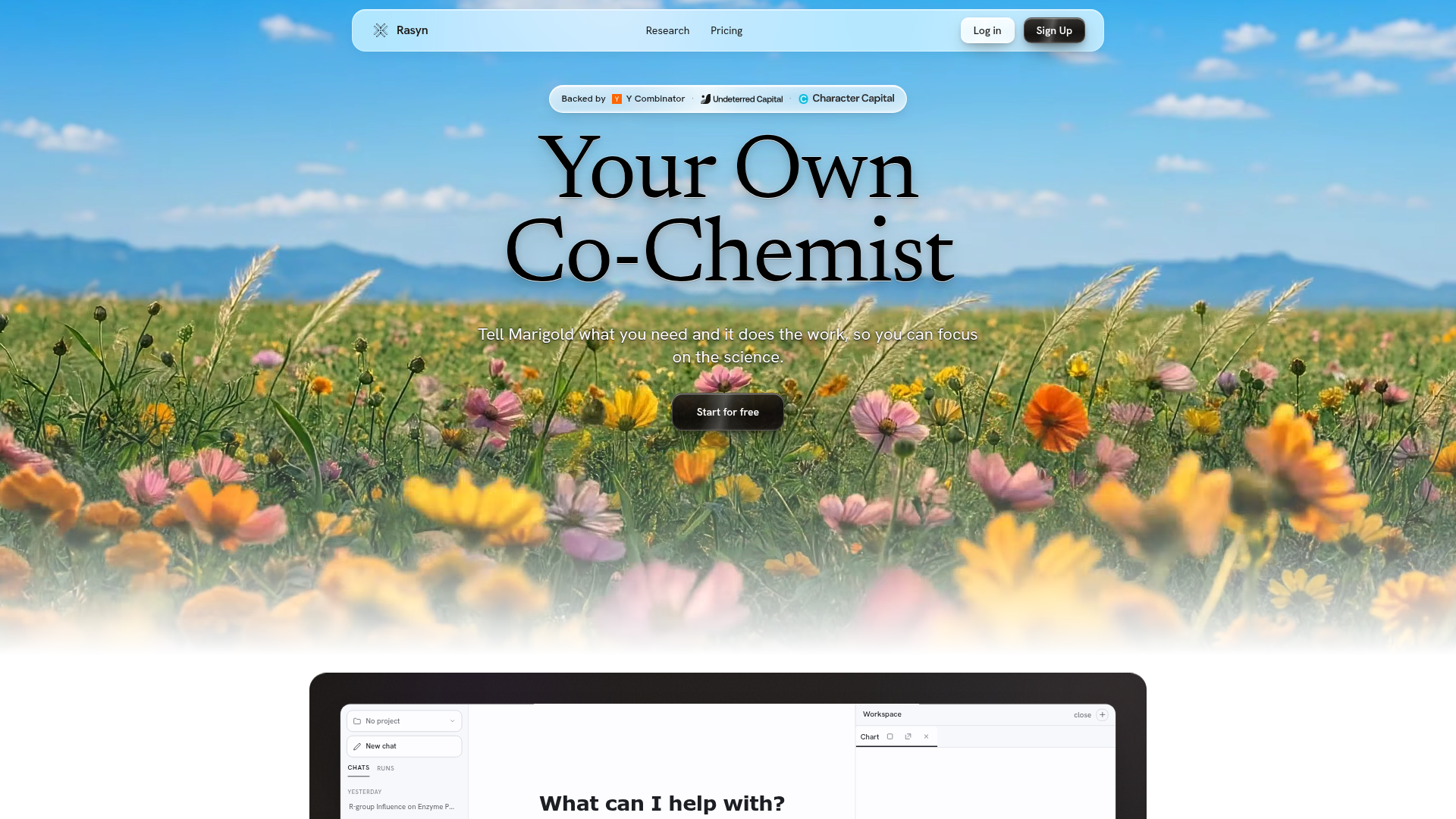
Chemistry software has a dirty secret: most AI copilots for scientists are demo-ware. They generate plausible-looking answers, but the moment you ask for a real docking score or a real DFT energy, they stall. Rasyn, a Y Combinator-backed seed startup, is making the opposite bet. Its pitch is not a smarter model but a stricter promise: every tool it claims to run actually runs, and the heavy jobs execute on hardware you control.
That promise is visible the moment you land on rasyn.ai. The site lists 54 tools—AlphaFold2, AutoDock Vina, RDKit, xtb, PySCF, and more—and then adds a line that is rare in AI marketing: "Every one really runs: 40 on hardware you connect, 14 on hosted endpoints." No vague talk of "integration." No fine print about simulated outputs. The tools are real open-source packages, and Rasyn's interface, a chat agent named Marigold, is built to execute them.
The 54-tool promise: every one really runs
The tool list is the product. It reads like a greatest hits of computational chemistry and structural biology: AlphaFold2 and AlphaFold2-Multimer for structure prediction, AutoDock Vina and DiffDock for docking, RDKit for molecular descriptors, xtb and CREST for conformer sampling, NWChem and Psi4 for electronic structure, OpenMM for molecular dynamics, and niche utilities like hplc-py for chromatogram fitting and Pyteomics for peptide mass calculations.
Each entry is linked to its open-source repository, with a one-line description of what it actually does. This is not a feature list; it is a bill of materials. Rasyn is effectively saying: we did not build new chemistry software, we built a layer that makes the existing software usable through natural language.
That is a meaningful distinction. Most AI tools in this space try to replace the scientist's judgment. Rasyn's approach is more modest and arguably more useful: it automates the plumbing—the file parsing, the parameter setting, the output interpretation—that makes tools like AutoDock Vina painful to use. The value is not in the model's chemistry knowledge; it is in the execution layer.
Marigold: a chat interface that treats chemistry as a workflow
The chat interface is named Marigold, and the website shows a typical session. A user asks, "Load PDB 1HCK and describe the binding site." Marigold responds not with a text answer but with a sequence of steps: it parses the CIF file, computes metadata, calculates ligand contacts, and loads a structure viewer. The interface shows intermediate reasoning—"I need to execute the code and load the viewer"—and even flags failed steps.
This is the key design choice: Marigold is not a chatbot that answers chemistry questions; it is a workflow runner that happens to use chat as its input. The user is not asking for an explanation; they are asking for a computation. The chat history shows tasks like "B3LYP/6-31G* Geometry Optimization" and "IC50 Analysis of Eight Compounds," which are not questions but jobs.
The workspace includes a chart view and a structure view, suggesting that Marigold's outputs are not just text but interactive artifacts. The site describes it as "Your Own Co-Chemist," a phrasing that emphasizes delegation rather than conversation. You tell Marigold what you need; it does the work.
Your cluster, not theirs: the SSH trust model
The most unusual aspect of Rasyn's design is where the computation happens. The website states: "Heavy jobs go to your own cluster. Backbone generation runs on the machine you connected, over SSH. Nothing about your structures leaves it."
This is a trust model that most AI startups avoid. By running on the user's hardware, Rasyn sidesteps the data-privacy concerns that plague cloud-based drug-discovery platforms. Proprietary structures never leave the lab. It also changes the economics: Rasyn does not need to pay for GPU time on every inference; the user provides the compute.
The tradeoff is obvious. Requiring SSH access raises the technical bar for adoption. A bench chemist who has never touched a terminal may balk. But the target user is a research chemist at an institution like Yale, Caltech, or Oxford—all of which appear in the logo list—and those users have clusters and know how to use them. For them, the SSH model is a feature, not a barrier.
Rasyn also offers 14 hosted endpoints for lighter tasks, presumably for users who want a quick result without connecting hardware. This hybrid approach—local for heavy, hosted for light—is pragmatic.
From YC seed to lab adoption: what the logos suggest
Rasyn is backed by Y Combinator, Undeterred Capital, and Character Capital. The funding stage is seed, and the site does not disclose amounts. What is more telling is the list of institutions that appear as users: Yale, Caltech, Oxford, KAIST, USTC, and a range of pharma companies including IFM Therapeutics, Piramal, and Jubilant Biosys. The list also includes universities in Mexico, Costa Rica, and Indonesia, suggesting a global reach.
The logos are not proof of deep adoption—they could be pilot users or even aspirational—but they signal that Rasyn is being evaluated by serious research organizations. The mix of academic and industrial names is a good sign for a tool that needs to be trusted with proprietary data.
Where the evidence thins: pricing, benchmarks, and the road ahead
The website is refreshingly free of hype, but it is also thin on specifics. There is no pricing page, no benchmark results, no technical whitepaper. The claim that "54 tools really run" is supported only by the tool list and the SSH description, not by independent verification. The site does not disclose how Marigold handles ambiguous requests or how it recovers from failed steps, though the chat example shows a "1 failed" step, implying some error handling.
Rasyn's biggest risk is not technical but behavioral. Chemists are conservative about their workflows. Convincing them to delegate a docking run to an AI agent—even one that runs on their own cluster—requires a leap of faith. The chat interface may lower the barrier, but the SSH requirement may raise it back up.
Still, Rasyn's execution-first bet is a smart one. In a field crowded with models that hallucinate chemistry, a tool that actually runs AutoDock Vina and returns a real binding affinity is a different category. The question is whether Rasyn can turn that difference into a durable business. The seed stage and the YC backing give it runway; the tool list gives it credibility. The rest is up to the chemists.