Impact-Site-Verification: 41b53a0c-6d04-458b-a457-fe9e29acde1a

SaaS & Productivity··5 min read

RejectCheck

Audit your entire candidate profile, fix the one thing that gets you cut, and apply with confidence.

NN

NewName Editorial

Editorial Team

RejectCheck product image 1
RejectCheck product image 2

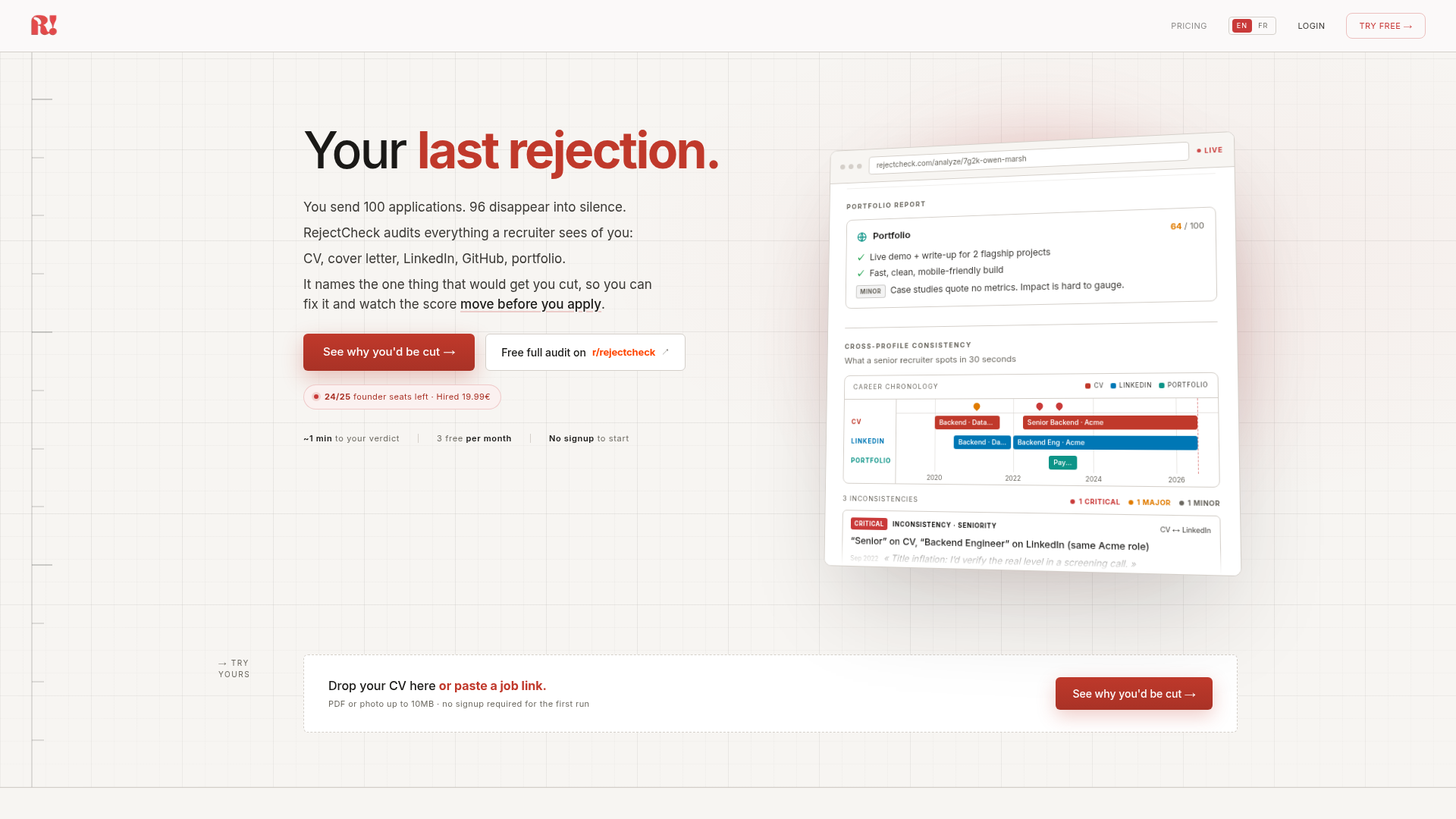
You send 100 applications. 96 disappear into silence. That's the opening line on RejectCheck's homepage, and it's the problem this tool is built to solve—not by polishing your CV into a generic masterpiece, but by telling you, bluntly, why a recruiter would cut you before you even hit submit.

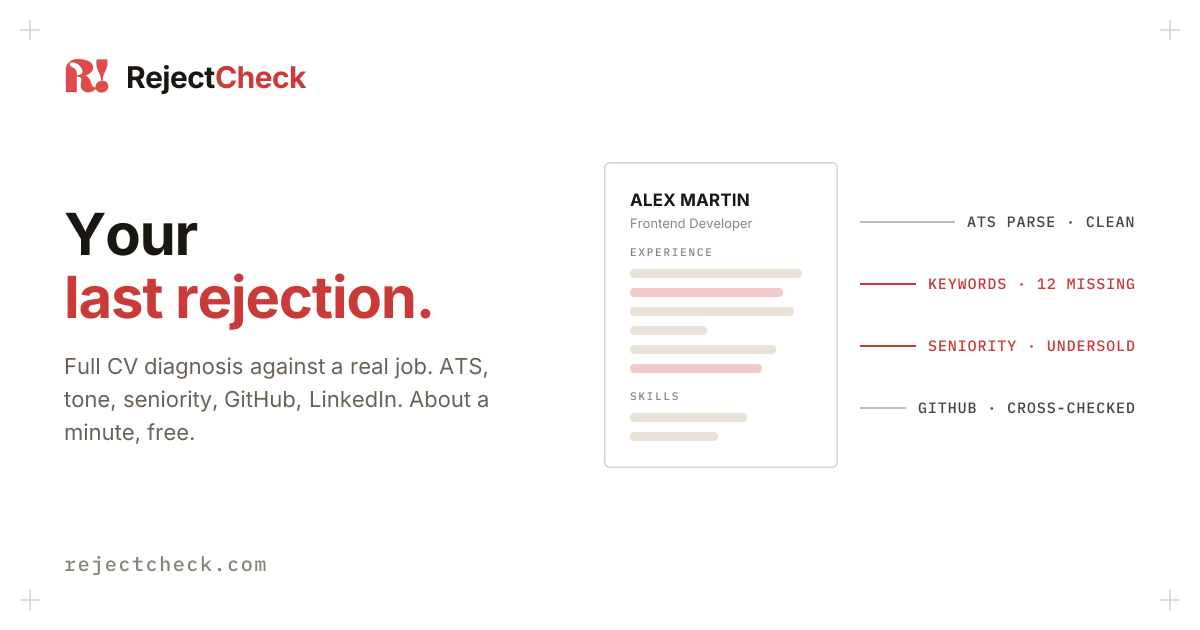
The product, built by Lenny Garnier and Arshiyaa Rai in Paris, is a job application diagnosis tool that goes far beyond the typical "ATS score" check. It cross-references everything a recruiter sees: your CV, cover letter, LinkedIn, GitHub, and portfolio. It names the one thing that would get you cut, so you can fix it and watch the score move before you apply. That's the thesis: rejection isn't a mystery; it's a diagnosable condition with specific causes that can be identified and treated.

The 96 silent applications

The core pain is the silence. You send out dozens of applications and hear nothing. You assume your CV is the problem, but you don't know which part. RejectCheck's answer is to simulate the rejection before it happens. It gives you a rejection risk score (0-100) and a breakdown of signals: keyword match, tech-stack fit, experience level, GitHub signal, LinkedIn signal. In a sample report for a Senior Backend Engineer role at Airbnb, the candidate scores 62%—Moderate risk, with 3 blockers and 3 profile conflicts. The tool doesn't just say "you're at risk"; it says "here's why," with specific missing keywords like Kubernetes, CI/CD, and Terraform, each with point deductions.

This is a different beast from the usual CV checker. It's not a generic scan; it's a diagnosis anchored to a specific job description. The same CV could score 90% for one role and 50% for another, because the analysis is job-specific, not generic.

Cross-examining the candidate, not just the CV

The most distinctive feature is the cross-source audit. RejectCheck doesn't just read your CV; it cross-examines it against your LinkedIn, GitHub, and portfolio. It looks for contradictions—title mismatches, claims that don't match activity, dates that disagree. In the sample report, it flags a critical inconsistency: "Senior" on the CV but "Backend Engineer" on LinkedIn for the same role. It even quotes a simulated recruiter: "Title inflation: I'd verify the real level in a screening call." Another major issue: "Led the payments rewrite (solo)" on the CV, but the GitHub repo shows 14 contributors. The tool catches these before a human does.

This is a genuinely novel angle. Most job seekers don't realize that recruiters check their LinkedIn and GitHub, and even fewer realize that inconsistencies between them are red flags. RejectCheck makes the invisible visible.

Six dimensions a recruiter scans in six seconds

The tool breaks down the audit into six dimensions, each scored and explained:

  1. Cross-source contradictions
  2. GitHub & portfolio depth
  3. Career chronology
  4. Seniority band
  5. Quantified outcomes
  6. ATS reality check

Each dimension is designed to mirror what a human recruiter actually looks for in a quick scan. The ATS reality check is particularly honest: it notes that most ATS don't auto-reject on keyword score—a human still makes the call. So RejectCheck checks both the machine-readable layer and the human judgment layer.

The briefing, not a score

The report is not a thumbs-up or down; it's a briefing. It includes a priority fix—the one change that would move the score most—and a list of key findings. In the Stripe example, the priority fix is to add distributed systems, gRPC, and observability to bullets where they truthfully apply, with an estimated score impact of −22 points. It also includes a skill mapping, showing gaps like Kubernetes at 24 and Terraform at 12.

The tool also provides a "Bridge the gap" section, recommending a project to close a specific skill gap. For a distributed systems gap, it suggests building a rate-limited Payments API with Go, Redis, gRPC, and Kubernetes, complete with a new CV bullet to add. This is actionable, not just diagnostic.

Fix it, re-run, watch the score move

The workflow is iterative. You fix what it flags, re-run the audit, and see the score move. This is not a one-shot report; it's a tool for continuous improvement. The free tier gives you 3 analyses per month, and the paid plans offer more. The pricing is transparent: Free forever, Founding member at €19.99/month (locked for life, limited to 25 seats), and Hired at €39.99/month with a refund guarantee if you land a job during an active billing month.

The name as a promise: RejectCheck

The name is a bold choice. It's not "CV Optimizer" or "JobFit"; it's RejectCheck—a name that embraces the negative outcome. It promises to check your rejection, to find out why you'd be rejected before you apply. This is a positioning that flips the script: instead of promising to get you hired, it promises to prevent rejection. It's a more honest, and arguably more compelling, value proposition for job seekers who are tired of silence.

The domain, rejectcheck.com, is clean and memorable. The name is specific, not generic, and it immediately communicates the core value. It's a name that could be seen as negative, but it's precisely that negativity that makes it stand out in a sea of positive-sounding career tools.

Who should care and what's still missing

RejectCheck is for anyone who's tired of sending applications into the void. It's especially useful for tech professionals, given the GitHub and portfolio analysis. The tool is bilingual (English and French), which is a nice touch for a Paris-based startup.

What's missing? The site doesn't disclose funding or detailed company metrics, and the founder seats are limited to 25, suggesting an early-stage product. The testimonials are positive but sparse. The tool relies on AI models (Claude Sonnet and Haiku) for analysis, which raises questions about consistency and bias, though the site claims it never invents your numbers—suggested rewrites come with placeholders until you add real figures.

Overall, RejectCheck is a promising tool that addresses a real pain point with a unique approach. It's not just a CV scorer; it's a cross-examiner, a briefing, and a coach. If you're job hunting and tired of the silence, it's worth a try—especially since the first analysis is free, no signup required.