rekursiv.ai
Autonomous AI scientists that hypothesize, experiment, and discover new ML algorithms at a fraction of human cost.
NewName Editorial
Editorial Team
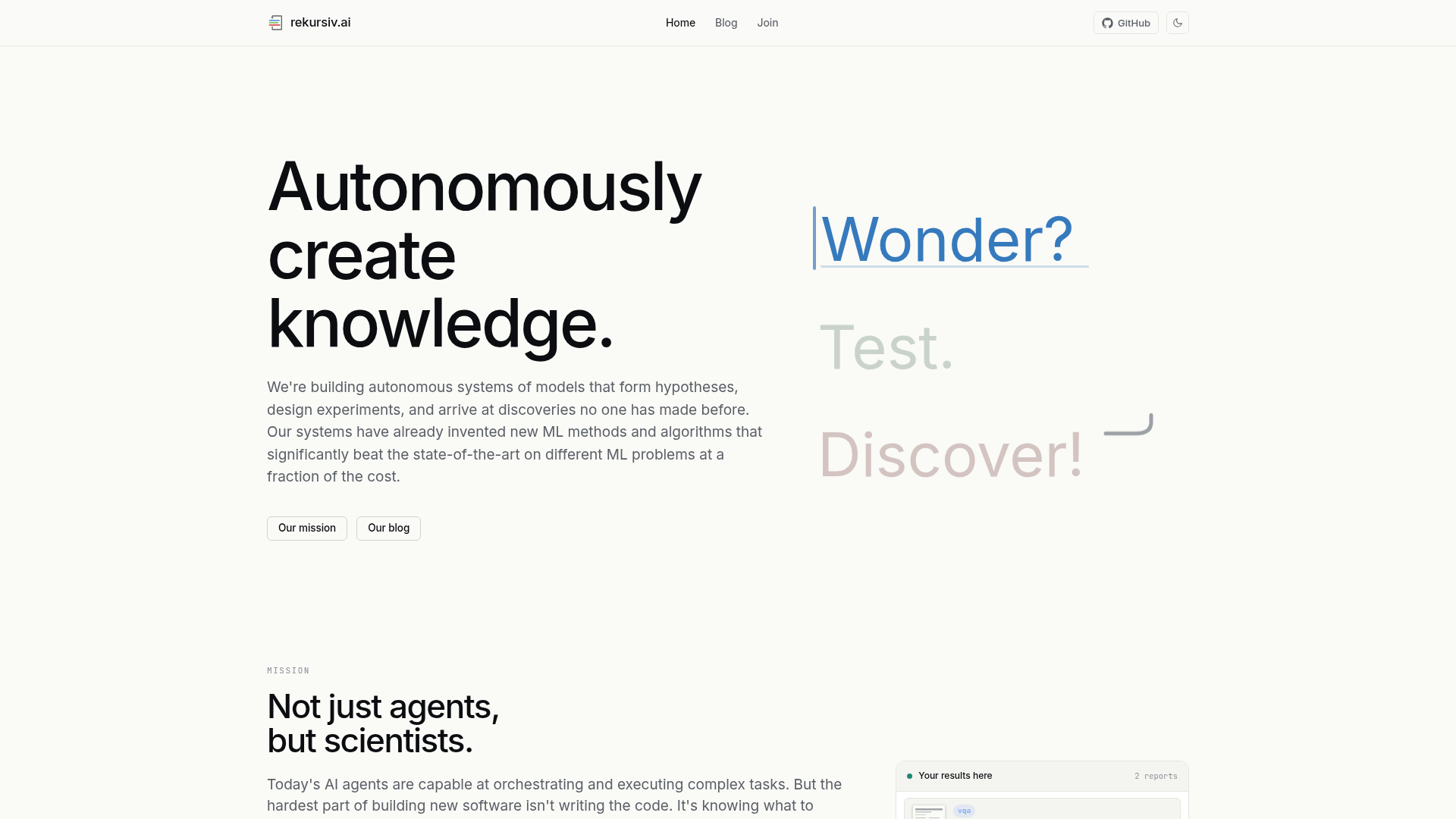


The pitch for rekursiv.ai is deceptively simple: "Autonomously create knowledge." But the company's real claim is more radical. It's not building another agent that writes code or executes tasks. It's building systems that form hypotheses, design experiments, and arrive at discoveries no one has made before. The site's own words: "Not just agents, but scientists."
That distinction matters. Today's AI agents are orchestration engines—they can book a flight, refactor a codebase, or run a test suite. But the hardest part of building new software, as rekursiv.ai's founders argue, isn't writing the code. It's knowing what to build and why. That's a research problem, not an engineering one. And rekursiv.ai is betting that a fleet of autonomous scientists can crack it.
The bottleneck isn't code, it's hypotheses
Most AI tooling assumes the problem is execution. You give an agent a task, it breaks it down, writes code, and iterates. But rekursiv.ai starts one step earlier. Its AI Scientists are designed to hypothesize, set evals, experiment, review each other's work, and push leaderboards. The emphasis on hypothesis generation is the core thesis: the bottleneck in ML research isn't the ability to run experiments—it's deciding which experiments are worth running.
The company's blog post, "An AI Team Invented an Algorithm I Wouldn't Have," makes this concrete. Four AI Scientists and $500 created a machine learning paper with an idea the human author, Joshua V. Dillon, says he never would have tried. That's the promise: not just automating the grind, but generating the kind of creative leaps that human researchers sometimes miss.
A cockpit for autonomous research: what the interface reveals
The product page shows a "cockpit for autonomous research." The interface is a live dashboard of experiments, with metrics like "video-diffusion 0.6512" and "coder-llm-finetune 1.498." Each row shows a problem, a score, and a trail of agent actions: "Edit data.py · dedupe shards," "add fim objective α=0.3," "fix sync." There's a chat log where agents like "ml-scientist-8" and "analyst-5" discuss hypotheses: "baseline DiT-XL/2 at 256² overfits text-conditioning. propose CFG=4.0 → 6.0 sweep."
This isn't a polished product demo. It's a raw window into how the system works. The interface reveals that rekursiv.ai is not selling a single AI model—it's selling a multi-agent research team. The "fleet" of AI Scientists includes specialized roles: ml-scientist, data-scientist, analyst, engineer. They collaborate, critique each other, and use tools like Bash and Python scripts. The leaderboard is the product: every claim is traced to its evidence.
The evidence: ARC-AGI, Sudoku, and a $500 paper
The blog posts provide the most concrete evidence of what these systems can do. In July 2026, the team published "Pushing the Limits of Autonomous ML Science on ARC-AGI," claiming their AI Scientists raised the ARC-AGI Pareto frontier with stronger accuracy at dramatically lower cost. ARC-AGI is a benchmark designed to resist memorization—it's a hard test for any AI system. The claim of state-of-the-art efficiency on both ARC-AGI-1 and ARC-AGI-2 is significant, if not yet independently verified.
Another post describes how an autonomous AI team discovered a neural approach that achieves 100% accuracy on Sudoku, a task that often stumps neural networks due to its exact logical constraints. The method, called "Hypothesis-Pinning Search," was discovered by the AI Scientists themselves. These are not incremental improvements; they're novel algorithmic contributions.
The $500 paper is the most striking data point. Four AI Scientists, a $500 budget, and a new ML method that outperformed the state-of-the-art. The cost comparison is stark: human research often requires months of salary and compute. rekursiv.ai is claiming that autonomous systems can do it for the price of a mid-range GPU rental. That's a fundamental shift in the economics of research.
The cost tradeoff: cheap experiments, expensive trust
The cost advantage is real, but it comes with a hidden price: trust. When a human researcher publishes a result, the community can scrutinize the methodology, reproduce the experiments, and judge the reasoning. With an autonomous system, the reasoning is opaque. The leaderboard shows scores and agent actions, but how do you know the improvement is real and not a fluke of overfitting? The site says "Every claim is traced to its evidence," but that evidence is generated by the same system that made the claim. There's an inherent circularity.
This is the central tradeoff of rekursiv.ai's approach. The cost of discovery drops by orders of magnitude, but the cost of verification may not. For now, the company is targeting researchers who can validate the results themselves. The cockpit gives them visibility into the process, but it's still a black box in the most important sense: the hypotheses are generated by a model, not a human mind.
From DeepMind to rekursiv: the team behind the bet
The founding team brings almost 30 years of combined research experience at Google, DeepMind, and Luma AI. They built TensorFlow Probability, led the models powering Dream Machine, and developed VideoPoet, which won the ICML 2024 Best Paper award. This is not a team of unknown founders; it's a team with deep credibility in the ML research community.
That pedigree matters because rekursiv.ai is making a bold claim: that AI can do science, not just assist with it. If the team were less accomplished, the claim would be easier to dismiss. But when people who have built core infrastructure for TensorFlow and led state-of-the-art video generation say they're now working on "AI that discovers on its own," it's worth paying attention.
The company is still early. The site doesn't disclose funding, and the product is in private access. But the evidence they've published—the ARC-AGI results, the Sudoku success, the $500 paper—suggests they're not just pitching vaporware. They're building a system that can generate hypotheses, test them, and find new knowledge. Whether that system can scale from a handful of scientists to millions, as they claim, remains to be seen. But the direction is clear: the next frontier in AI isn't better agents; it's better scientists.