Retroideas
Turn any team situation into a better retrospective—instantly.
NewName Editorial
Editorial Team
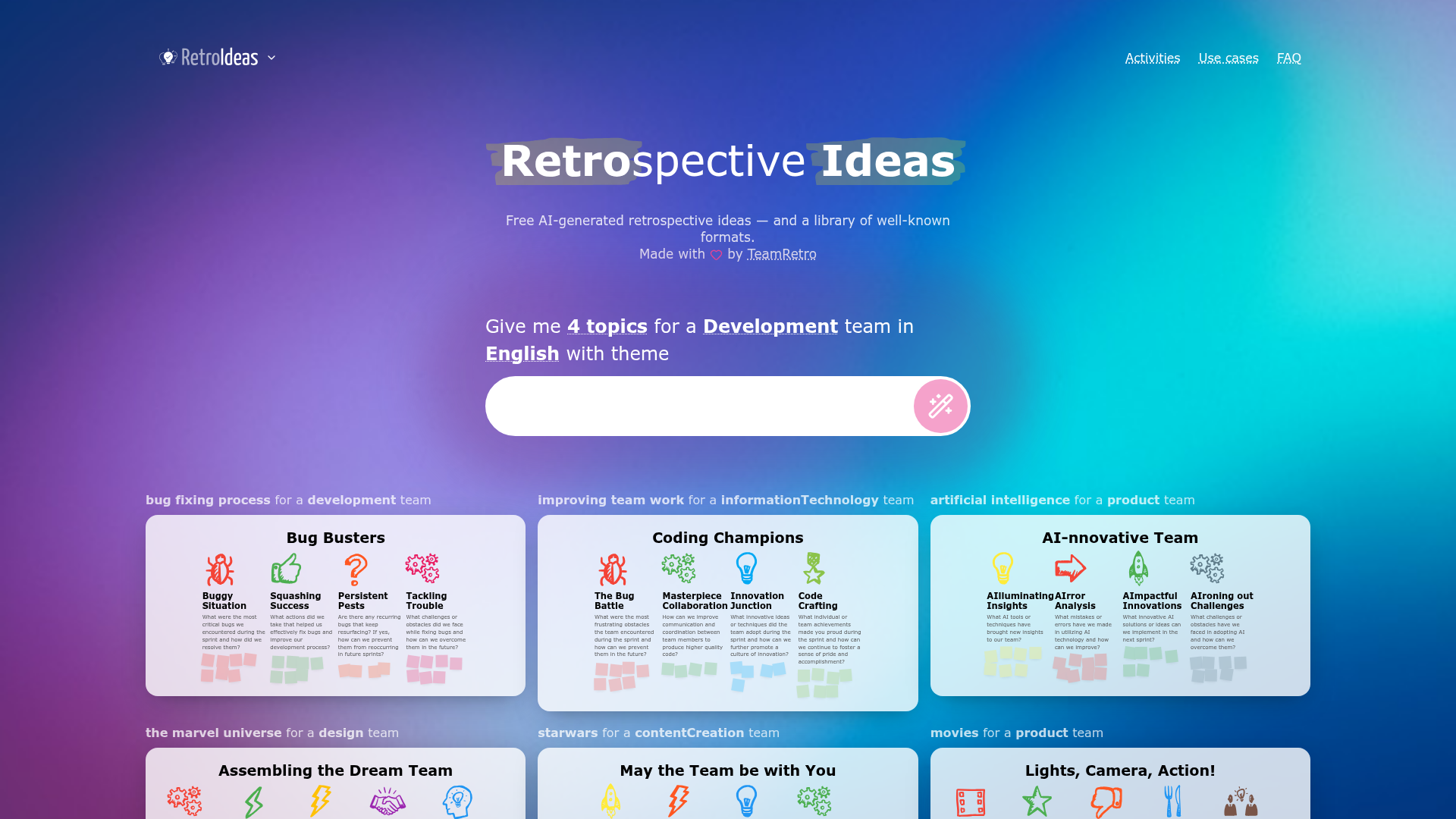


Agile retrospectives have a fatigue problem. After the tenth sprint, the same "What went well?" and "What went wrong?" prompts elicit the same polite nods and recycled complaints. Teams don't need another template; they need a reason to talk. Retroideas, a free AI-powered tool from TeamRetro, tries to manufacture that reason by turning any theme—from "bug fixing process" to "the Marvel universe"—into a structured retro with fresh prompts. It's a small idea with a big implication: the retro doesn't have to be a chore; it can be a creative act.
The Retrospective Rut: Why Teams Stop Retrospecting
Retrospectives are the most commonly skipped Agile ceremony. The reasons are familiar: time pressure, repetitive formats, and the sense that nothing will change. When every sprint ends with the same four questions, the exercise becomes a box-ticking ritual. Retroideas attacks the root cause—not by improving facilitation or action tracking, but by injecting novelty at the moment of creation. Instead of opening a template library and scrolling past the same "Start, Stop, Continue" boards, a facilitator types a theme that matters to the team right now: "low morale," "missed deadlines," or even "the Marvel universe." The tool then generates a complete retro with prompts, flow, and actionable outcomes tailored to that context. The novelty is the hook; the structure is the payoff.
From Theme to Retro: The Mechanics of Instant Structure
The core interaction is deceptively simple. A user selects a team type from a list that spans Development, Marketing, Customer Support, and a dozen others. Then they choose a theme—either from a suggested list or by typing their own. The platform instantly returns a themed retro with a name ("Bug Busters," "Coding Champions") and a set of prompts, each with a playful icon and a pointed question. For example, a development team entering "bug fixing process" gets "Buggy Situation" ("What were the most critical bugs we encountered during the sprint and how did we resolve them?") and "Persistent Pests" ("Are there any recurring bugs that keep resurfacing?"). The prompts are not generic; they are clearly tuned to the theme and the team type. The tool also lets users specify the number of topics (from 2 to 6), giving facilitators control over the length and depth of the session. This is not a random prompt generator; it's a structured conversation scaffold.
The Playful Layer: Why 'Bug Busters' and 'Coding Champions' Work
The naming of the generated retros is a deliberate design choice. "Bug Busters" for a development team, "Coding Champions" for an IT team, "AI-nnovative Team" for a product team—these are not just labels; they are emotional frames. A retro titled "Bug Busters" invites a team to feel like heroes tackling a shared enemy, rather than defendants in a post-mortem. The prompts follow suit: "Squashing Success" asks what actions helped fix bugs effectively, turning a negative topic into a positive inquiry. This playful layer lowers the psychological barrier to honest conversation. Teams are more likely to engage when the language is light and the metaphors are relatable. It's a subtle but powerful shift from "what went wrong" to "how do we become the team we want to be."
The TeamRetro Lineage: A Free Tool with a Commercial Parent
Retroideas is not a standalone startup; it's a free tool from TeamRetro, an established Agile retrospective platform. The website footer reads "Made with by TeamRetro," and the domain ideas.teamretro.com reinforces the connection. This lineage matters for two reasons. First, it means Retroideas is likely a marketing funnel for TeamRetro's paid product—a way to attract teams with a free, useful tool and then upsell them on the full retrospective suite. Second, it means the tool benefits from TeamRetro's domain expertise and existing user base. The prompts are not randomly generated; they reflect years of retrospective facilitation knowledge. For users, this is a win: they get a polished, free tool with no ads or paywalls. For TeamRetro, it's a smart lead generation strategy. The risk is that Retroideas may remain a side project, not a fully supported product.
What Retroideas Does Not Solve (Yet)
The tool's simplicity is also its limitation. Retroideas generates prompts, but it does not facilitate the retro, track action items, or integrate with tools like Jira or Slack. Teams must still bring their own facilitation skills and follow-up processes. The generated retros are conversation starters, not complete solutions. The website does not disclose any collaboration features, analytics, or export options. If a team wants to capture the output of a "Bug Busters" session, they'll need to copy the prompts into a separate tool. This is fine for a free tool, but it means Retroideas is best used as a spark, not a platform. The public materials also do not mention any plans for deeper integration or a paid tier, leaving the roadmap unclear.
Who Should Bookmark This Page
Retroideas is for any Agile team that has felt the dread of another stale retrospective. It's especially useful for facilitators who want to inject variety without spending hours crafting custom prompts. The tool is also a great resource for teams that are new to retrospectives and don't know where to start. The themed retros—from "Star Wars" to "baking bread"—make the exercise approachable and even fun. For those who want to take it further, the TeamRetro platform offers a full suite of retrospective features. But even as a standalone tool, Retroideas proves that a retrospective can be more than a ritual; it can be a creative act that teams actually look forward to.