Rilavek
A managed bridge that turns FTP and TUS into direct S3 streams, with zero-knowledge pass-through.
NewName Editorial
Editorial Team
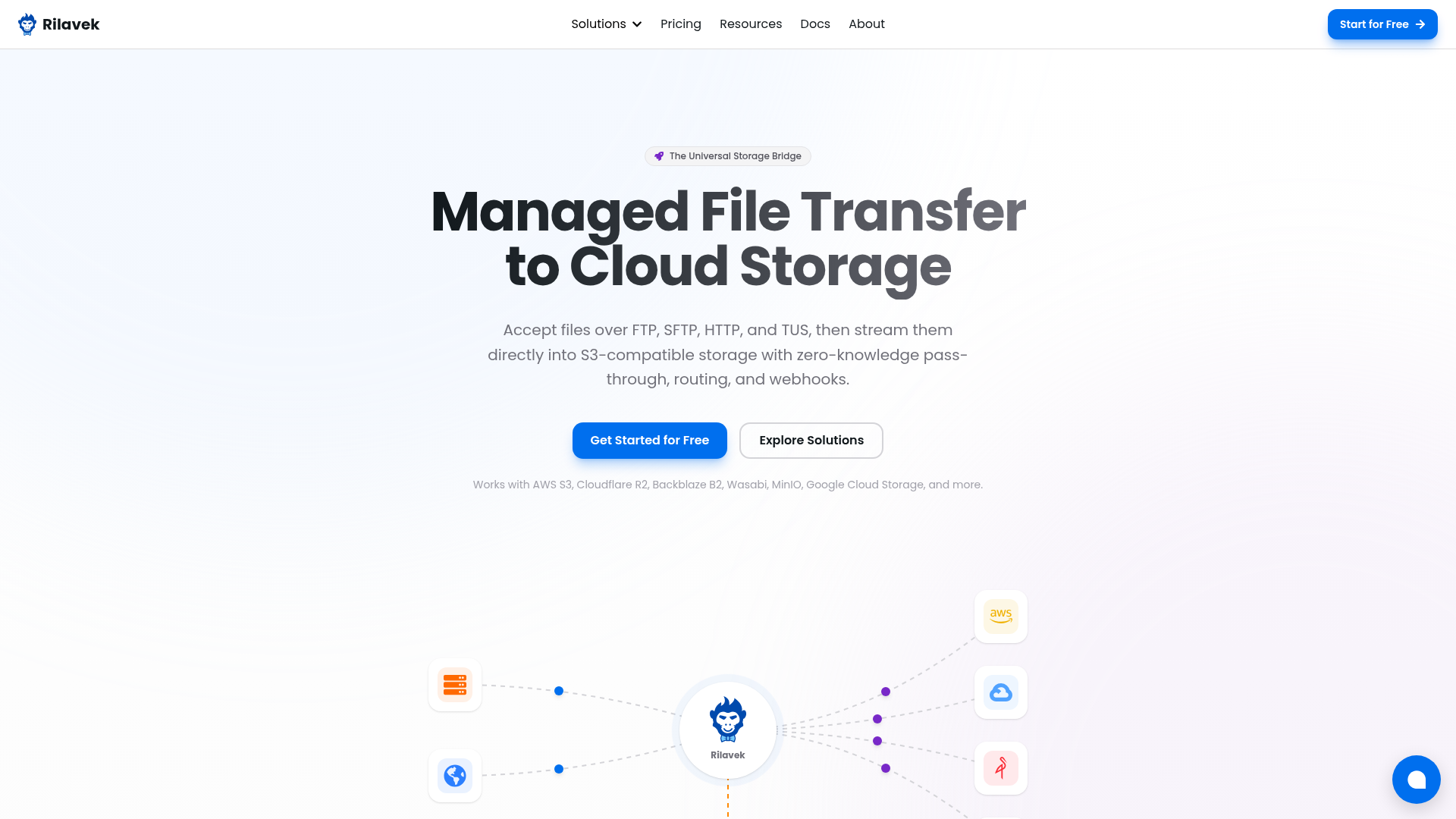

In a world that has moved on to APIs and serverless functions, FTP still runs the back offices of media, logistics, and manufacturing. It's the protocol that won't die, and for good reason: cameras, PLCs, and vendor systems speak it natively. But bridging that legacy to modern cloud storage has always meant writing and maintaining brittle glue code. Rilavek's bet is that this plumbing should be a managed service, not a side project. The company positions itself as the 'Universal Storage Bridge,' and its pitch to solo developers and indie builders is refreshingly specific: connect an FTP/SFTP endpoint or a TUS upload link, and have files stream directly into your S3 bucket, with no servers to run and no data touching Rilavek's disk.
The 1990s protocol that won't die
FTP is ancient, insecure by default, and still everywhere. It's the language of IP cameras, Sony Alpha cameras, industrial PLCs, and a thousand vendor portals. The modern answer has been to write Python scripts that poll an FTP server, download files, and re-upload them to S3. These scripts break at 3 a.m., fail on large files, and require constant babysitting. Rilavek's core insight is that you don't need to kill FTP—you need to give it a modern exit ramp. The service accepts FTP, FTPS, SFTP, HTTP, and TUS, then streams directly to any S3-compatible store: AWS S3, Cloudflare R2, Backblaze B2, Wasabi, MinIO, Google Cloud Storage, and more. That's not a new idea, but the execution is: a managed gateway that terminates the legacy protocol and handles the cloud handoff, so the developer never touches a server.
Five primitives, one mental model
Rilavek's documentation introduces a clean architecture: Source, Sender, Pipe, Data Store, and Sync Event. This is the kind of abstraction that makes a product stick. You create a Data Store (your S3 bucket), create a Pipe (the endpoint that accepts FTP or TUS), assign a Sender (a credential for a camera or vendor), and connect them. The Pipe is the logic layer—it handles routing and fan-out. A Sync Event fires a webhook when a transfer completes. The mental model is simple enough to explain in a diagram, yet powerful enough to cover multi-cloud replication, camera-to-cloud, and vendor SFTP exchange. It's the sort of clarity that comes from deep understanding of the problem, and it's what separates Rilavek from a generic 'file upload service.'
The zero-knowledge pass-through bet
Rilavek's most distinctive claim is zero-knowledge pass-through: files are streamed directly from source to destination in memory, never touching disk on Rilavek's servers. This is a bold architectural choice. It means Rilavek can't read your files, can't be subpoenaed for them, and doesn't incur storage costs. For privacy-conscious buyers, that's a huge differentiator. But it also raises a question: what happens if the destination bucket is temporarily unavailable? The site says transfers are 'resumable' and 'durable,' but the zero-knowledge constraint means Rilavek can't buffer the file on its side. The docs don't detail the failure mode, so there's an inherent tension between pure pass-through and guaranteed delivery. Still, for the target user—a solo developer who wants a simple, private pipe—the trade-off is often worth it.
From camera to cloud: the workflows Rilavek actually powers
The website lists eight solution areas, but the most compelling are the ones that solve real, niche pain. 'Camera to Cloud' is a standout: photographers can set up Sony, Canon, or Nikon cameras to upload directly to cloud storage over 5G or venue Wi-Fi, without waiting to return to the office. 'Managed SFTP Gateway' gives vendors dedicated credentials without managing Linux accounts. 'Industrial Edge Ingest' connects IP cameras and PLCs to data lakes. These are not hypothetical use cases—they're the kind of workflows that have been held together by duct tape and cron jobs for years. Rilavek's ability to serve all of them from one platform is a testament to its protocol-neutral design.
Pricing that undercuts the 'server tax'
Rilavek's pricing is aggressively simple: Free (10GB/month), Starter ($10/month for 100GB), and Pro ($30/month for 1TB). There's no per-seat fee, no per-request fee, just transfer volume. For a solo developer, $10 a month replaces the cost of a small VPS plus the hours spent maintaining an SFTP server. The free tier is generous enough to test the service without a credit card. This pricing strategy is a clear signal: Rilavek wants to be the default choice for indie builders, not an enterprise sales motion. The trade-off is that power users with 10TB+ needs will quickly outgrow the plans, but for the target market, it's a perfect fit.
What Rilavek's name says about its ambition
The name 'Rilavek' is a coined word, and it's a deliberate choice. It doesn't describe the product literally—it's not 'FTPBridge' or 'S3Pipe.' Instead, it sounds like a brand, something that could become a category leader. The logo is clean, the domain is exact-match, and the tagline 'No servers, no hassle' is a promise. The name is memorable and pronounceable, though it doesn't immediately convey what the product does. That's a risk: a first-time visitor might not know what Rilavek is. But for a company that's building a platform, not a single tool, a coined name offers room to grow. It's the kind of name that works if the product delivers, and Rilavek's early execution suggests it might.
Rilavek is not trying to reinvent file transfer. It's trying to make the boring parts disappear. For solo developers and indie builders who are tired of writing the same FTP-to-S3 script for the tenth time, Rilavek offers a managed path that's private, simple, and cheap. The zero-knowledge architecture is a bold bet, and the pricing is a gift to the indie community. The real test will be reliability: can a pass-through service handle a 100GB camera upload over flaky Wi-Fi? If it can, Rilavek might just become the default bridge between the old world of FTP and the new world of cloud storage.