RiskCube
AI-native insurance brokerage that gets startups vendor-ready in about a day.
NewName Editorial
Editorial Team


Insurance is the last thing a founder wants to think about when a deal is on the line. But it's often the thing that kills it. A missing Certificate of Insurance (COI) or an unmet vendor requirement can stall a signed contract for weeks, and by the time procurement flags a coverage gap, the deal has gone cold. RiskCube, a Y Combinator-backed AI insurance brokerage, is built to eliminate that friction. Its pitch is simple: get vendor-ready insurance faster, often within a day, by comparing top-rated carriers and delivering the COIs that unblock enterprise deals and government contracts.
This is not a story about insurance as a commodity. It's about the specific moment when a startup's momentum collides with a risk-averse enterprise's compliance process. RiskCube's thesis is that the COI is the real product, and everything else—the AI agents, the licensed brokers, the carrier comparisons—is in service of getting that piece of paper into the right hands quickly.
The COI bottleneck: why startups lose deals over a piece of paper
For a startup selling to an enterprise or bidding on a government contract, insurance requirements are not a back-office afterthought. They are a hard gate. The website's own language is blunt: "A missing Certificate of Insurance or an unmet contract requirement can stall your deal for weeks." The problem is not just the absence of coverage; it's the inability to prove it in the format the vendor demands. A COI is a standardized document, but getting one from a traditional broker can involve phone tag, multiple forms, and days of waiting. Meanwhile, the deal sits in procurement limbo.
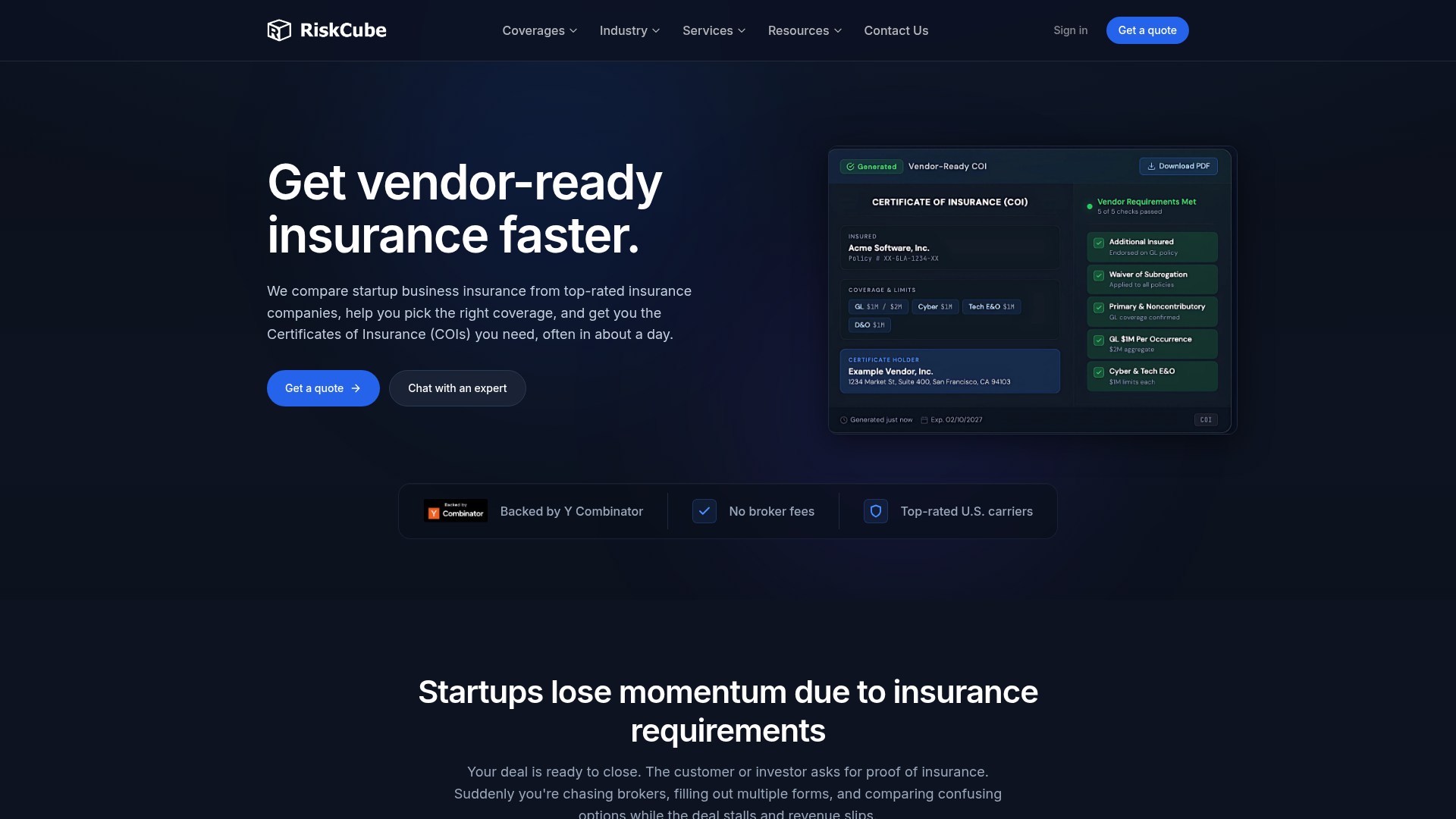
RiskCube's solution is to make the COI the centerpiece of its user experience. The homepage shows a mock "Vendor-Ready Certificate of Insurance" with coverage details and vendor requirements highlighted. The workflow is explicit: assess your risk profile in a ~10-minute form, let AI and brokers scan the market, and get vendor-ready proof of coverage in ~24 hours. This is a radical compression of a process that traditionally takes weeks.
The site also identifies two related pain points: the "exclusion gap" and the "wrong coverage." Policies hide critical exclusions in complex language, and some founders buy a policy that doesn't meet the actual requirement. RiskCube positions itself as the translator that highlights exclusions and gaps "not buried in fine print." This is a trust play, and it's essential for a category where buyers are often sophisticated but time-poor.
AI agents and licensed brokers: a hybrid model for speed
RiskCube calls itself an "AI-native insurance broker," but the model is deliberately hybrid. The website describes "AI agents and licensed brokers" scanning the market's top-rated carriers. This is not a fully automated robo-broker; it's a human-in-the-loop system where AI accelerates the comparison and the human ensures accuracy and compliance. The site notes that a "licensed broker reviews every recommendation," which is a critical trust signal in a regulated industry.
The platform offers a comparison view that shows multiple carriers with premiums, limits, deductibles, and prior acts coverage. In one example, Carrier A is marked as "Best fit" with a $4,400/year premium for $1M limit, while Carrier B is $5,200/year and Carrier C is $6,800/year with a $2M limit. The table highlights the tradeoffs, and the site claims that the "best-fit saves $2,400/yr vs. next option." This transparency is a departure from the opaque, one-quote-at-a-time approach of traditional brokers.
The user journey is designed to be digital-first: apply once, get multiple quotes, select, e-sign, and generate COIs. The platform also manages renewals and tracks coverage, acting as a single pane of glass for a startup's insurance stack. This is the "agentic platform" promise: compare, buy, manage.
The exclusion gap and the transparency problem
Insurance policies are notoriously difficult to read, and exclusions are where coverage dies. RiskCube's website explicitly calls out the "exclusion gap" as a core problem: "Insurance policies hide critical exclusions in complex language. Without expert review, you won't know what's not covered until it's too late." This is a common pain point for startups that buy a cheap policy only to discover it doesn't cover the specific liability their enterprise client requires.
RiskCube's answer is to highlight exclusions and gaps in its comparisons, making them visible before purchase. This is a differentiator in a market where brokers often gloss over exclusions to close a sale. The site's promise is that a licensed broker reviews every recommendation, ensuring that the policy actually meets the vendor's requirements. This is not just a feature; it's a positioning statement that aligns with the startup's need for speed and certainty.
The transparency also extends to pricing. The case study shows a YC-backed fintech that was quoted $11,000/year for D&O by a direct carrier. RiskCube compared 40+ carriers, identified the top 6 best-fit options, and placed coverage with more limit at $4,400/year. That's a 60% savings, and the site presents it as evidence of the platform's ROI. While this is a single case study, it illustrates the core value proposition: better coverage at a lower price, with the speed to close deals.
Coverage for AI, Space, and Defense: a niche that makes sense
RiskCube's industry focus is deliberately narrow: AI, Defense, Space, Digital Assets/Web3, and Fintech. These are sectors where insurance is not just a compliance checkbox but a strategic enabler. For an AI startup, cyber liability insurance is critical, and RiskCube even offers "purpose-built excess coverage for agentic AI." For defense and space startups, the risk profiles are complex, and traditional brokers may not have the expertise. RiskCube's tagline—"Top-rated insurance to close enterprise deals & gov contracts for AI, Space & Defense startups"—signals that it understands the specific requirements of these industries.
This focus also creates a defensible moat. Generalist brokers may not understand the nuances of AI-related liabilities or the contracting requirements of the Department of Defense. RiskCube's content library includes guides and glossaries tailored to startup founders, and its services include contract requirement review and insurance due diligence for VCs. This is a full-stack approach that goes beyond simple brokerage.
The site also mentions GovTech as an industry, though it's not listed in the main industry dropdown. This suggests an ambition to serve the government contracting space, where insurance requirements are often stringent and the stakes are high. If RiskCube can crack that market, it could become the default broker for a generation of deep-tech startups.
The D&O case study: what 40+ carrier comparisons actually mean
The case study on the homepage is a powerful piece of evidence. A YC-backed fintech was quoted $11,000/year for D&O by a direct carrier. RiskCube compared 40+ carriers, identified the top 6 best-fit options, and placed coverage with more limit at $4,400/year. The numbers are specific: $11,000 to $4,400, 40+ carriers, 24h vendor-ready. This is not just a marketing claim; it's a concrete example of the platform's value.
But what does "comparing 40+ carriers" actually mean? In a traditional brokerage, an agent might have relationships with a handful of carriers and quote from those. RiskCube's AI agents can scan the market more broadly, but the actual placement still requires a licensed broker. The case study suggests that the AI-driven comparison surface is what enables the savings, but the human broker is what makes it trustworthy.
The case study also highlights the importance of D&O insurance for startups raising capital. The site notes that D&O is "required by most Series A investors," which makes it a deal-closer for fundraising. By focusing on this pain point, RiskCube positions itself as an essential partner for the startup lifecycle.
What the name 'RiskCube' signals—and what it doesn't
The name "RiskCube" is a portmanteau of "risk" and "cube," suggesting a three-dimensional view of risk. It's a clever name that evokes both the complexity of risk and the idea of seeing it from all angles. The cube metaphor also suggests structure and containment—risk enclosed in a manageable box. This aligns with the platform's promise to make insurance transparent and manageable.
However, the name does not explicitly signal "insurance" or "brokerage." A first-time visitor might not know what RiskCube does from the name alone. The tagline, "AI insurance brokerage for startups," does the heavy lifting. The domain, riskcube.com, is clean and memorable, which is a plus for a startup that wants to be the go-to brand in its niche.
The name's abstraction is a double-edged sword. On one hand, it allows the brand to expand beyond insurance into broader risk management services. On the other, it may require more marketing to explain what the company actually does. The website's clear positioning and the Y Combinator badge help mitigate this, but the name alone would not be enough to convey the value proposition.
In the context of the industry, "RiskCube" stands out among competitors with more literal names like "CoverWallet" or "Embroker." It's more abstract, which could be a differentiator or a liability. The cube imagery is also used in the logo, reinforcing the brand's visual identity.
Open questions: AI in insurance, trust, and the road ahead
RiskCube's model raises several questions. First, how much of the process is truly AI-driven versus human-brokered? The site says "AI agents and licensed brokers scan the market," but the exact division of labor is unclear. If AI is doing the heavy lifting, how does it handle edge cases or complex risks? If humans are still essential, what's the scalability story?
Second, trust is paramount in insurance. The site emphasizes that it's a licensed brokerage (NPN 21694336, CA License #6017028) and that it's backed by Y Combinator. These are strong trust signals, but the company is still young. How will it handle claims, especially for high-stakes industries like defense and space? The site mentions "claims support," but there's no evidence of a claims track record.
Third, the market for AI-native insurance is crowded, with players like CoverWallet, Embroker, and Next Insurance. RiskCube's niche focus on AI, Space, and Defense is a differentiator, but it also limits the total addressable market. The company will need to expand beyond these verticals to achieve scale, or it will need to dominate these niches completely.
Finally, the case study is compelling but anecdotal. The site does not disclose the number of customers or the total premiums placed. For a startup, this is typical, but it means that the claims of "60% savings" and "24-hour COIs" are not yet backed by broad data. As RiskCube grows, it will need to publish more evidence to build credibility.
Despite these open questions, RiskCube's thesis is sound: startups need insurance to close deals, and the process is broken. By focusing on the COI as the product and using AI to compress the timeline, RiskCube is addressing a real pain point. The name, the branding, and the YC pedigree all suggest a company that understands its market. Whether it can execute at scale remains to be seen, but the direction is promising.