Rowboat Labs
Rowboat Labs: an open-source AI coworker that remembers your work as Markdown, runs locally, and builds your apps.
NewName Editorial
Editorial Team
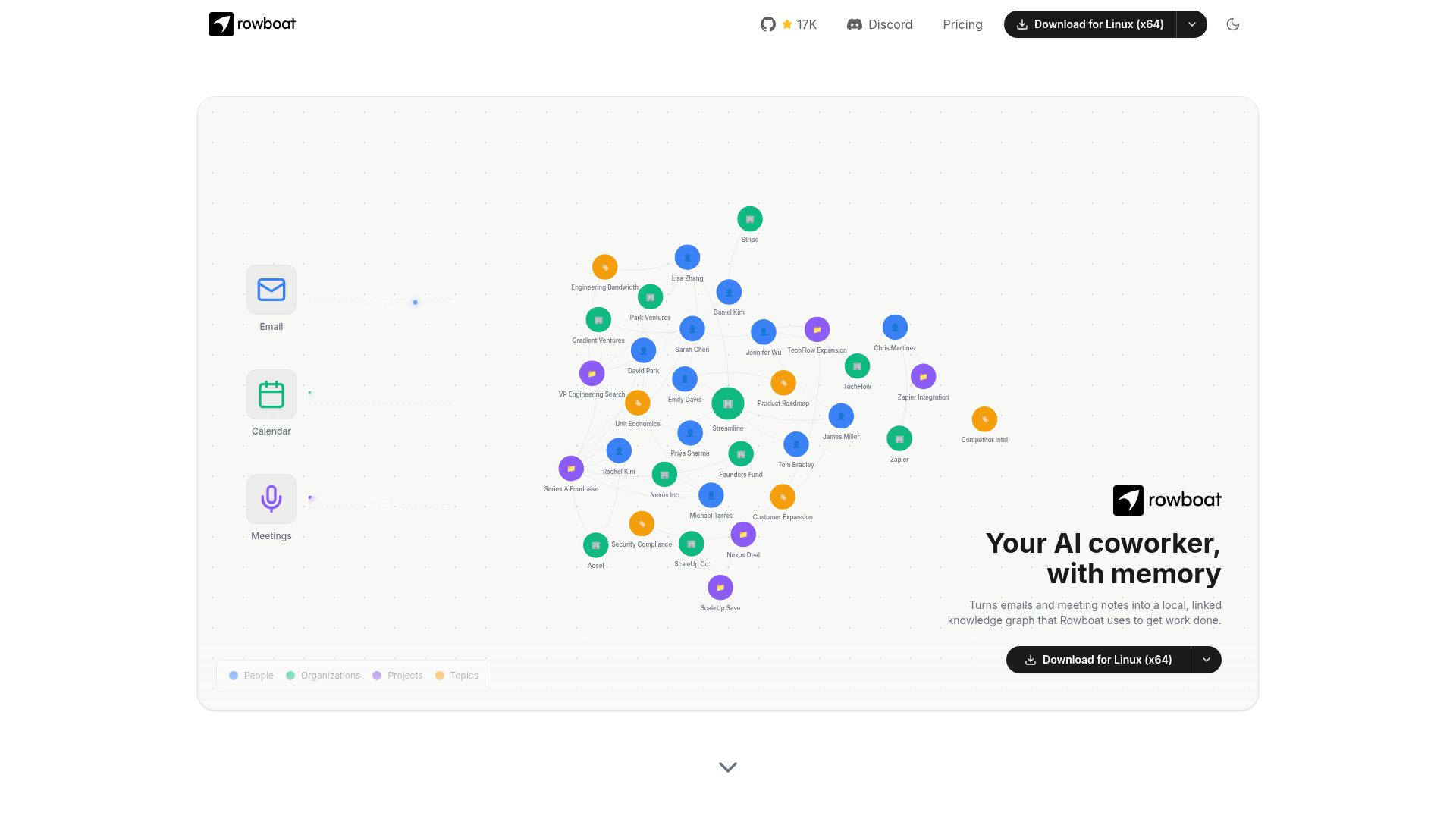
The AI assistant market is crowded with chatbots that answer questions but forget everything the moment the conversation ends. Rowboat Labs takes a different bet: that the future of AI assistance isn't a smarter chat window, but a persistent, portable memory of your work, stored as plain Markdown on your own machine. It's an open-source, local-first alternative to Claude Desktop, and it's building a knowledge graph that updates itself as you work.
Rowboat's thesis is that context is the missing ingredient in AI productivity. A model that knows your projects, people, and priorities can draft better emails, prep you for meetings, and even write code that fits your workflow. But that context is usually locked in silos: your inbox, your calendar, your Slack history. Rowboat pulls it all into a single, local-first Brain, and then uses that Brain to power a suite of work surfaces — from background agents to custom-built apps.
The memory problem: why AI assistants forget who you are
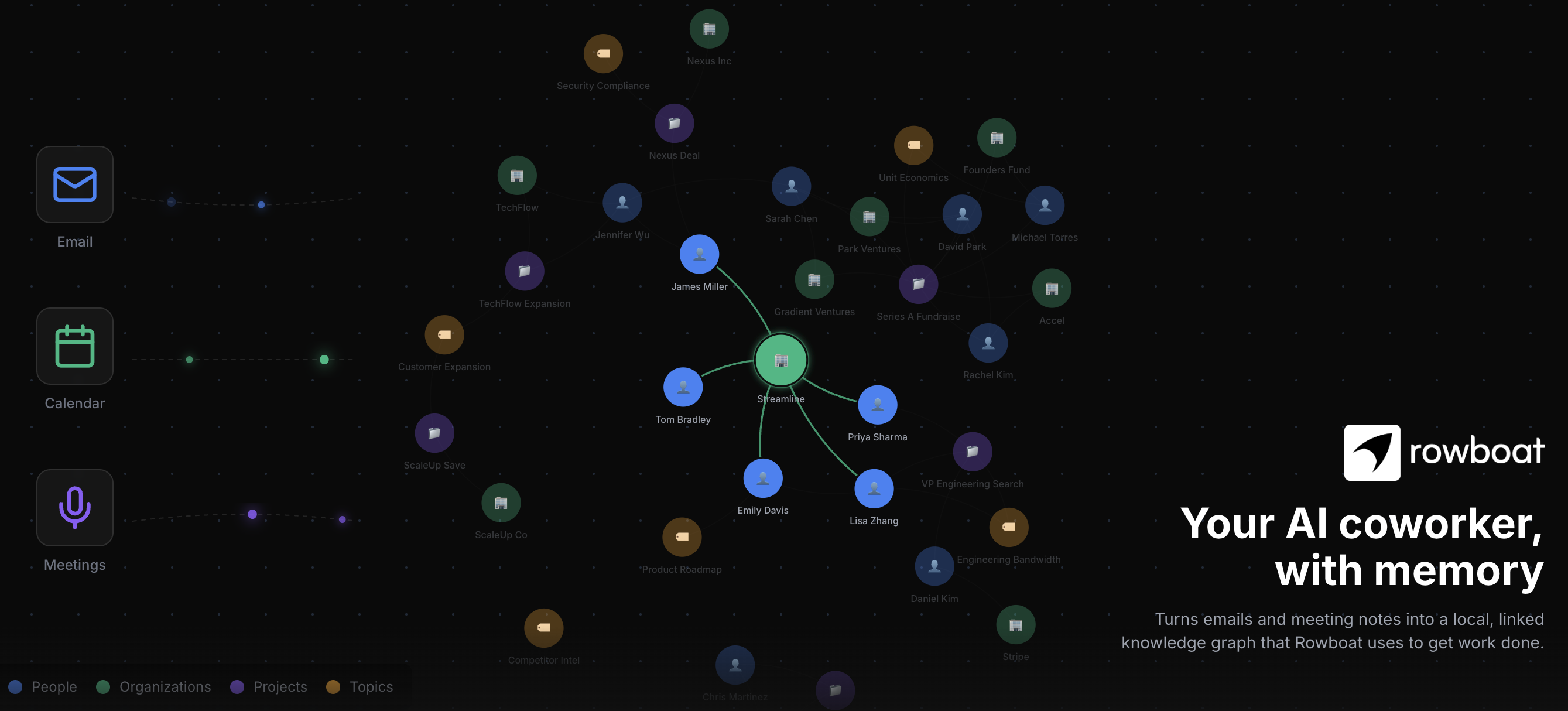
Most AI assistants are amnesiacs. They might remember the current conversation, but they don't know your long-term goals, your team's vocabulary, or the history of a deal you've been working on for months. Rowboat's answer is a "Brain": a local, linked knowledge graph that distills everything it sees — emails, meeting transcripts, Slack messages, assistant chats — into plain-markdown notes. These notes link to each other, Obsidian-style, creating nodes for people, companies, projects, and topics.
The result is an assistant that doesn't just answer questions; it understands your world. When a new email arrives from Sarah Chen about term sheet feedback, Rowboat doesn't just draft a reply — it knows that Sarah is a potential investor, that you've been negotiating for two weeks, and that the deal is supposed to close by Friday. It can prep you for a meeting with Horizon Ventures by summarizing the agenda, your asks, and likely questions, all drawn from your accumulated notes.
A knowledge graph in plain Markdown: Rowboat's Brain
The Brain is the core of Rowboat's architecture, and its design is deliberately simple. Everything is stored as Markdown files on your disk — readable, portable, and yours. No proprietary database, no cloud lock-in. You can export your entire memory anytime, or even inspect the files directly. This is a radical departure from the black-box memory of other AI tools, and it aligns with the local-first philosophy that runs through the entire product.
The knowledge graph is not static; it updates itself as you work. New emails trigger note updates, meeting endings capture summaries and action items, and Slack conversations are distilled into relevant notes. This means your Brain is always current, without any manual effort. The demo shows a note for Sarah Chen with an activity log that updates automatically: "Jan 16: Sent term sheet draft, wants to close by Friday." This is the kind of memory that makes an AI coworker feel genuinely useful.
Local-first by design: privacy as a feature, not a compromise
Rowboat runs entirely on your machine. Everything is processed locally, and your data is never stored elsewhere. This is a privacy feature, but it's also a practical one: you can bring your own model (via Ollama or LM Studio) or use your own API keys for GPT, Claude, or Gemini. The site emphasizes that "your memory is markdown on disk, so nothing is ever held hostage."
This local-first approach is a direct challenge to cloud-based assistants like Claude Desktop, which send your data to remote servers. For enterprises dealing with sensitive information, Rowboat's architecture is a compelling alternative. It also means that Rowboat works offline, and you're not dependent on a third-party service's uptime or pricing changes.
The trade-off is that you're responsible for your own compute. Running a local model requires a decent machine, and even with API keys, you're paying for usage. But for users who value privacy and control, this is a worthwhile exchange.
Background agents: work that happens while you don't
Rowboat's background agents are persistent processes that fire on events or schedules. They can triage your inbox, draft follow-ups after meetings, send investor updates, or generate changelogs — all while you're doing something else. The agents have access to your context, so they can act intelligently. For example, an agent might see a new email from a customer and draft a response that takes into account your recent notes about their account.
The agents are not just reactive; they can also be scheduled. You could set one to run every morning at 8am to summarize your calendar and prepare a daily briefing. The output is always available for review, so you stay in control. This is a step beyond simple automation: it's delegation to an AI that understands your priorities.
Code Mode: when a meeting note becomes a pull request
One of the most intriguing features is Code Mode. Rowboat can spin up parallel coding agents using Claude Code or Codex, and drive them with your work context. If a meeting note says "Meridian needs SSO," an agent can branch off, write the code, and present a reviewable diff. You don't have to re-explain the background to anyone — the agent already knows the context from your Brain.
This is a powerful workflow for developers and technical founders. It bridges the gap between knowledge work and coding, allowing decisions made in meetings to become actionable code changes without friction. The demo shows a branch with a reviewable diff, emphasizing that this is not autonomous coding but a collaborative process where you remain in control.
Work surfaces: from chat to a fundraise CRM, built by a copilot
Rowboat's final differentiator is its "Apps" feature. You can describe a personal app to the copilot — a fundraise CRM, a runway tracker, a customer-health board — and it will build a small web app that lives inside Rowboat, runs locally, and is fed by your agents and data. These "work surfaces" are not just static dashboards; they keep themselves current, so you don't have to update them manually.
This is a bold vision: instead of forcing you to adapt to a fixed set of tools, Rowboat lets you create the tools you need. The copilot assembles the app, wires it into your memory, and the agents keep it fresh. It's a step toward the promise of "software that writes itself," but grounded in a practical, local-first framework.
The demo shows two workspaces, and the interface suggests a fundraise CRM with metrics like NRR 128% and CAC Payback. This is exactly the kind of tool a founder would want, and Rowboat can build it on demand.
Shipped in public: the Hacker News go-to-market
Rowboat has launched its major releases on Hacker News, and the response has been strong. The CLI release in November 2025 hit the front page with 131 points, and the Knowledge release in February 2026 reached 205 points and #1 on GitHub Trending. The Work Surfaces release in July 2026 got 218 points. These launches have helped Rowboat accumulate over 17,000 GitHub stars, a testament to its resonance with the developer community.
The public launches are a deliberate strategy. By shipping in public, Rowboat builds trust and gathers feedback early. The site quotes a Hacker News commenter: "This is a product that just makes sense to me - well done on picking a great problem to solve and communicating it so well." This community-driven approach is fitting for an open-source project, and it positions Rowboat as a product built by and for its users.
Rowboat's go-to-market is also notable for its timing. The site claims it shipped the CLI two months before Anthropic's Cowork, and the Knowledge graph two months before Karpathy's viral LLM-wiki post. Whether or not these claims are accurate, they signal that Rowboat is at the forefront of a trend toward memory-augmented AI.
Rowboat Labs is not just another AI assistant; it's a statement about what AI assistance should be. By making memory local, portable, and open, it addresses the core weakness of cloud-based assistants: their lack of context and their hold on your data. The product is still in its early stages, with a Linux download and a pricing model that ranges from $5 to $200 per month, but its vision is clear. For knowledge workers who want an AI that truly understands them, Rowboat is a compelling — and refreshingly honest — option.