Impact-Site-Verification: 41b53a0c-6d04-458b-a457-fe9e29acde1a

AI & Machine Learning··6 min read

RxBulb

Cited medical answers for clinicians and patients, validated against real sources every time.

NN

NewName Editorial

Editorial Team

RxBulb product image 1
RxBulb product image 2

In the crowded field of medical AI, most chatbots project confidence regardless of the evidence. RxBulb takes the opposite stance: it will tell you when it doesn't know. This refusal to guess, backed by a citation-validation pipeline, is what makes RxBulb more than another ChatGPT wrapper. It's a clinical reference tool designed for a world where a hallucinated drug interaction could be lethal.

RxBulb, built by Rudrasoft LLC in Pittsburgh, positions itself as "Medical AI for Doctors. Medical AI for Patients." The platform answers clinical questions with concise summaries, each claim linked to a clickable citation from peer-reviewed literature, FDA drug labels, and clinical guidelines. The site's counter shows over 7,000 clinical questions answered, with more than 6,000 backed by real citations. But the numbers matter less than the mechanism: every citation is validated before the user sees it.

The Citation Layer: Why RxBulb Refuses to Guess

The core problem RxBulb tackles is the hallucination epidemic in general-purpose AI. Generic chatbots answer every question with the same confident tone, whether the evidence supports it or not. Citations, if any, are often invented or unverifiable. RxBulb's differentiator is its "citation layer": every factual claim carries a clickable [n] marker, and those citations are checked against actual sources before the answer is displayed. If a reference doesn't exist or doesn't match, it's stripped out automatically.

This is a significant technical and philosophical choice. It means RxBulb's answers are only as good as its source coverage. When the literature and FDA data don't adequately cover a question, the platform says so explicitly, labeling the gap clearly rather than hiding it. This "cited, not just confident" approach is a direct challenge to the prevailing AI trend of always having an answer. For clinicians, this honesty is more valuable than a smooth-sounding but unverifiable response.

The site's FAQ reinforces this: "Does RxBulb hallucinate citations?" The answer is no, because validation runs on every answer before it's shown. This is a bold claim in the AI space, and it's the foundation of RxBulb's value proposition.

From Question to Source: The Workflow RxBulb Sits Inside

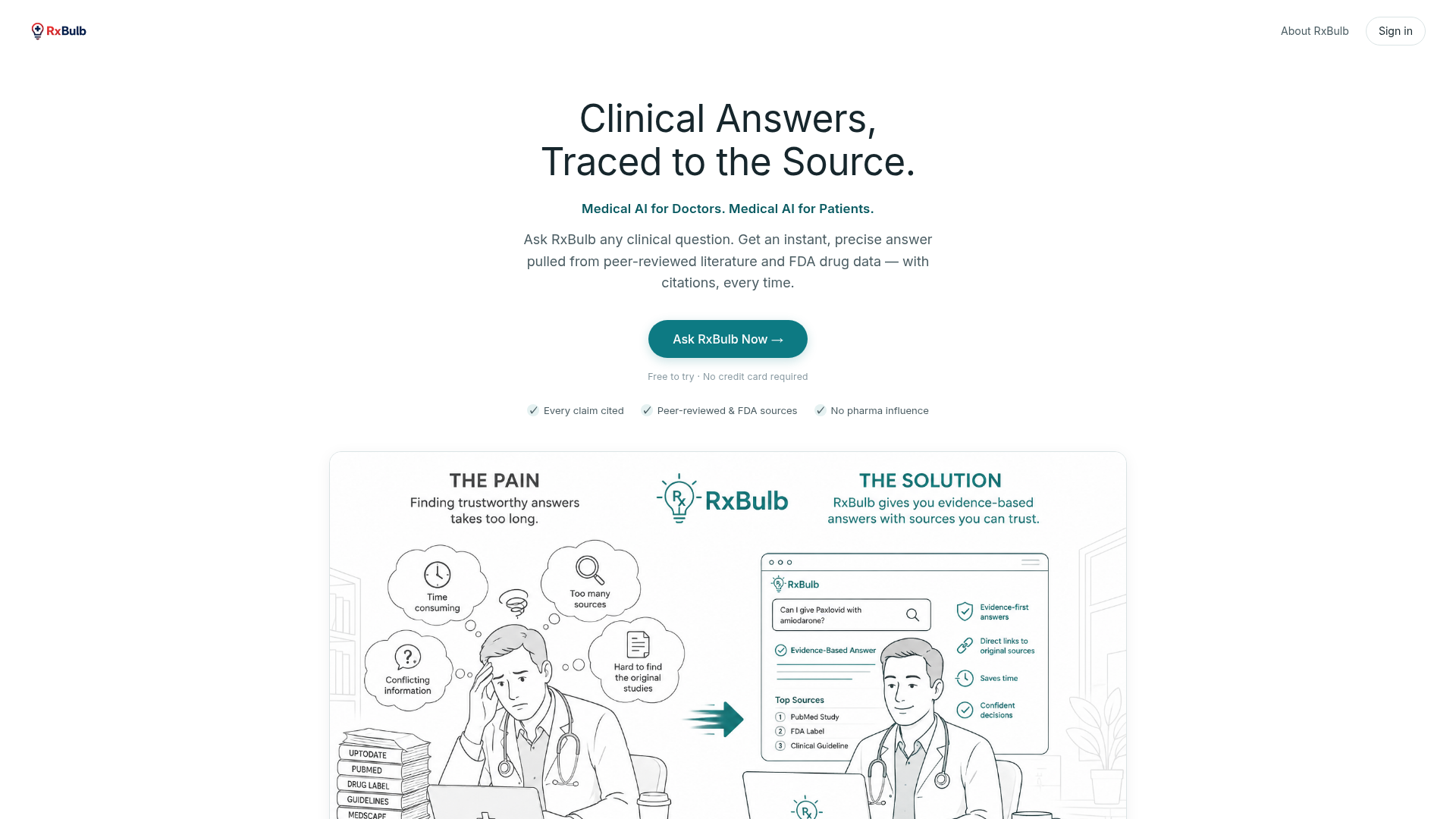
RxBulb is designed for the clinical workflow, not for casual browsing. The hero image illustrates the problem: a clinician searching multiple conflicting sources like UpToDate, PubMed, and drug labels takes too long. RxBulb collapses that into one evidence-based answer with clickable citations to the original papers and FDA labels.

For a physician double-checking a drug interaction mid-shift, the speed is crucial. One testimonial from an OB/GYN says, "I use it to double-check interactions before I second-guess myself mid-shift." Another from an internal medicine physician notes, "Being able to click straight through to the actual paper changes how I use this versus a normal chatbot." The workflow is: ask a question, get a cited answer, click through to the primary source, and verify. This is closer to how clinicians actually practice—evidence-based, source-checking—rather than relying on a black-box summary.

RxBulb also supports follow-up questions, allowing users to "learn on the job" between patients. For trainees, it's a study tool: every answer links to the actual paper or FDA label, helping medical students build evidence appraisal habits early. The platform's Q&A library, with real questions like "Can Paxlovid be used with amiodarone?" and "Which drugs should not be taken with Paxlovid?", shows the depth of clinical topics covered.

The FDA Data Advantage: Dashboards Beyond Chat

RxBulb isn't just a chat interface; it also offers drug safety dashboards. The site claims over 2,000 dashboards built, pulling live from FDA adverse event, labeling, shortage, and recall data. These dashboards can be refreshed on demand, giving clinicians a full safety picture for a drug—interactions, warnings, shortages, recalls—before making a decision.

This moves RxBulb beyond simple Q&A into a regulatory data tool. The dashboards are a differentiator because they're not just AI-generated summaries; they're structured views of official data. For a clinician worried about a drug shortage or a new recall, this is practical, actionable information. The combination of chat and dashboards makes RxBulb a more complete clinical reference than a pure chatbot.

The site emphasizes that drug safety data is sourced from public regulatory and literature databases, with no pharma influence. This independence is a key trust signal in a space where sponsored content is a real concern.

Who Actually Uses RxBulb: Clinicians, Trainees, and Patients

The target audience is broad but specific. RxBulb is for doctors, pharmacists, researchers, and medical students—professionals who need cited answers. But it also opens its doors to patients and caregivers, with a promise: "RxBulb never shows a paywall to non-clinicians, and always recommends talking to your prescriber or pharmacist." This is a smart move, as it builds trust with the general public while maintaining a professional focus.

Testimonials highlight the professional use cases: an internal medicine physician, an OB/GYN, and a medical student. The platform's features are tailored to each group: "Double-Check Before You Prescribe" for clinicians, "Sound Sharp on Rounds" for trainees, and "Catch Up Between Patients" for continuous learning. For patients, the value is understanding their own care better, with the caveat that it's not a substitute for professional judgment.

This dual audience is a challenge—clinicians demand precision, patients need clarity—but RxBulb seems to handle it by keeping answers concise and always citing sources. The disclaimer at the bottom of the page is clear: it's an educational tool, not medical advice.

The Name and the Promise: RxBulb's Brand of Trust

The name "RxBulb" is a deliberate blend: "Rx" is the universal medical prescription symbol, and "bulb" suggests a lightbulb moment or a source of illumination. Together, they imply a bright, reliable source of medical knowledge. The domain rxbulb.com is clean and memorable, reinforcing the brand's focus on prescriptions and clarity.

The tagline, "Clinical Answers, Traced to the Source," reinforces the core promise of verifiability. The brand's visual identity—a simple logo and a clean interface—mirrors its no-nonsense approach. The name doesn't hint at AI or chatbots; instead, it evokes a trusted medical reference, which is exactly the positioning RxBulb wants: not a flashy AI toy, but a serious clinical tool.

However, the name could be seen as slightly generic—"bulb" is used by many products (e.g., a lightbulb for ideas). But in the medical context, it works: it's short, distinctive, and tied to the prescription concept. The brand's emphasis on "no pharma influence" and "academic integrity" further strengthens the trust signal.

What RxBulb Doesn't Claim: Limits and Open Questions

RxBulb is transparent about its limitations. It explicitly states when sources are insufficient, and it doesn't pretend to be a substitute for clinical judgment. The FAQ clarifies that it's not medical advice, and the footer repeats the educational purpose disclaimer. This honesty is refreshing, but it also raises questions about coverage: How comprehensive is the peer-reviewed literature it draws from? The site doesn't disclose the exact number of sources or update frequency for the literature (though drug dashboards are live).

Another open question is the business model. RxBulb offers a free trial, then a monthly or annual subscription ($19/month or $149/year). This is a reasonable price for professionals, but it may limit patient adoption. The site doesn't disclose funding or team size, so it's unclear how sustainable the citation-validation pipeline is at scale.

Despite these unknowns, RxBulb's approach—validated citations, explicit uncertainty, and a focus on primary sources—positions it as a trustworthy alternative in a market flooded with overconfident AI. For clinicians who value evidence, it's a tool worth trying. For patients, it's a way to understand their care better, with the right caveats. RxBulb's bet is that in medicine, being "cited" matters more than being "confident." That's a bet worth watching.