Scala Tutorials
Interactive Scala 3 lessons in the browser, powered by Scastie.
NewName Editorial
Editorial Team
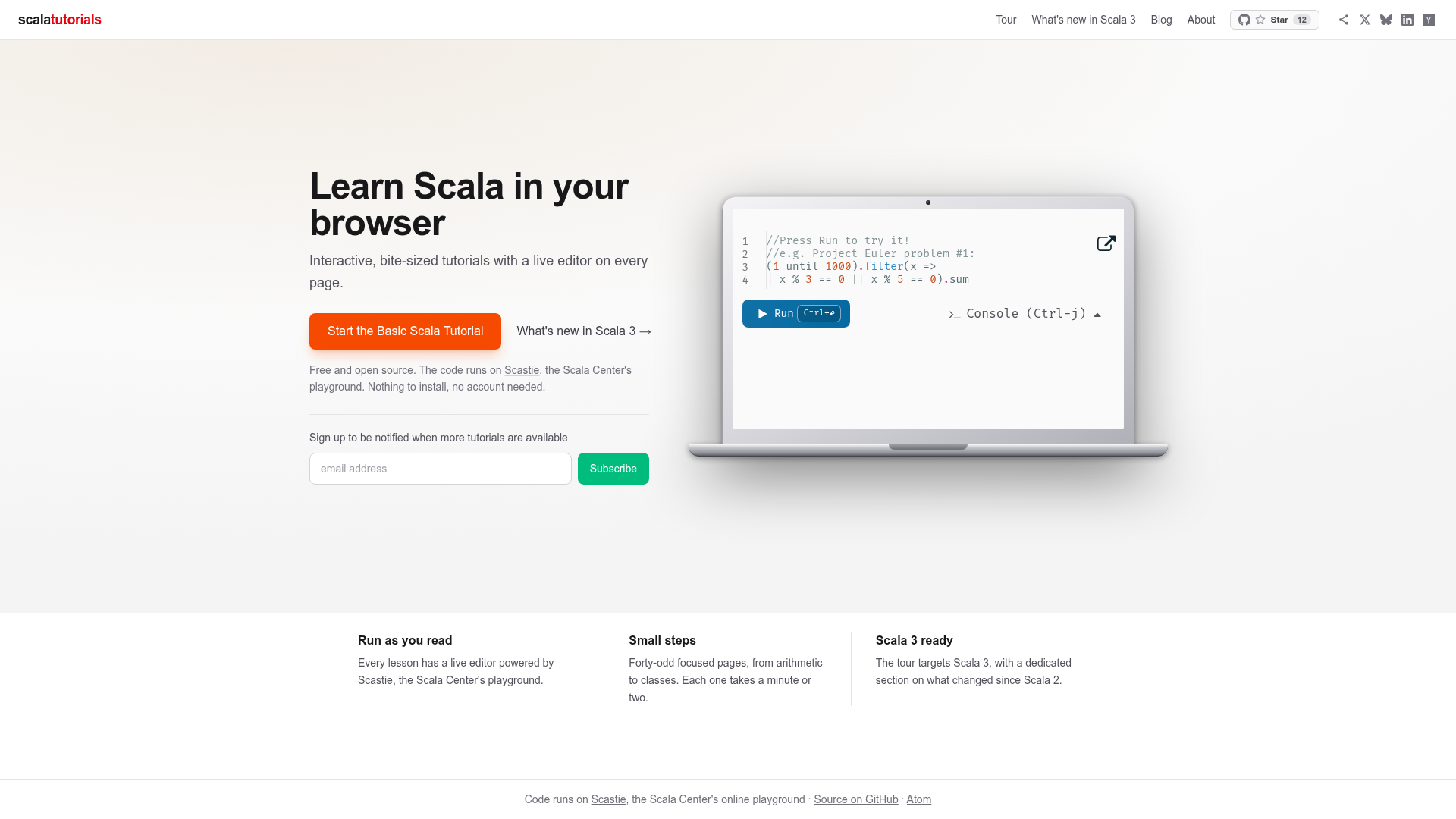
Scala Tutorials is not trying to be the definitive Scala course. It's a collection of forty-odd bite-sized lessons that run entirely in the browser, with a live editor on every page. The pitch is simple: no install, no account, just click and run. That's a refreshingly low-friction approach to a language that is often accused of being intimidating.
The site's modernized tour targets Scala 3, the language's current major version, and includes a dedicated section on what changed since Scala 2. For a beginner, that's a direct bridge from the old world to the new. For someone who has been away from Scala for a while, it's a quick way to see what's different without wading through a full book.
The Browser as a Scala Classroom
The core idea is that you learn by doing, and doing means running code immediately. Each lesson page embeds a live editor, so you can read a concept, tweak the example, and hit Run to see the result. This is not a video or a static code block; it's a playground. The lessons are designed to take a minute or two each, which encourages a "just one more" rhythm. That's a smart design choice for a language with a steep learning curve: it breaks the material into digestible chunks that don't overwhelm.
The site's tagline, "Interactive Scala 3 lessons in the browser," is accurate. It's a promise that the site delivers on. The experience is smooth, and the Scastie integration is seamless. You don't need to set up a local development environment, which is often the first hurdle for new Scala developers. This removes a significant barrier to entry.
Scastie: The Engine Behind the Run Button
Under the hood, the live editor is powered by Scastie, the Scala Center's official online playground. This is a smart partnership: Scala Tutorials doesn't have to maintain its own compilation infrastructure. It leverages a trusted, community-backed tool. The site's About page notes that historically it ran on ScalaKata, created by Guillaume Massé, who later went on to create Scastie. So the Run button has a fine pedigree, as the site puts it.
Scastie itself is a full-featured playground. It supports multiple Scala versions, including 3.3.8 LTS and 3.8.4 Next, and allows you to add libraries, configure sbt, and even switch to Vim or Emacs keybindings. For a tutorial site, that's a lot of power under the hood. It means that as you progress, you can experiment beyond the lesson's scope. The integration is not just a simple embedded code runner; it's the real deal.
From Scala 2 to Scala 3: A Curriculum in Transition
The tour is explicitly Scala 3 ready. This is a significant update. Scala 3, released in 2021, introduced major syntax changes and new features like enums, given instances, and significant simplifications. Many existing tutorials still target Scala 2, which can be confusing for newcomers. Scala Tutorials addresses this by building its lessons around Scala 3 from the start.
The site includes a dedicated section on "What's new in Scala 3," which is a quick way to understand the key differences. This is particularly valuable for developers coming from Scala 2 who want to modernize their skills. The lessons themselves cover everything from arithmetic to classes, so they build a solid foundation. The focus on Scala 3 is a forward-looking choice that positions the site as a relevant resource for the current and future state of the language.
Open Source, Community, and the Long Tail
Scala Tutorials is open source, with the entire site on GitHub. This is a double-edged sword. On one hand, it invites community contributions; anyone can spot an error or add a lesson. On the other hand, it means the site's maintenance depends on volunteer effort. The About page mentions that it was created by Eran Medan in 2013 and modernized in 2026, which suggests a long-term commitment. The site also has a blog with posts from 2013, indicating a history of content.
The open-source nature also means the site is free, with no account needed. That's a strong value proposition. The site's GitHub repo has 12 stars, which is modest but not surprising for a niche educational resource. The community aspect is more about the potential for contributions than a massive user base. Still, the fact that it's open source is a signal of trust and a way to build credibility.
Naming: Simple, Descriptive, and Slightly Forgettable
The name "Scala Tutorials" is straightforward and descriptive. It tells you exactly what the site is: tutorials for Scala. That's a plus for SEO and for clarity. However, it's also generic. There are many Scala tutorials on the web, and this name doesn't distinguish itself. It doesn't hint at the interactive, browser-based nature that sets it apart. The domain, scalatutorials.com, is a perfect match, which is good for memorability, but the name itself doesn't spark curiosity.
In a world where many developer tools have catchy, brandable names (think Docker, Kubernetes, or even Scastie), "Scala Tutorials" feels utilitarian. It's a name that prioritizes function over flair. That's not necessarily a bad thing; it's honest and easy to remember. But it does mean the site has to work harder to communicate its unique value proposition through its content and user experience.
Who Should Bookmark This Tour
Scala Tutorials is ideal for two main audiences. First, complete beginners to Scala who want a gentle, interactive introduction without the setup hassle. The bite-sized lessons and live editor make it easy to get started. Second, developers who know Scala 2 and want to see what's new in Scala 3. The dedicated section on changes is a quick way to get up to speed.
It's also a useful resource for educators who want to point students to a free, interactive tool. The open-source nature means it can be forked or embedded, though the site doesn't currently offer an obvious embed feature. For anyone else, it's a bookmark-worthy resource that respects your time and doesn't require a sign-up. The main limitation is the scope: forty-odd lessons is not a comprehensive course. But as a starting point, it's excellent.
In a landscape of video courses and heavy IDEs, Scala Tutorials offers something lighter: a quick, interactive tour that gets you writing Scala in minutes. It's a small site with a clear purpose, and it does that job well.